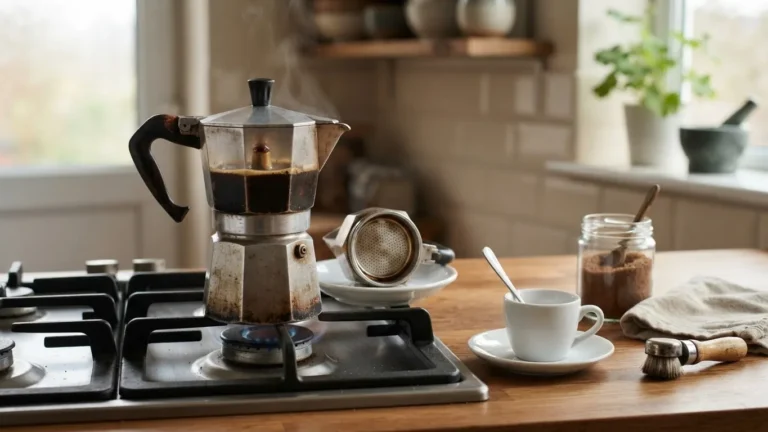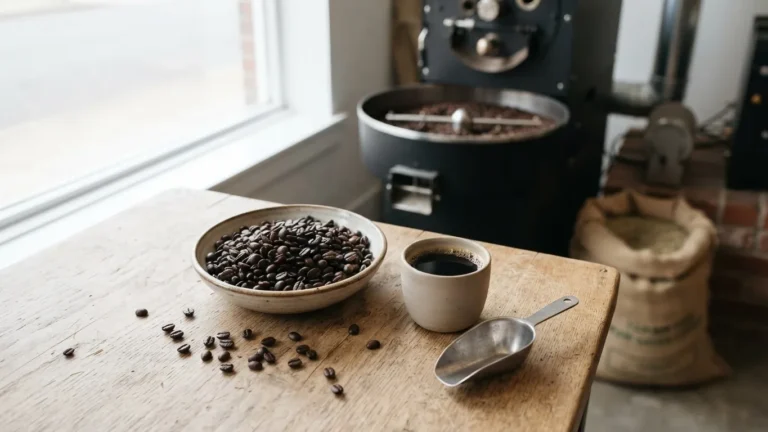
Flower Child Coffee is a limited release roasting project based in Oakland, California, and the single hardest thing about buying it is that no one page tells you the price, the roast day, and where to actually order without hitting a locked storefront. This guide fixes that. It pulls the real bag prices, the subscription tiers, the Monday-to-Tuesday roast-and-ship rhythm, and the brew parameters into one place, and it separates this roaster cleanly from the two unrelated businesses that share the name. If you searched the term and landed on an “Invalid Password” screen, start here instead.
Founder Prestin Yoder runs the operation as a green-buying and small-batch roasting outfit rather than a cafe with a permanent lineup. That distinction shapes everything: the lots rotate, the sizes stay small, and the flavor targets clarity over caramelization. For context on how a printed lineup differs from what a shop is legally required to disclose, our breakdown of a coffee shop menu and the law is a useful companion read.
Quick answer: Flower Child Coffee is an Oakland light-roast micro-lot project founded by Prestin Yoder, sold direct online with bags priced from 25 to 32 USD and subscriptions at 28, 49, 67, and 85 USD with free shipping. Beans are roasted every Monday and shipped Tuesday, so order before Sunday for the next batch. Brew at a 1:18 ratio with water between 190 and 211 degrees Fahrenheit, and rest the beans 3 to 8 weeks post-roast for peak flavor. A UK distributor, Sigma Coffee, handles orders across the Atlantic.
Why does this level of detail matter for a bag of coffee that costs less than a movie ticket. Because the three sources most people find first each answer only part of the question. The official store has the prices but locks half its pages behind a password wall. The review aggregator has the tasting notes but nothing about checkout. The directory listings repeat the same two sentences about Oakland and light roast without adding anything new. None of the three tells you, in one place, what to click, what to pay, and what day to expect the box.
Three Different Businesses, One Name: Which Flower Child You Want
Flower Child Coffee the Oakland roaster is not the Chatswood cafe near Sydney, and it is not the fast-casual restaurant chain that operates under a similar Flower Child brand across the United States. Searchers routinely collide these three, and the confusion wastes clicks. The roaster is a direct-to-consumer bean project run by Prestin Yoder, focused on light-roast single origins. The Australian cafe is a sit-down espresso venue with no relation. The restaurant group serves bowls and salads, not coffee lots. If you want beans shipped to your door, the roaster is the only one of the three that matters.
Here is the fast way to tell them apart:
- The roaster (this guide): Oakland, California; direct online sales; light-roast micro-lots; Instagram handle @flowerchild_coffeeroasting with roughly 6,115 followers across 49 posts.
- The Sydney-area cafe: a physical coffee shop in the Chatswood area, unrelated ownership, no bean subscription.
- The US restaurant chain: a food-service brand, not a coffee seller.
Once you know which one you mean, the rest of the decisions get simple. The aggregator that catalogs the roaster, coffeeroast.com, lists it under a dedicated roaster path, which is a reliable disambiguation signal on its own. If a search result mentions bowls, salads, or a dine-in menu, it is the restaurant chain, not the Oakland project. If it mentions a physical address in New South Wales, it is the Chatswood cafe. Only pages referencing Oakland, micro-lots, or Prestin Yoder by name belong to the roaster this guide covers.
A quick sanity check before you order: does the page mention a subscription, a roast date, or green coffee buying practices. If yes, you are almost certainly looking at the right business. If the page instead talks about a dining room, a host stand, or a location finder for sit-down service, close the tab and search again with “Oakland” or “roaster” appended to your query.
Who Runs Flower Child Coffee and Why Direct Trade Matters Here
Prestin Yoder buys green coffee directly from producers, pays above market, and keeps relationships going year over year rather than jumping to the cheapest available lot. That sourcing model is the backbone of the project. It also raises a labeling point worth getting right, because “direct trade” and “fair trade” are not the same thing and mean different things to your wallet and to the farmer.
Fairtrade International and Fair Trade USA certify the equitable label through third-party audits. Direct trade is a relationship claim, not a certified one: no outside body verifies it. That does not make it weaker, but it does make it unverifiable in the way a certification mark is. The International Coffee Organization publishes reference market prices, which is what “above market pay” is measured against. When a roaster says it pays over the market, the ICO indicator is the yardstick.
Recurring origins in the lineup include Ethiopia, Kenya, Burundi, Colombia, and Ecuador, with Ecuadorian geshas appearing among the higher-tier releases. Varieties and processes you will see named across releases include:
- Varieties: Caturra and Castillo, both common in Colombian and Latin American micro-lots.
- Processes: washed, natural, and honey process, each pushing the cup toward a different flavor register.
The practical effect of process choice is worth spelling out. A washed Ethiopian tends toward floral clarity and tea-like body, since the fruit is removed before drying and the bean ferments only briefly in water. A natural process leaves the fruit on the bean through drying, which pushes the cup toward berry and wine notes but raises the risk of over-fermentation if handled carelessly. Honey process sits between the two, retaining some mucilage for added body and sweetness without the full fruit-forward intensity of a natural. Knowing which process a lot uses tells you roughly what to expect in the cup before you ever open the bag.
If organic claims ever appear on a bag, that word is governed in the US by the USDA National Organic Program, which sets what “organic” legally means on a label. The FDA sets the broader food and beverage labeling framework those claims sit inside. Neither agency governs the phrase “direct trade” itself, which is why the claim rests entirely on the roaster’s own account of its buying relationships rather than a stamp you can verify independently.
Real Prices, Subscription Tiers, and What the Numbers Actually Buy
Flower Child Coffee bags run from 25 to 32 USD each on the official store, with observed price steps at 25, 26, 26.50, 27, 28, and 32 USD depending on the lot. Subscriptions come in four tiers priced at 28, 49, 67, and 85 USD, all with free shipping.
The gap in the market is that no competitor consolidates these numbers. The official storefront is partially password-gated, so the price pages exist but often greet you with “Invalid Password.” The review aggregator has tasting notes but no transactional data. The directories are thin and duplicated. So here is the pricing laid out plainly:
- Single bags: 25 USD to 32 USD, lot-dependent. Higher tiers track scarcer origins like the Ecuadorian geshas.
- Subscription entry: 28 USD with free shipping.
- Subscription ladder: 49, 67, and 85 USD tiers, also free shipping, scaling volume or frequency.
To judge whether that per-cup cost is reasonable, it helps to run the same arithmetic other specialty bags demand. Our walkthrough of a comparable single-origin brand, the real cost per cup of Leet Coffee, shows how a bag price converts to a per-cup figure once you fix a dose and yield.
Work through the math on a mid-range bag. At a 1:18 ratio with an 18-gram dose per cup, that bag yields roughly 18 to 19 cups. That is squarely in line with other specialty single-origin roasters and well under a cafe pour-over, which is the argument for subscribing rather than treating each order as a one-off purchase.
One more spending note: prices and social counts here are July 2026 snapshots. Micro-lot pricing moves as lots sell out, so treat the 25-to-32 USD band as the working range rather than a fixed sticker. If you build weekly protein-forward meals around your coffee ritual, the batch-cooking logic in these high-protein recipes mirrors the buy-ahead discipline a coffee subscription rewards.
The Monday Roast, the Tuesday Ship, and Why the Sunday Deadline Exists
Flower Child Coffee roasts every Monday and ships every Tuesday, which means the order cutoff for the next batch lands before Sunday. This is the single most practical fact a buyer needs and the one no directory bothers to print. Miss Sunday and your coffee waits a full week, not because of a supply problem but because the roaster batches production tightly to keep beans fresh. Understanding this rhythm turns a frustrating wait into a scheduling decision you control.
The freshness logic behind the schedule is deliberate. Light roasts change fast in the first days off the roaster, and shipping days-old beans is the whole point of roasting to order. A tight Monday-Tuesday cycle keeps the gap between roast and doorstep short.
Plan your ordering like this:
- Order Wednesday through Saturday: comfortable margin for the Monday roast.
- Order Sunday: cutting it close; confirm the batch is still open.
- Order Monday or Tuesday: you have likely missed the current roast and joined next week’s.
Think about what this schedule implies for stock levels. A roaster that only roasts once a week cannot carry deep inventory of every origin at once, which explains why certain lots sell out mid-week and disappear from the store until the next cycle. If a specific origin matters to you, such as the Ecuadorian gesha, order early in the week rather than waiting until Saturday, since scarce lots tend to move fastest among subscribers who get first access.
This buy-ahead cadence rewards the same planning muscle that food-truck operators use to prep for a service window, a discipline covered well in this guide to running mobile food trucks. Coffee shipped fresh, like food cooked to a rush, lives and dies by timing.
How to Brew Flower Child Coffee: Ratio, Temperature, and Rest Window
Flower Child Coffee is built to be brewed at a 1:18 ratio or higher, meaning 1 gram of coffee for every 18 grams of water, with water heated to between 190 and 211 degrees Fahrenheit, which is roughly 88 to 99 degrees Celsius. Those numbers are not arbitrary. They sit inside the Specialty Coffee Association Golden Cup framework, which defines the reference brew ratios and extraction targets that specialty roasters build their recommendations around. Follow the ratio and the temperature and a light, clarity-focused roast opens up instead of tasting sour or thin.
The rest window is where most people go wrong. Fresh light roast needs time. The recommended tasting window runs from about 2 weeks out to 10 weeks and beyond, with peak flavor landing between 3 and 8 weeks post-roast. Brew a light roast two days off the roaster and it can taste flat and gassy; give it three weeks and the cup blooms. That is the opposite of the “fresher is always better” instinct, and it is why the roast date on the bag matters more than the buy date.
The home kit the roaster points to is straightforward:
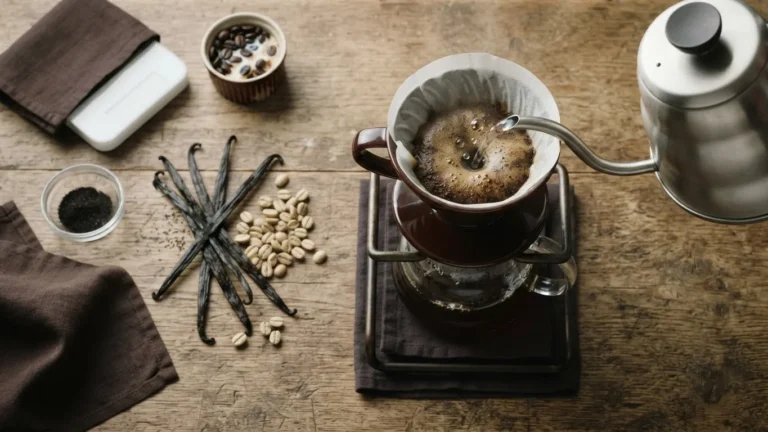
- Brewer: a V60 pour-over cone.
- Filters: Abaca paper filters or T-92 filters, plus a melo-drip option.
- Tools: a stir stick for the bloom and pour phases.
A practical routine looks like this. Dose your beans, hit the 1:18 ratio on a scale, heat water into the 190 to 211 degree Fahrenheit band, bloom, then pour in stages while stirring. The Specialty Coffee Association scores coffees above 80 out of 100 as specialty grade, and the Coffee Quality Institute trains the Q Graders who evaluate green coffee against that scale, so the beans arriving in your V60 have already cleared a quality bar before you touch them.
Step by step, a bloom-and-pour routine for an 18-gram dose looks like this. Grind medium-fine for a V60. Pour water at the low end of the temperature band to saturate the grounds, then wait for the bloom to settle and gas to escape. Follow with slow, circular pours in stages until you reach your target water weight for the dose. Total brew time should land in a moderate window; if it finishes noticeably fast, grind finer next time, and if it drags on much longer, grind coarser.
Troubleshooting a flat or sour cup usually traces back to one of three culprits: beans brewed too soon after roasting, water outside the 190 to 211 degree band, or a grind mismatched to the filter. If the cup tastes thin and grassy, the beans are likely under their rest window, so hold the bag another week or two before judging the lot. If it tastes harsh or ashy, check that your water has not overshot 211 degrees Fahrenheit, since scorching a light roast strips out the clarity the roaster is aiming for.
Watch water quality too. If a brew tastes muddy, the culprit is often mineral content, not technique. And if the ritual ever meets your carpet, our field-tested rundown of how to remove a coffee stain from carpet covers seven fixes worth bookmarking before the first spill.
Permits, Inspections, and the Real Compliance Cost of a Roaster
A roaster selling packaged coffee across state lines operates inside a stack of food-safety and labeling rules that shape the price on every bag, and the agencies involved are worth naming because each governs a different slice. The FDA sets the federal labeling framework for foods and beverages: net weight, ingredient statements, and the format of any claim on the package. The USDA National Organic Program controls whether “organic” can appear at all. Certification bodies like Fair Trade USA and Fairtrade International govern the equitable label, which, unlike direct trade, requires a paid third-party audit to display.
The costs land in ways buyers rarely see but always pay. Consider the moving parts:
- Labeling compliance: FDA-conformant packaging design and net-weight verification, a fixed cost spread across every bag.
- Organic certification: if claimed, USDA National Organic Program accreditation carries recurring audit fees, which is why many small roasters skip the word entirely.
- Quality grading: Coffee Quality Institute Q Grader evaluation and Specialty Coffee Association cupping protocols cost time and trained labor before a lot is ever listed.
This is also why “direct trade” appears more often than “fair trade” on small-batch bags. Direct trade is a relationship claim with no certification fee attached, so a roaster paying above the International Coffee Organization market reference can describe its sourcing honestly without buying a label. The tradeoff is verifiability: the buyer takes the roaster’s word rather than an auditor’s stamp.
For a project the size of Flower Child Coffee, this tradeoff makes practical sense. Third-party certification fees are typically sized for large-volume exporters, and a micro-lot operation moving small batches from a handful of farms would absorb a disproportionate cost per bag to carry a Fairtrade or organic seal. Skipping the certification and instead publishing the sourcing story directly, through the storefront and social channels, is a common path for roasters at this scale, even though it means the claim rests on reputation rather than an audit trail.
Recalls sit at the sharp end of this system. When a coffee product fails a safety check, the paperwork trail runs straight through these agencies. Our closed-file review of the Dollar General coffee recall shows exactly how a compliance failure moves from shelf to notice, and it is a useful reminder that the same rules protecting a mass retailer also cover a Monday-roast micro-lot.
Reputation, Scores, and How Flower Child Coffee Stacks Up
Flower Child Coffee carries an aggregate rating of 4.71 on coffeeroast.com, drawn from 10 cataloged roasts and 9 reviews, which is a small but consistent sample pointing to reliable clarity across origins. That score, paired with detailed third-party tasting notes and cupping references, is the closest thing to an independent report card the roaster has, since the official site offers no rich indexable about-us page. Reviewers repeatedly flag the same strengths: clean, bright, fully developed light roasts that avoid both under-development and roasty flatness.
What the score does not tell you is transactional. The aggregator has no prices, no availability, and no buying instructions, which is why cross-referencing it with the pricing above is the only way to move from “sounds good” to “in my cart.” The directories add nothing here beyond duplicated summaries.
A few reputation signals worth weighing:
- The 4.71 aggregate across 10 roasts and 9 reviews leans positive but thin; read individual tasting notes rather than the headline number.
- Independent video reviews and xBloom brewing content give visual confirmation of the light, clarity-forward style.
- Instagram at ~6,115 followers across 49 posts signals an active but boutique operation, consistent with a limited release project.
Put the sample size in context. Nine reviews is a small enough number that a single bad batch or a single mismatched palate could swing the average meaningfully, so treat 4.71 as directionally positive rather than statistically definitive. What strengthens the signal is consistency: reviewers across separate lots and separate origins describe the same clarity and same fully developed profile, which suggests the roasting approach, not any single lot, drives the reputation.
Set against broader coffee coverage, the roaster’s light-roast, low-caramelization profile is roughly the flavor opposite of the mass-market and decaf conversations happening elsewhere. If you are curious how roast level and processing intersect with caffeine and chemistry, our explainer on the rules and solvents behind decaffeinated coffee pairs well with understanding why a fully developed light roast tastes the way it does.
Buying Internationally and Building a Menu Around the Beans
Flower Child Coffee reaches the UK through a single distributor, Sigma Coffee, which is the practical answer to whether the roaster ships across the Atlantic. Rather than manage international logistics from Oakland, the project routes UK demand through that partner, so British buyers order from Sigma rather than the US storefront. This keeps shipping times and duties manageable and sidesteps the customs friction that kills freshness on a light roast bound for a 3-to-8-week peak window.
For everyone else, the buying path stays domestic: order direct before Sunday, receive a Monday roast shipped Tuesday. Pairing the coffee with food turns a bag into a ritual. A bright, washed Kenyan or Ethiopian lot cuts through rich brunch plates, and a honey-process Colombian sits comfortably beside dessert.
Some pairing ideas that respect the clarity-forward cup:
- Bright washed lots alongside a fresh vegetable dish like this garlicky lemon asparagus pasta, where acidity meets acidity cleanly.
- Rounder natural or honey lots beside protein-heavy plates; the same logic that makes a meat and protein spread satisfying applies to a fuller-bodied cup.
- An afternoon light roast with something herbal and warming, such as a bowl of flavor-packed vegan pho whose broth complements a tea-like Ethiopian.
If you would rather sample several origins before committing to a 32 USD bag, the tasting-set approach in our guide to coffee flights and what they cost is the low-risk way to calibrate your palate to a roaster’s house style first.
For readers outside the US and the UK, direct ordering is possible but comes with tradeoffs worth naming plainly. Shipping outside the Sigma Coffee UK channel can mean customs delays, higher shipping costs, and a longer gap between roast date and delivery, all of which work against a light roast meant to be enjoyed while still relatively fresh. If you live outside those two markets, weigh whether the flavor payoff justifies a shipment that may arrive closer to the tail end of the tasting window than the peak.
Frequently Asked Questions
Where can I buy Flower Child Coffee?
Buy it direct from the Oakland roaster’s online store, either as single bags priced from 25 to 32 USD or through a subscription at 28, 49, 67, or 85 USD with free shipping. In the United Kingdom, order through the distributor Sigma Coffee instead. Place any order before Sunday to catch the Monday roast that ships out the following Tuesday.
Is Flower Child Coffee a light roast?
Yes. The roaster specializes in fully developed light roasts built for clarity, deliberately avoiding both under-development and heavy, roasty flavors. Recurring origins include Ethiopia, Kenya, Burundi, Colombia, and Ecuador, using washed, natural, and honey processes. The Specialty Coffee Association scores specialty coffees above 80 out of 100, the quality tier this style targets.
How long should I rest the beans before brewing?
Rest a light roast between 3 and 8 weeks after the roast date for peak flavor, though the full tasting window runs from about 2 weeks to 10 weeks and beyond. Brewing too soon, within a day or two of roasting, often tastes flat and gassy. Check the roast date on the bag rather than the day you received it.
Does Flower Child Coffee ship internationally?
To the United Kingdom, yes, through the distributor Sigma Coffee rather than the US storefront. Routing UK demand through a local partner shortens transit and reduces customs friction, which matters for a light roast meant to hit its 3-to-8-week flavor peak. For other regions, check availability directly before ordering, since micro-lot supply is limited.
What ratio and water temperature work best?
Brew at a 1:18 ratio, meaning 1 gram of coffee to 18 grams of water, with water between 190 and 211 degrees Fahrenheit, about 88 to 99 degrees Celsius. Those figures align with the Specialty Coffee Association Golden Cup standard. A V60 with Abaca or T-92 paper filters and a stir stick handles the recommended home method well.
What does the aggregate review score mean?
The 4.71 rating on coffeeroast.com comes from 10 cataloged roasts and 9 reviews, a small sample that leans positive but should not be read as definitive. It reflects consistent clarity across origins rather than a large statistical base. Read the individual tasting notes for a clearer sense of each lot before you buy a specific origin.
Is direct trade the same as fair trade?
No. Fair trade is a certified label audited by third parties such as Fairtrade International and Fair Trade USA. Direct trade describes a buying relationship, in this case Prestin Yoder purchasing green coffee directly from producers above market rates, but it carries no third-party certification. The claim rests on the roaster’s own account rather than an auditor’s stamp, which is worth knowing before treating the two terms as interchangeable.