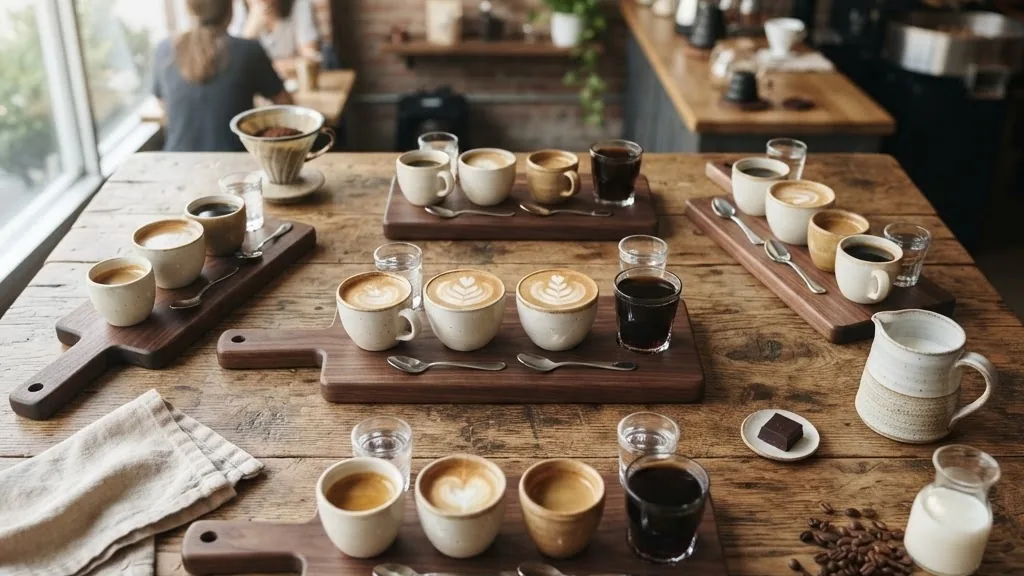
Coffee flights near me is the search you type when you want to taste three or four coffees side by side instead of committing to one twelve-ounce cup. A flight is three to six small portions poured at once for direct comparison. The format borrows its logic from wine and beer tastings. Below is the pricing, the ounce math, the tasting order, and a shop-by-shop directory so you know what to expect before you drive across town.
Quick answer: A coffee flight is a set of three to six small samples, usually 2 to 4 ounces each, poured together so you can compare them in one sitting. Prices for coffee flights near me swing widely. Call ahead before visiting. Flights are often morning-only, sometimes reservation-based, and can take up to 20 minutes to prepare because a barista makes multiple drinks.
What a coffee flight actually is (and what it is not)
A coffee flight is three to six small portions of coffee served side by side. This physical arrangement allows you to taste them against each other in a single sitting. Specialty guides in 2025 put the standard pour at 2 to 4 ounces per sample. This modest size is small enough that four or five cups will not overload you on caffeine. The idea mirrors a wine or beer flight. You get several short pours, arranged for comparison, rather than one full drink. Some shops go smaller at 2 ounces flat. Others stretch to 5 or even 10 ounces depending on the drink and the format they have chosen.
A flight is not a cupping. Cupping is the standardized professional protocol that roasters and buyers use to score coffee. It is run by trained tasters against a fixed method using specialized spoons and crust-breaking techniques. A flight is the casual, public-facing cousin. There is no scoresheet, no strict grinder calibration, and no professional lab required. It is just a wooden or metal tray and your own palate. The goal is personal enjoyment and education, not assigning a numerical grade to a seasonal harvest.
The format varies widely depending on what the shop wants to highlight. A standard tray might feature any of the following structures:
- Same origin, different roasts to isolate what the roasting process does to one specific bean.
- Same roast, different origins to compare a washed Colombian against a natural Ethiopian.
- Same coffee, different methods, such as filter versus espresso versus cold brew.
- Espresso-only flights to highlight blend differences under high pressure.
- Seasonal latte flights, featuring flavored syrups or alternative milks.
- Iced or boozy versions for afternoon or evening cafe menus.
If you have ever compared two bags on a shelf and wondered how the printed words map to the actual cup, a flight bridges that gap. The same analytical instinct that drives people to read a specs-first field guide to reading any bag applies here. The physical format of the tray is doing the explaining for you. You taste the difference in real time rather than reading about it on a paper label.
The labor behind the bar
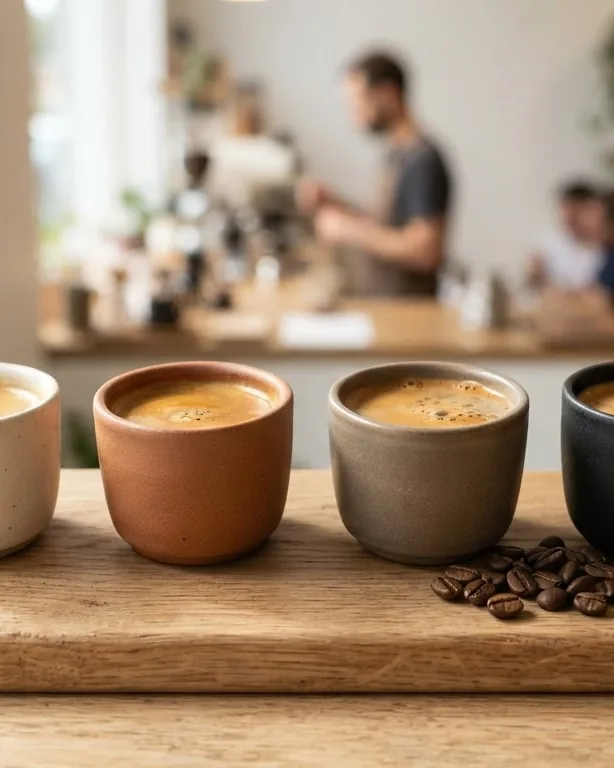
A coffee flight requires significantly more manual labor than a standard cafe drink. When you order a single latte, the barista grinds, tamps, pulls one shot, and steams one pitcher of milk. When you order a mixed flight, the barista must execute three or four distinct workflows simultaneously. They might need to pull an espresso, pour a nitrogen-infused cold brew, and manage a manual pour-over all at once. This operational bottleneck is the exact reason why shops restrict flight availability.
During peak morning rushes, a single flight order can stall an entire cafe production line. Baristas often need up to 20 minutes to prepare a complex tray. To manage this wait time, many shops make flights a weekday-only or morning-only item. Others require you to book a weekend reservation in advance. If you walk into a busy, high-volume shop on a Saturday morning expecting a fast flight, the staff will likely turn you away or ask you to wait indefinitely.
How much a coffee flight costs, shop by shop
Coffee flight prices are not standardized, and the spread across different markets is dramatic.
Price tracks three fundamental variables: how many samples you get, how many total ounces each pour holds, and whether complex milk drinks or specialty extractions are involved.
A flight of straight batch drip coffee in tiny glasses costs less than a mixed tray. If a flight is built around a cortado, a drip coffee, and a cold brew, the labor and raw ingredient costs rise. This is why mixed-method flights always sit at the top of the price range. The dairy alone increases the baseline cost of the tray.
The piece on what a coffee board says and what the law requires unpacks how retail menus get built. Transparency varies wildly from cafe to cafe, so asking the barista for a price breakdown before ordering prevents sticker shock at the register.
How many ounces are in a coffee flight
Most specialty coffee flights pour 2 to 4 ounces per sample across three to six samples. Real cafe menus stretch that band in both directions. The Coffee Movement in San Francisco serves three coffees in 4-ounce glasses. This converts to exactly 118 milliliters per glass. Coma Coffee builds a flight from a 4-ounce cortado, a 4-ounce drip, and a 4-ounce cold brew. Every station on their tray is uniform, making it easy to compare the extraction methods.
Badger Hill Brewing in Shakopee, Minnesota goes bigger with four distinct cold brews at 5 ounces apiece. Course Coffee pushes the volume further still, pouring massive 10-ounce portions. They offer a two-sample tray called The One Way alongside a three-sample tray called Around the World. These larger formats are edge cases, but they exist if you seek them out and possess the caffeine tolerance to handle them.
Why the small pours matter: with three to six cups in front of you, keeping each one modest stops a tasting from turning into a severe caffeine overdose. The reduced volume is a deliberate safety measure, not a stingy business practice.
- Smallest common pour: 2 ounces per glass.
- Most common band: 2 to 4 ounces per sample across most specialty shops.
- Larger formats: 5 ounces at Badger Hill Brewing, up to 10 ounces at Course Coffee.
Milk defaults matter heavily when counting total ounces. Many real shop menus pour 2 percent milk by default. If you want the cortado dairy to read a certain way, say so when you order. Whole milk or oat milk will change both the physical volume and the lipid flavor profile of the sample.
Understanding the glassware used for coffee flights
The glasses on your tasting tray are chosen for specific scientific reasons. Most shops use clear glass rather than opaque ceramic mugs. Clear glass allows you to inspect the visual color and clarity of the brew. A paper-filtered pour-over will look translucent and bright red or brown. A metal-filtered espresso or French press sample will look murky with heavy suspended oils. Visual inspection is the crucial first step in any proper tasting.
The physical shape of the glass also matters. Narrow, tulip-shaped glasses concentrate the volatile aromatic compounds, forcing them up into your nose as you sip. Smell accounts for a massive portion of human flavor perception. If the shop uses wide, shallow cups, the aromatics dissipate into the air too quickly. Pay attention to how the shop presents the liquid. The vessel itself is an active part of the brewing recipe.
The order to taste them in, and how to reset your palate
Taste a coffee flight from lightest to darkest, or from mildest to most robust. Rinse your mouth thoroughly with water between each pour. That precise sequence keeps a bold, roasty cup from flattening the delicate florals or bright acidity of a lighter one. This is the exact same sensory reason a wine tasting moves from white to red rather than the other way around. If you reverse the order, the dark roast will immediately overwhelm your taste buds.
Start with the pale, filter-style or lighter-roast sample. Work your way slowly toward the espresso or dark cold brew. Treat water as the mandatory reset button between stations. Do not skip the water rinse. Without it, the heavy oils from the first cup will blend with the second, muddling the comparison. Some shops also set out plain unsalted crackers or a small pastry to physically clear the palate.
What you are actively training yourself to notice is acidity, body, and finish. The Specialty Coffee Association, together with World Coffee Research, publishes the Coffee Taster Flavor Wheel. This is the official reference vocabulary industry tasters use to name what they taste. It categorizes flavors starting from generic citrus and berry down to specific notes like cocoa, hazelnut, and jasmine.
You do not need to memorize the wheel to enjoy a flight. Just glancing at it turns a vague statement like this one is better into a precise observation like this one is brighter and more acidic with a much cleaner finish.
- Go lightest to darkest, or mildest to most robust.
- Rinse with room-temperature water between every single sample.
- Use unsalted crackers or a plain pastry as a palate cleanser if offered.
- Name specific acidity, body, and finish rather than just calling a cup good or bad.
Troubleshooting a coffee flight
A very common problem during a flight is rapid temperature loss. Because three to six drinks are poured at once, the last cup will cool down significantly by the time you reach it. This is a normal, expected part of the process. Do not rush through the hot drinks just to beat the clock. Coffee often reveals completely different flavor notes as it cools.
A light roast that tastes generic and muted while boiling hot might show bright berry notes at room temperature. If your palate feels fatigued halfway through the tray, stop and eat a cracker. Palate fatigue happens when bitter or acidic compounds overwhelm the receptors on your tongue. Taking a full five-minute break and drinking a large glass of water will restore your ability to distinguish flavors. Do not force yourself to finish every drop.
A note on caffeine across four or five cups
The intentionally small pours are the safety mechanism of the format. A flight of five 2-ounce samples equals exactly 10 ounces of total liquid. This is roughly the volume of one standard mug, merely spread across five different tastes. This mathematical reality is exactly why shops keep the glasses tiny. If they served five full 8-ounce cups, no customer could safely finish the tray without severe physical discomfort.
If overall caffeine content is a medical or dietary concern for you generally, you can ask for a decaf flight. Be aware that few shops offer them due to limited bean variety. The breakdown in the guide to the rules, solvents, and milligrams of decaf is the clearest place to see how the numbers actually add up. Always pace yourself and leave coffee in the glass if you hit your limit.
How to read a coffee flight menu
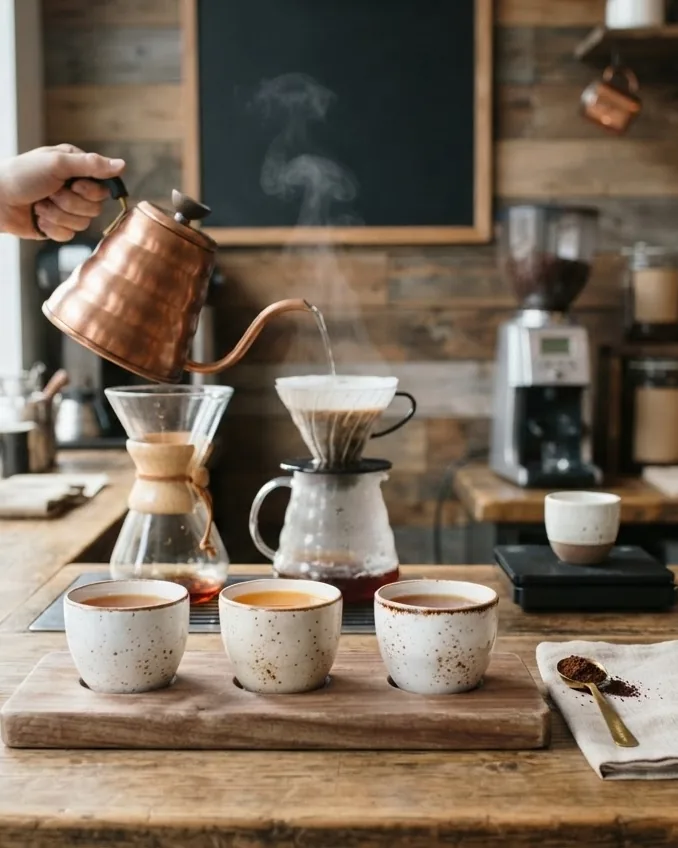
Coffee flight menus can be highly confusing because shops rely heavily on industry shorthand. If a menu lists a single origin flight, it means you will taste coffees sourced from one specific farm, country, or micro-region. A blend flight combines beans from multiple regions to create a specific, engineered flavor profile. If you see the word washed or natural, the menu is describing the post-harvest processing method.
Washed coffees tend to be cleaner and much more acidic, while natural coffees offer heavy, fermented, fruit-forward flavors. If a menu lists extraction variables, the shop is serving the exact same bean brewed in entirely different ways. You might get an espresso shot, a pour-over, and a full immersion brew. This isolates the brewing method as the only variable. Reading these terms correctly helps you predict what will arrive on the tray.
How processing methods change the flight experience
Many educational flights are built entirely around coffee processing methods. Processing refers to how the sticky fruit is removed from the coffee seed after the harvest. A washed coffee has the fruit stripped off immediately using water channels, resulting in a clean, highly acidic cup. A natural coffee is dried in the hot sun with the fruit still attached. This ferments the sugars directly into the seed, creating wild, heavy berry flavors.
A processing flight will serve the exact same bean, harvested from the exact same farm, processed in two different ways. Tasting a washed and natural coffee side by side is a total educational revelation. It proves conclusively that the farmer post-harvest decisions impact the final flavor just as much as the roasting process. Look for these specific flights if you want to understand farm-level mechanics.
How to find coffee flights near you (the actual method)
Finding a coffee flight near you is a manual phone-and-map job, not a quick one-click job. Flights are a rotating, low-volume menu item. Most shops do not advertise them heavily on their main storefront or website. Open Google Maps and search coffee flight exactly, rather than generic coffee shop. Searching the specific item forces the map algorithm to read reviews and user-uploaded photos for mentions of the tray.
Cross-check your map results with Yelp. Yelp publishes monthly-updated Top 10 Best Coffee Flight lists for larger cities. These lists are incredibly dense in major metros like New York or San Francisco. However, they thin out to nonexistent in mid-size suburban towns. If your city returns absolutely nothing on Yelp, you must widen the geographic radius or move to the phone.
Call the shop directly and ask three highly specific things. Ask whether they run flights at all, on which days they serve them, and whether you need to reserve a spot. Expect friction. Flights are frequently morning-only or weekend-only. As mentioned earlier, preparation can take up to 20 minutes. If you do not call ahead, you risk wasting a trip.
Regional food blogs are the other highly reliable source. Writers in the Twin Cities and Metro Detroit publish frequent roundups with verified addresses, phone numbers, and current prices. These local blogs catch the granular details that large map listings consistently miss. They provide first-hand experience that proves the shop actually serves the item you are looking for.
- Search the item, not the category: typing coffee flight beats coffee shop on Maps.
- Check Yelp monthly lists for big-city coverage and recent user reviews.
- Call ahead to confirm days, hours, and whether formal reservations are required.
- Budget your time: prep can run up to 20 minutes before the tray even arrives.
This is the exact same call-before-you-go discipline that saves you from surprises elsewhere in the food world. Whether you are chasing a moving vendor through the world of food trucks or confirming a limited seasonal run, verifying details directly is the only way to guarantee actual service.
Coffee flights by city: a starter directory
A city-level directory is the absolute fastest way to skip the guesswork. Here is a verified starting set with formats and prices attached. Badger Hill Brewing in Shakopee serves four cold brews at 5 ounces each.
In San Francisco, The Coffee Movement pours three coffees in 4-ounce glasses. Coma Coffee offers a mixed tray featuring a cortado, drip, and cold brew. Course Coffee provides a massive 10-ounce pour format. These are anchors, not the whole map. The point is to show you what a real listing looks like so you can evaluate the ones you find in your own town.
| Metro | Shop | Format / price |
|---|---|---|
| Twin Cities, MN | Badger Hill Brewing (Shakopee) | 4 cold brews, 5 oz each |
| San Francisco, CA | The Coffee Movement | 3 coffees, 4 oz (118 ml) |
| Various | Coma Coffee | Cortado, drip, cold brew (4 oz each) |
| Various | Course Coffee | 2 or 3 coffees, 10 oz each |
Two structural facts about internet coverage are worth internalizing. First, Yelp is excellent in dense cities and completely empty in mid-size markets. Second, regional blogs are rich in detail but strictly single-region. A reader outside the covered metro leaves empty-handed. That gap is exactly why the phone method above still matters more than any aggregated list.
Demand for this kind of tasting is not a random fluke. The National Coffee Association tracks U.S. consumption through its National Coffee Data Trends reporting. Specialty coffee has been on a massive growth trajectory that gives shops a real financial reason to invest in tasting formats. Consumers want to know what they are paying for.
Quality credentials sit directly behind that trend too. Coffee Quality Institute Q-graders and programs like Cup of Excellence establish strict baseline standards. These programs are what let a shop honestly call a bean specialty rather than just nice. This professionalization of the entire supply chain makes retail tasting flights possible in the first place.
Build a coffee flight at home for a few dollars
You can assemble a highly professional coffee flight at home with three or four coffees. You will need small glasses of 2 to 3 ounces, and a large glass of water for rinsing between pours. Pick a theme first, the exact same way shops do. Choose three single origins to compare terroir, one coffee brewed three ways, or a light-to-dark roast progression from a single roaster.
Brew each one and pour them slowly into matched small glasses. Using visually identical glasses ensures volume does not skew your read of the flavor. Taste lightest to darkest with a water rinse in between every single sip. That is the entire method, and it costs a mere fraction of a cafe tray. It is an excellent weekend project that requires zero specialized equipment beyond a standard brewer.
The home version is also the absolute cheapest way to learn the vocabulary before you pay for it at a cafe. Set the Coffee Taster Flavor Wheel beside your glasses. Force yourself to name one specific note per cup. Do not settle for vague descriptions. Pinpoint whether the acidity tastes like lemon, green apple, or grapefruit.
- Coffees: 3 to 4, chosen around one single point of comparison.
- Glasses: 2 to 3 ounces each, visually matched.
- Reset: Drink water between every single sample.
- Documentation: Write down one specific flavor note per glass.
Grind consistency will instantly make or break the comparison. The difference between a fair test and a muddled one often comes down to raw particle size. The primer on what a medium grind label really means lays out the mechanics in plain numbers. Keep your variables tight so the bean shines through the water.
Cleanup is the other half of the home ritual. Pouring multiple small glasses on a kitchen counter inevitably leads to spills. A stray splash is much easier to handle when you already know seven fixes that actually lift a coffee stain. Keep a damp cloth nearby while assembling your tray to catch drips immediately.
Where flights fit alongside the rest of your table
A coffee flight rarely stands alone. It usually slots into a morning or a slow weekend built entirely around comparison and small plates. The palate-cleanser tradition of crackers and pastry means flights pair naturally with food. Thinking about a tasting as one course among several changes how you plan the entire outing.
If you are hosting rather than going out, the flight becomes the centerpiece of a breakfast spread. The exact same comparison instinct that makes flights fun carries into the food you serve alongside it. A tray of distinct cheeses or jams mirrors the structure of the coffee tray perfectly. Guests can mix and match bites with sips.
That crossover is where the wider cooking world becomes highly useful. A protein-forward brunch built from a stack of high-protein recipes balances the sharp acidity of a light-roast flight. The fats in the food coat your palate, mellowing the sharpest fruit notes in a washed Ethiopian coffee so they do not become overwhelming.
A heartier board leaning heavily on a run of meat and protein mains stands up perfectly to a dark cold-brew tasting. Heavy, roasted coffees require bold flavors to match their physical intensity. Spicy sausage or thick bacon will not get lost behind a dark, smoky French roast.
Even the reheats matter for a lazy tasting morning. The method in reheating fried chicken without the rubber or the rot keeps a savory side crisp next to the cups. Nobody wants a soggy pastry or rubbery leftover meat ruining a premium coffee tasting. Textural contrast is just as vital as flavor contrast.
For a plant-forward table, look for bright, acidic companions. A bright, tangy homemade green enchilada sauce poured over breakfast tacos gives you contrast without competing for the palate. The goal is to build a menu that supports the coffee rather than fighting it for attention.
Frequently asked questions
How much is a coffee flight?
Complex trays with cortados or pour-overs will always sit at the higher end of the scale.
How many ounces are in a coffee flight?
Each sample typically holds 2 to 4 ounces, poured across three to six cups. Some shops go significantly bigger. Badger Hill Brewing pours 5 ounces per cold brew. Course Coffee serves massive 10-ounce portions. The Coffee Movement pours 4-ounce glasses, which is exactly 118 milliliters each. Small pours prevent caffeine overloads while allowing comprehensive comparison.
What is the difference between a coffee flight and a cupping?
A cupping is the standardized professional tasting protocol roasters and buyers use to mathematically score coffee. It is run by trained tasters against a fixed method. A flight is the casual public version. You get three to six small pours arranged for simple comparison. There is no scoresheet. It is meant for enjoyment rather than strict quality grading for the commodity market.
In what order should I drink a coffee flight?
Move steadily from lightest to darkest, or mildest to most robust. Rinse with room-temperature water between each pour. This sequence stops a bold, roasty cup from overwhelming the delicate acidity and florals in a lighter sample. It uses the exact same sensory sequencing logic a wine tasting uses when moving from white to red.
Do I need a reservation for a coffee flight?
Sometimes. Flights are frequently limited to mornings, weekdays, or weekends. Some shops take them by reservation only to manage the intense workflow. Preparation can run up to 20 minutes because a single barista pulls several complex drinks by hand. Calling ahead to confirm days, hours, and booking is the most reliable move to avoid being turned away.
Can I make a coffee flight at home?
Yes. Use three or four distinct coffees built around one specific comparison. Pour them slowly into matched 2-to-3-ounce glasses. Keep filtered water nearby to rinse between samples. Taste lightest to darkest. Use the Specialty Coffee Association Flavor Wheel to name one specific note per cup as you go. This provides an authentic tasting experience without the cafe markup.
What if a shop refuses to serve a flight?
Not every specialty shop will serve a coffee flight, even if they have the glassware. If a barista declines, do not argue. High-volume cafes physically cannot stop their line to pour four custom samples during a morning rush. The refusal is a matter of operational logistics. Instead, order two distinct pour-overs with a friend and share them.
Should I share a coffee flight?
Coffee flights are highly social, and sharing a tray is common. Proper etiquette ensures both people actually taste the nuances. Never drink directly from the sample glasses if sharing. Ask the barista for a second set of tiny tasting cups. Pour a portion of each sample into the secondary cups before anyone takes a sip to prevent flavor contamination.