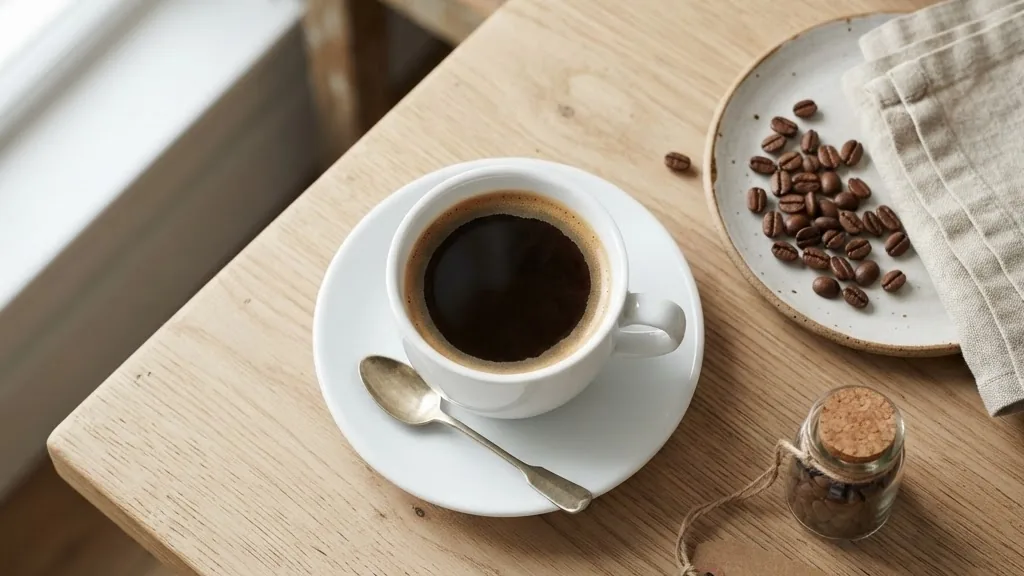
Coffee decaffeinated coffee sits on the shelf as a single product and is regulated as at least four different things, depending on whose rulebook you read. The bag almost never tells you which method stripped the caffeine out, because in the United States nothing requires it to. That silence is the whole problem. A shopper who wants to avoid methylene chloride has no legal disclosure to lean on, and the pages that explain the health side mostly skip the chemistry while the pages that explain the chemistry are written by people with a position to defend. If you want the short version of the numbers and label rules behind decaf, start there; what follows is the long one.
Quick answer: Coffee decaffeinated coffee is coffee whose green beans had at least 97 percent of their caffeine removed before roasting, which is the US benchmark. The European Union instead caps what remains: 0.1 percent anhydrous caffeine by weight in roasted coffee. Four methods do the work: methylene chloride, ethyl acetate, the Swiss Water Process, and carbon dioxide. Most US decaf uses methylene chloride, which the Food and Drug Administration limits to 10 ppm residue in roasted decaf. An 8 oz cup of decaf drip carries roughly 2 to 15 mg of caffeine against about 95 mg for regular. Certified organic legally excludes the solvent; “naturally decaffeinated” does not.
Coffee decaffeinated coffee, defined: 97 percent removed or 0.1 percent left?
Two rulebooks govern the word decaf, and they measure different quantities. The United States leans on an industry benchmark referenced by the Food and Drug Administration: at least 97 percent of the original caffeine removed from the green bean. That is a relative test. The European Union sets an absolute ceiling instead, under Directive 1999/4/EC.
Roasted coffee sold as decaffeinated in the EU may carry no more than 0.1 percent anhydrous caffeine by weight of dry matter. Extracts and instant get 0.3 percent. Because the American test measures how much left and the European one measures how much stayed, the same bean can pass both, or pass one and sit awkwardly against the other. The International Organization for Standardization adds its own definition in ISO 3509, which is where trade contracts usually point.
Where the two tests diverge
Work the arithmetic. A green arabica bean at 1.2 percent caffeine by weight, stripped of 97 percent, lands at about 0.036 percent. That clears the EU 0.1 percent bar with room to spare. Start with a bean that was low in caffeine to begin with, though, and 97 percent removal still leaves a residue that can legally sit higher than what a European roaster would be allowed to call decaf. Robusta complicates it from the other direction: it carries roughly double the caffeine of arabica, so the same percentage removal starts from a much bigger number.
| Market | Legal test | Practical effect |
|---|---|---|
| United States | At least 97 percent of original caffeine removed | Relative. No federal cap in mg per cup. |
| European Union | 0.1 percent max in roasted, 0.3 percent in extracts | Absolute ceiling on what remains. |
| Canada, South Korea | 0.1 percent | Korea MFDS threshold effective 2026. |
| Japan | 90 percent removal, industry self-regulation | A legal Japanese decaf can carry roughly double a US or EU decaf. |
The four decaffeination methods and what each one costs the bean
Every method starts the same way and ends the same way. Green beans are steamed or soaked to swell them and mobilise the caffeine, the caffeine is pulled out by a solvent or by water, and the beans are dried back to their original moisture before shipping. What changes is the middle step, and the middle step decides the price, the flavour, and whether a chemical name ends up in the conversation.
None of it happens after roasting. Decaffeination is a green-bean process, full stop. You cannot decaffeinate a roasted bean, and you certainly cannot decaffeinate grounds in your kitchen. That myth survives because the bag looks identical to the caffeinated one.
Direct solvent, also sold as the European Method
Methylene chloride, also called dichloromethane, is the cheapest and the most common. The National Coffee Association, the US trade body, states that most American decaf is made this way. Beans get steamed, rinsed repeatedly with the solvent, steamed again to drive off residue, then dried. The solvent has an affinity for caffeine and comparatively little for the aromatic compounds, which is why the method survived a century of competition on flavour grounds. An indirect variant exists too, where the solvent never touches the bean and instead scrubs the caffeine out of the water the beans soaked in.
Ethyl acetate, the sugarcane route
Ethyl acetate occurs in ripening fruit and is produced commercially from sugarcane fermentation, which is why bags say sugarcane decaf or naturally decaffeinated. Colombia dominates this category, and it is the default for single-origin decaf in specialty shops. It is still a solvent process. The marketing word “natural” describes the feedstock, not the mechanism.
Swiss Water Process
No solvent is added. Green beans soak in green coffee extract already saturated with everything except caffeine, so only caffeine migrates out; activated carbon filters then strip the caffeine from the liquid and the extract is recycled. The process is owned by Swiss Water Decaffeinated Coffee Inc., a commercial operation, and it runs in British Columbia, Canada. Not Switzerland. The name refers to where the underlying water-based approach was developed, and a water-based process was patented back in 1941.
Carbon dioxide
Supercritical carbon dioxide at 250 to 300 bar and 40 to 80 C behaves as a selective caffeine solvent, drawing it out while leaving larger flavour molecules in place. Kurt Zosel developed the patents at Muelheim from 1970 onward. Capital costs are high, which is why the method concentrates in large commercial and decaf-instant production rather than small roasteries. Comparative testing found CO2 and ethyl acetate held phenols slightly better than the Swiss Water and methylene chloride routes.
- Cheapest at scale: methylene chloride.
- Most common in specialty single-origin: ethyl acetate.
- Only method with no added solvent: Swiss Water.
- Highest capital cost, best phenol retention alongside ethyl acetate: CO2.
Methylene chloride: the FDA limit, the EPA ban, and the open petition
One agency permits the chemical in your coffee while another has banned it almost everywhere else, and both are correct. The Food and Drug Administration authorises methylene chloride as an extraction solvent under 21 CFR 173.255, capping residues at 10 ppm, or 0.001 percent, in decaffeinated roasted coffee and in decaffeinated soluble coffee extract. The agency characterises the risk at those levels as essentially non-existent.
The Environmental Protection Agency regulates the same molecule for non-food uses under the Toxic Substances Control Act. It pulled methylene chloride out of consumer paint strippers in 2019, then finalised a far broader ban on 8 May 2024, effective 8 July 2024. That action explicitly does not touch food. The EPA also classifies the chemical as a probable carcinogen, the National Toxicology Program at the National Institutes of Health lists it in its Report on Carcinogens, and the International Agency for Research on Cancer has its own classification. The regulatory maps you can read at the EPA’s own chemical safety pages and at the FDA food additive rules simply do not overlap.
What the petition actually argues
In December 2023, the Environmental Defense Fund led a food and colour additive petition, docketed 21 Dec 2023, targeting four solvents: benzene, ethylene dichloride, methylene chloride, and trichloroethylene. Maria Doa, Senior Director for Chemicals Policy at the Environmental Defense Fund, fronted it. Co-petitioners included Breast Cancer Prevention Partners, the Center for Environmental Health, and the Environmental Working Group. The Center for Science in the Public Interest filed in support on 11 Mar 2024.
The argument is legal rather than toxicological. The Delaney Clause, added to US food law in 1958, bars approval of any food additive shown to induce cancer in humans or animals, at any dose. It is a bright line, not a risk assessment. That distinction is the entire dispute: petitioners are not claiming your cup will hurt you, they are claiming the approval cannot lawfully stand.
The testing data, with its caveats attached
Clean Label Project, whose executive director is Jaclyn Bowen, ran decaf testing that the petition cites. Of 17 samples, 7 contained measurable methylene chloride, which is 41 percent. Detected traces ran from 10 percent to more than 99.5 percent below the FDA limit. The results are consistent with the group’s 2020 study and have not been independently verified; the petition itself says so. Clean Label Project also claims the FDA has not re-evaluated the ingredient since 1985, and that over 70 percent of people reaching for decaf are pregnant women or people with health conditions, a figure attributed to Bowen with no published methodology behind it.
The dose argument, stated fairly
Industry’s rebuttal rests on volatility. Methylene chloride evaporates at roughly 104 F (40 C). Coffee is roasted at 350 to 425 F (177 to 218 C) and brewed at 190 to 212 F (88 to 100 C), so the solvent has been driven off twice before the cup exists. Tonya Kuhl of the UC Davis Coffee Center has made the related chemistry point that the solvent does not meaningfully penetrate a waterlogged bean. An FDA solvent-residue survey found under 1 mg/kg residual organic solvent in decaffeinated green coffee, 11 to 640 micrograms/kg in roasted, and 0.49 micrograms/kg in instant. The National Coffee Association, which opposed the petition, likens the 10 ppm ceiling to 10 drops of water in 10 gallons.
Who is arguing, and what they want
Flag the sources honestly. The National Coffee Association is the US coffee trade body, led by President and CEO Bill Murray; it formally opposed both the petition and California AB 2066, and it does not present that as advocacy on its own pages. Clean Label Project and the Environmental Defense Fund are advocacy organisations with the opposite interest. The European Food Safety Authority and Food Standards Australia New Zealand have separately authorised the European Method, which the trade body cites.
What California nearly did
Assembly Bill 2066, carried by Assemblymember Reyes, started as an outright ban and was amended into a labelling mandate: bags would have had to state that methylene chloride is used in the decaffeination of the product from 1 Jan 2027, with penalties up to $5,000 for a first violation and $10,000 for subsequent ones. It also directed the Office of Environmental Health Hazard Assessment, which runs the Proposition 65 listing, to update the No Significant Risk Level and Maximum Allowable Dose Level. The bill was held in Assembly Appropriations suspense and did not become law. The FDA reopened its comment period, which closed 29 June 2026 and specifically asked for practical considerations on phasing out affected uses. No decision has been announced as of mid-July 2026.
The angle nobody sells
Consumers argue about parts per million in a cup. Workers stand next to the vessel. The Occupational Safety and Health Administration maintains an occupational exposure standard for methylene chloride precisely because the plant-floor dose has nothing in common with the residue dose. Whatever the Delaney fight decides about your mug, the exposure that actually matters in this supply chain is not yours.
How much caffeine is really in decaf, in milligrams
Percentages are useless at the counter. What a caffeine-sensitive reader needs is milligrams. An 8 oz cup of regular drip coffee runs about 95 mg, with a published range of 95 to 135 mg. The same volume of decaf drip lands somewhere between 2 and 15 mg. A 1 oz espresso shot carries about 63 mg; a decaf shot, about 5 mg.
Shop servings have been measured directly. Published analysis found 0 to 13.9 mg per 16 oz (475 ml) decaf serving, and 3.0 to 15.8 mg per Starbucks decaf espresso shot. The spread inside a single chain is the interesting part: two identical-looking drinks can differ fivefold.
The rule of thumb that falls out of those numbers is roughly 10 to 20 cups of decaf to equal one regular cup. That is reassuring for the sleep-sensitive and irrelevant for almost nobody, since almost nobody drinks 15 decafs. If you are counting shots rather than mugs, the ratio maths behind the caffeine and ratio of a cortado is the same arithmetic applied to milk drinks.
What the health evidence actually says about decaf
Decaf is not a placebo version of coffee. Across the Swiss Water, methylene chloride, ethyl acetate and liquid CO2 routes, decaffeinated coffee retains more than 80 percent of regular coffee’s antioxidant level, so the chlorogenic acids and related polyphenols largely survive the process. The bioactive load that most coffee research points at is still in the cup.
The largest decaf-specific dataset comes from Ding M. and colleagues, “Caffeinated and decaffeinated coffee consumption and risk of all-cause and cause-specific mortality,” published in Circulation in 2014, volume 129, issue 6, pages 643 to 659. Bhupathiraju and co-authors examined type 2 diabetes risk in the same year, and Ludwig and colleagues characterised the bioactives that carry through. You can pull all three from the PubMed index at the National Institutes of Health rather than trusting anyone’s summary of them.
Say the caveat once and mean it: these are observational associations, not proof of cause. People who drink decaf differ from people who do not, often because a doctor told them to switch, which bends every cohort in the same direction.
On coffee itself, the International Agency for Research on Cancer reclassified it in 2016, removing it from Group 2B. That reversal is worth holding in mind while reading the current solvent argument, because it is a reminder that classification and consumption risk are separate questions.
Who decaf is actually for
Four groups get a real return on switching. Pregnancy is the clearest: the European Food Safety Authority’s guidance sets 200 mg of caffeine per day as the reference, and a decaf at 2 to 15 mg per 8 oz makes that arithmetic trivial instead of anxious. People with arrhythmia, diagnosed anxiety disorders, or caffeine-sensitive sleep architecture see the same benefit. So do slow CYP1A2 metabolisers, who clear caffeine over a much longer window than the label assumes.
Reflux is the exception people get wrong. Decaf still stimulates gastric acid secretion, because caffeine was never the only agent involved. Switching may help; it is not a cure, and the marketing that implies otherwise is selling. Medication interactions are worth raising with a pharmacist rather than a blog, and general clinical guidance sits at the NIH’s MedlinePlus consumer health library.
Reading the bag: which phrases legally exclude methylene chloride
US law does not require a decaf bag to disclose which method was used. That single sentence is the reader’s actual problem, and it appears on almost none of the pages that rank for this question. So label phrases split into three groups: ones that legally exclude the solvent, ones that describe a different solvent, and ones that mean nothing at all.
Certified organic excludes methylene chloride, because a synthetic solvent cannot be used on a bean carrying that certification. Swiss Water and Mountain Water name specific water-based processes, so they exclude it by mechanism. Sugarcane EA names ethyl acetate, which is a solvent, just not that one.
- Excludes methylene chloride: certified organic, Swiss Water, Mountain Water.
- Names a different solvent: sugarcane EA, ethyl acetate.
- Means nothing legally: solvent-free, chemical-free, naturally decaffeinated.
“Naturally decaffeinated” is the trap. It usually points at ethyl acetate, sometimes at nothing in particular, and it is not a defined term. “Chemical-free” is incoherent on its face, since water and caffeine are both chemicals. The Federal Trade Commission polices deceptive advertising claims generally, but no rule forces a roaster to volunteer the method.
What to do when the bag says nothing
Ask the roaster. Specialty roasters almost always know and will tell you, because the ones using Swiss Water or sugarcane EA paid extra for it and want the credit. Silence from a supermarket brand is weak evidence of the European Method, given the National Coffee Association’s own statement that most US decaf is made that way. CheckYourDecaf.org, run by Clean Label Project, maintains a lookup, and the group’s advocacy position should be read alongside its data.
Why decaf tastes flatter and stales faster
The process changes the bean physically, not only chemically. Soaking, solvent contact and re-drying leave a more brittle, more porous structure, which behaves differently under heat and against a grinder burr. Roasters see it as faster development: the bean colours earlier and can pass through the window before the sugars have done their work.
Two practical consequences follow. Grind setting has to be re-dialled rather than borrowed from the caffeinated bag, because the same burr gap produces a different particle distribution. And decaf goes stale faster, so a bag that would have been fine at four weeks is tired at two. Buy smaller, buy more often. The same development-window logic drives what happens in the numbers behind a light roast bag.
Where decaffeinated coffee came from
Friedlieb Ferdinand Runge isolated caffeine in 1820 after Johann Wolfgang von Goethe handed him a box of Greek beans and asked what was in them. The commercial process arrived eighty-five years later: Ludwig Roselius patented a benzene-steam method in 1905 and founded Kaffee HAG on it. Benzene is a known human carcinogen, which is why that lineage matters to the current argument.
A water-based process was patented in 1941. Kurt Zosel’s carbon dioxide patents followed from 1970. The through-line is that every generation replaced the previous solvent once the toxicology caught up, and methylene chloride is simply the incumbent that has held the position longest.
FAQ
Does decaf coffee have zero caffeine?
No. An 8 oz cup of decaf drip carries roughly 2 to 15 mg of caffeine, against about 95 mg for regular drip. A decaf espresso shot runs about 5 mg. Measured Starbucks decaf shots came in between 3.0 and 15.8 mg. It takes roughly 10 to 20 decafs to match a single regular cup.
Is the methylene chloride in decaf dangerous?
The FDA caps residues at 10 ppm in roasted decaf and calls the risk at those levels essentially non-existent. Clean Label Project found measurable traces in 7 of 17 samples, all between 10 percent and over 99.5 percent below that limit. The open petition argues the approval is unlawful under the Delaney Clause, which is a legal test rather than a dose assessment.
Why did the EPA ban methylene chloride but the FDA did not?
They regulate different things. The EPA controls non-food uses under the Toxic Substances Control Act, banning consumer paint strippers in 2019 and finalising a wider ban on 8 May 2024, effective 8 July 2024. That action explicitly excludes food. The FDA governs the food use separately under 21 CFR 173.255, and has not withdrawn it.
Is Swiss Water decaf made in Switzerland?
No. Swiss Water Decaffeinated Coffee Inc. runs its plant in British Columbia, Canada. The name refers to the origin of the underlying water-based approach, not the production site. The process uses green coffee extract plus activated carbon and adds no solvent, which is why certified organic decaf frequently uses it.
Can you decaffeinate coffee after roasting?
No. Decaffeination happens on green beans before roasting, always. Every method starts by steaming or soaking the raw bean to mobilise the caffeine, then dries it back down for shipment to the roaster. Roasted beans and grounds cannot be decaffeinated, at a plant or at home, and no product on the market does it.
Does the label have to say which method was used?
Not in the United States. No federal rule requires disclosure of the decaffeination method. Certified organic, Swiss Water and Mountain Water exclude methylene chloride by definition. Solvent-free, chemical-free and naturally decaffeinated carry no legal weight. California AB 2066 would have mandated a warning from 1 Jan 2027 but died in Appropriations suspense.
The bottom line before your next bag
Three facts do most of the work. The method is not on the label unless the roaster chose to put it there. Certified organic, Swiss Water and Mountain Water are the phrases that legally rule out methylene chloride, and “naturally decaffeinated” is not one of them. And the caffeine that survives, 2 to 15 mg per 8 oz, is small enough that the EFSA 200 mg per day pregnancy reference stops being a constraint.
The regulatory question stays open: the FDA comment period closed 29 June 2026 with no decision announced. If milligram counting is what brought you here, the same arithmetic applied to a stronger cup is in the real cost and caffeine per cup of Leet Coffee. Ask your roaster. They know.