How to remove coffee stain from carpet comes down to four decisions taken in order: what the fiber is, what was in the cup, how old the spill is, and how far it spread. Most retailer guides skip all four and hand you a menu of remedies. That menu is why people ruin rugs. The question of how to remove coffee stain from carpet also depends on whether the cup held milk, since protein and fat need a different pass than the tannin does, and a drink built on the milk ratio inside a cortado leaves a very different mark than black filter coffee does.
Quick answer
Blot with a white absorbent cloth, working from the outside edge inward, and never rub. Dilute with cold water, blot again, then weight a dry towel over the spot to pull moisture up. For synthetics, escalate to an acid-side spotter at pH 3 to 4, which is the trade standard for tannin. For wool, use only pH-neutral chemistry, diluted 1 part to 4 parts lukewarm water. For viscose, stop: water alone damages the fiber. That sequence is the whole of how to remove coffee stain from carpet on a fresh spill, and everything below is the branching detail.
The first 60 seconds decide the rest
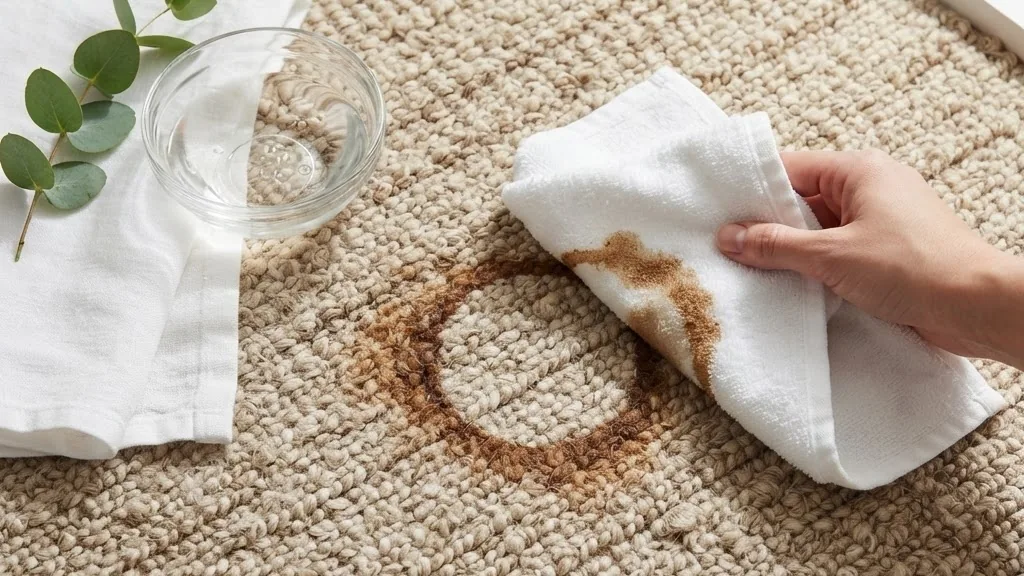
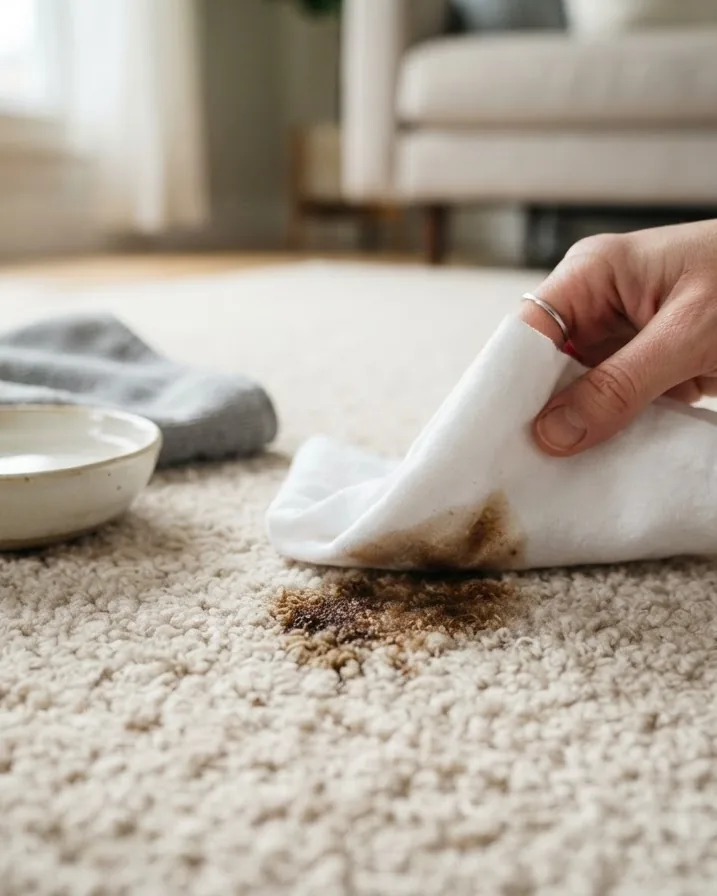
The first 60 seconds after a spill matter more than every product you will buy afterward. Blot with a white absorbent cloth, work from the outer edge toward the center, and use cold water only. Colored towels transfer dye into wet fiber, so white is the rule. Rubbing distorts the yarn twist and pushes liquid down into the backing and pad, where it becomes an odor and wicking problem rather than a surface problem. Hot water and steam machines belong at the end of the process, if at all, because heat helps set tannin rather than lift it. Flooring America gives the best single line on the whole subject: you can always add water, you cannot remove it. Over-wetting destroys backing adhesive and drives the stain deeper into the assembly than the coffee reached on its own.
The weight-and-wick step is the one most people skip. Fold a dry white towel, lay it over the damp area, and stand something heavy on it for several minutes. Capillary action pulls the liquid up into the towel instead of letting it settle at the base of the pile.
- Blot, do not rub. Rubbing distorts twist and drives liquid to the backing.
- Work outside-in. Inside-out blotting creates a halo wider than the spill.
- White cloth only. Dye transfer from a colored towel is a second stain.
- Cold water first. Heat and steam are finishing tools, never openers.
- Weight a dry towel on the spot before you reach for any chemical.
Diagnose before you treat: fiber, additives, age, size
Four questions resolve to one protocol. Question one is fiber: nylon, polyester, olefin, triexta (sold as SmartStrand), wool, silk, viscose-rayon, or jute and sisal. Question two is what was in the cup, because black coffee is tannin alone, cream adds protein and fat, and flavored syrup adds sugar plus dye that may be permanent. Question three is age, in four bands: under 10 minutes, under 24 hours, 24 to 48 hours, and over a week or previously treated. Question four is size and depth: did it stay in the pile, or did it reach the pad? A spill wider than 12 in (30 cm) or one that saturated the pad is a different job entirely. Answer all four before you open a bottle, because the wrong first pass forecloses the right second one.
Finding the fiber is easier than the internet makes it sound. Check the tag, the installer invoice, or the manufacturer record. Invista (which sells Stainmaster), Shaw, Mohawk and Lees all publish care instructions that bind their own warranties, and those documents specify what you may and may not put on the fiber.
Additives change the order of operations, not just the strength.
- Black coffee: tannin only. Go straight to the acid side.
- Coffee with cream or milk: protein and fat first (mild alkaline or an enzyme), tannin second (acid), then rinse. Reverse that order and you cook the protein into the fiber.
- Coffee with syrup or flavoring: sugar plus added dye. Sugar residue re-soils, and the dye may be beyond removal.
- Coffee with liqueur: sugar-heavy and often colored, closer to the syrup case than the black case.
Then patch test. Pick a closet edge or the offcut under the sofa, apply the solution you intend to use, leave it, and press a white cloth against it. Any color on the cloth is a fail and the answer is no. Carpet One Floor and Home is right to repeat this instruction; it is also the one instruction that costs nothing and prevents the expensive outcome.
The chemistry: coffee behaves like a dye, and the whole page one gets it backwards
Coffee tannins are vegetable dyes, and they anchor to fiber the way dye anchors to fiber, which is why detergent alone underperforms. The trade prescription is an acid-side spotter at pH 3 to 4, and that prescription is correct. The explanation attached to it across the search results is chemically false. Multi-Clean, Zerorez and several rug retailers all state that tannins are alkaline, so you fight them with acid. Tannins are polyphenols, which are weak acids, and brewed coffee is acidic. The industry’s own lab protocol proves it: in the coffee-stain test method referenced against American Association of Textile Chemists and Colorists Test Method 175, brewed coffee is adjusted to pH 5.0 before it ever touches the sample. Bissell says on its own page that coffee has an acidic nature, contradicting the pages ranking beside it.
The reconciliation is jargon, not chemistry. In cleaning-trade shorthand, an “alkaline stain” means a stain that responds to the acid side of the pH scale. It was never a claim about the literal pH of the spill.
So why does acid work? Two mechanisms. Acid keeps the phenolic groups protonated and un-ionized, which weakens their grip on the fiber. Acid also chelates the metal-tannin complexes that anchor the chromophore in place, which is the same reason acid rinses outperform alkaline cleaners on tea and cola.
The pH map that trade guidance actually uses is worth memorizing. Solutions at pH 7 to 10 suit synthetic fibers such as nylon, rayon and olefin. Natural fibers (wool, silk, cotton, jute) tolerate neutral to only slightly alkaline chemistry and nothing more. Most household soils sit at pH 2 to 5, which is why general-purpose alkaline cleaners exist at all, and why they fail on tannin.
The lab protocol is worth reading in full if you want to understand what you are up against. The test carpet is a 30 oz per square yard cut-pile nylon with a 0.5 in pile height at 5/32 gauge. The coffee is applied at 140 F +/- 5 F (60 C +/- 2.8 C), 50 mL of it, inside a 2.75 in (7 cm) ring, and it is left to dwell for 4 hours +/- 20 min. That is the deliberate worst case: hot, concentrated, confined and given hours to bond. Your spill is cooler, thinner and younger. It is also, if you act, still a surface event.
Two further mechanisms explain most failures. Oxidation is one: coffee tannins bond substantially harder within 24 to 48 hours, which is why the same spill treated Tuesday resists what it would have surrendered on Monday. Residue is the other: any surfactant left in the pile attracts soil, so the spot you cleaned looks dirtier a month later than the carpet around it. Rinsing is not optional. Neither is understanding your coffee, and the particle size behind the cup is a real variable, which is why what a medium grind label actually specifies shows up in extraction strength and therefore in how much dye load hits the floor.
The method ladder: seven fixes, escalated in order
Escalate one rung at a time and stop the moment the white towel stops picking up color. Shotgunning five remedies at once mixes incompatible chemistry, and it removes your ability to know which rung worked. Every rung below assumes you already blotted, diluted with cold water and patch tested. Every rung ends with a clear-water rinse and a blot to slightly damp, never to soaked. Round three is your ceiling: if the white towel shows no transfer after the third pass, further rounds add water, which produces wicking rather than removal. That stop rule is the single most useful number on this page, because the failure mode of DIY carpet cleaning is almost always persistence rather than weakness.
- Method 0, cold water and blotting. Fresh spills under 5 minutes. Frequently sufficient on black coffee over nylon.
- Method 1, the consensus DIY solution. 1 tbsp (15 mL) clear liquid dish soap, 1 tbsp (15 mL) white vinegar, 2 cups (about 475 mL) cold-to-warm water. Dwell 5 to 10 min, blot, rinse. Bissell warns honestly that dish soap leaves a tacky residue which re-soils, and that vinegar odor lingers. Both warnings are real, and both are solved by rinsing properly.
- Method 2, a dedicated acid tannin spotter at pH 3 to 4. The trade standard, and the correct answer for black coffee on synthetics.
- Method 3, an enzyme cleaner. Correct use case is cream, sugar and the sour milk odor that follows. Wrong use case is black coffee, where there is no protein to digest.
- Method 4, 3% hydrogen peroxide. Drugstore strength, applied as a paste with baking soda, 5 to 10 min dwell, then blot and rinse. Synthetics and light colors only. It bleaches dark carpet and it damages wool.
- Method 5, dry absorbent or dry-extraction powder. The answer when over-wetting is the bigger risk than the stain: wool, viscose, anything over a pad you cannot dry.
- Method 6, hot-water extraction or a portable spot machine. A finishing and rinsing step after the chemistry, never the opening move. The Bissell Little Green Mini carries a 16 oz (473 mL) solution tank, which tells you the scale it is built for: spots, not rooms.
The do-not list carries mechanisms, because a warning without a mechanism gets ignored.
- Never mix bleach and ammonia, or vinegar and hydrogen peroxide. The Centers for Disease Control and Prevention publishes the household chemical exposure guidance worth reading before you improvise.
- No salt. It abrades pile tips and leaves a hygroscopic residue that pulls moisture back up and drives wicking. Carpet One recommends lemon juice and salt anyway, which contradicts its own wool advice on the same page.
- No bleach on colored carpet. No ammonia on wool. No OxiClean-type oxidizers on protein fiber.
- No scrubbing, ever, on any fiber.
Wool, viscose, and the rugs plain water destroys
Viscose is where the standard advice becomes actively dangerous. Viscose, rayon and so-called bamboo silk are cellulose, and they dominate the sub-$500 silk-look rug market, which means a great many households own one without knowing it. Water alone causes permanent fiber collapse, yellowing and pile distortion in viscose. Every reassuring instruction on page one of the search results (“splash cold water on it”, “blot with a damp cloth”) is an instruction to destroy the rug. If the pile feels cool and slick, shines hard under light, and the tag says viscose, rayon, art silk or banana silk, stop. Blot dry, use a dry absorbent powder if you use anything, and route the job to a certified professional. Getting this branch wrong is irreversible in a way that no other branch on this page is.
Wool is recoverable but unforgiving of the wrong chemistry. Its natural stain resistance comes from lanolin, which makes the fiber relatively water-repellent, and that same repellency is why an old wool stain needs to be gently re-wetted before anything will lift it.
The wool protocol is narrow. Use 1 part pH-neutral wool detergent, or white vinegar, to 4 parts lukewarm water. Never hot. No hydrogen peroxide, no alkaline products, no oxidizers. Oriental Rug Salon, which holds both IICRC and CRI credentials and WoolSafe Approved Service Provider status, publishes that dilution, and the WoolSafe Organisation maintains the approved-product list that keeps you inside the line. The Woolmark Company publishes its own wool care guidance for the same fiber.
Dye bleed is the stop signal. If the patch test cloth shows color from the rug rather than from the coffee, your job is finished and someone else’s has begun.
Dried stains, cream stains, and the spot that came back
A dried coffee stain needs rehydration before chemistry, because you cannot lift a dye that has nothing to move in. Lay a cold, damp white cloth over the spot and leave it long enough to soften the bond, then run the ladder from Method 1 upward. This is the branch Flooring America hands off to a professional entirely, and Carpet One covers without a single dwell time. Coffee with cream is a two-pass job: mild alkaline or enzyme chemistry for the protein and fat, acid for the tannin, then a rinse, in that order. If it soured, the odor is bacterial and the enzyme step is doing the real work. Milk that reached the pad sets the odor threshold at which pad replacement beats further cleaning.
The reappearing stain has exactly two causes, and telling them apart takes one week.
- Wicking: the stain reappears within hours or a day of drying, because liquid still in the backing and pad rose back up the fibers. The fix is airflow, a weighted dry towel, repeat extraction, and less water next time.
- Residue re-soiling: the spot darkens gradually over weeks and feels slightly tacky. Surfactant left behind is collecting soil. The fix is a clear-water rinse and extraction with no product in the tank.
Both mechanisms are absent from the pages currently ranking, which is why “it came back” is the most common follow-up question on the whole subject.
Standards, warranties and what the certifying bodies actually govern
Five organizations govern this subject, and knowing which one governs what tells you whose advice binds your warranty. The Institute of Inspection, Cleaning and Restoration Certification (IICRC) writes the consensus standards for professional textile floor covering cleaning. Its flagship document is ANSI/IICRC S100, the Standard for Professional Cleaning of Textile Floor Coverings, with a companion R100 Reference Guide that contains a named Spot and Stain Removal section. The lineage is long: first published as S001 in 1991, renamed S100 in 1994, then revised in 1997, 2002, 2011, 2015 and 2021, with a consensus body currently reworking the 2021 edition. The IICRC also certifies technicians and publishes free consumer tip sheets.
The American National Standards Institute (ANSI) accredits S100 as an American National Standard and sells the 2021 edition through its webstore. That accreditation is what separates S100 from a vendor blog post: it went through a consensus process with a documented revision history.
The Carpet and Rug Institute (CRI) runs the Seal of Approval program, which certifies cleaning solutions, spot removers, vacuums and extraction equipment. This one costs you money in a way people discover too late. Several carpet warranties key off Seal of Approval status, so a bottle bought on price rather than on certification can void the coverage on the floor it is sitting on. Check the warranty document from Invista, Shaw or Mohawk before you improvise a solution, because those documents are the contract.
Two more bodies matter at the edges. The American Association of Textile Chemists and Colorists (AATCC) publishes the standardized test methods behind stain-resist claims, including Test Method 175, the apparatus referenced in the coffee protocol described earlier. The Environmental Protection Agency runs Safer Choice, which certifies cleaning chemical ingredient safety and is the right filter if pets or children use the room. Its program lives at epa.gov/saferchoice, and independent product testing from Consumer Reports covers the machines those chemicals go into.
When to stop and hand it to a certified professional
Some spills are a phone call rather than a project. Stop immediately and call an IICRC-certified technician if the rug is viscose, rayon, art silk, real silk, antique or hand-knotted; if the stain is wider than 12 in (30 cm); if liquid reached and saturated the pad; if the patch test showed dye bleed from the carpet itself; or if three full rounds of the correct protocol have failed. Verify certification through the IICRC rather than a van decal, and ask for the WoolSafe Approved Service Provider credential specifically for wool. Professionals bring dry-extraction options and pH-controlled rinses that no drugstore aisle sells. For high-traffic carpet, vendor guidance from Jaipur Rugs puts the deep-clean cadence at every 12 to 18 months, which is also the maintenance rhythm that stops spot cleaning from creating visible clean patches.
Aftercare and prevention that survives the next cup
Drying is the last technical step, and it is where careful work gets undone. Move air across the damp area with a fan or an open window, keep pets and children off the spot until it is dry (damp pile is a slip hazard and a re-soiling magnet), and vacuum once dry to reset the pile so the treated area matches its neighbors. Cleaning can strip a factory stain-resist treatment, so reapplying protector afterward is part of the job rather than an upsell. Lidded cups and a mat at the transition from kitchen to carpet prevent more stains than any bottle removes. If hydrogen peroxide is in play, wear gloves, ventilate, and treat eye contact as urgent; the Mayo Clinic maintains the household exposure guidance.
Frequently asked questions
Does a coffee stain become permanent?
Rarely on synthetics, often on flavored syrup dyes, and quickly on viscose. Coffee tannins bond substantially harder within 24 to 48 hours as they oxidize, which is why a Monday spill treated on Wednesday resists chemistry it would have surrendered immediately. Age, fiber and additives decide permanence far more than the coffee itself does.
Will steam cleaning set the stain?
Used as the first move, yes. Heat helps set tannin into fiber, and the industry stain-test protocol deliberately applies coffee at 140 F +/- 5 F (60 C +/- 2.8 C) to create a worst case. Hot-water extraction belongs at the end of the sequence, as a rinse after the chemistry has already released the dye.
Can I use a Bissell or Hoover machine on it?
Yes, as a finishing tool. The Little Green Mini carries a 16 oz (473 mL) solution tank, which tells you it is designed for spots. Spray beyond the perimeter of the stain, brush the solution in gently, extract, repeat, then air-dry overnight with a fan or an open window.
Can I use OxiClean or another oxidizer?
On synthetics in light colors, cautiously, after a patch test. On wool, silk or any protein fiber, never: oxidizers damage the fiber and no rinse undoes it. For a consumer-grade lightener, 3% hydrogen peroxide as a paste with baking soda, 5 to 10 min dwell, is the safer option that Carpet One also lands on.
Does club soda or baking soda actually work?
Both are mostly dilution and absorption doing the work you could get from cold water and a dry towel. Neither addresses the tannin-fiber bond, which is what an acid-side spotter at pH 3 to 4 targets. Baking soda earns its place mixed into a hydrogen peroxide paste, or as a dry absorbent on fibers that cannot take water.
Why did the spot come back after it dried?
Wicking or residue. Wicking returns within hours because liquid still in the backing rose back up the pile, and the fix is airflow, weight, and less water. Residue darkens gradually over weeks because leftover surfactant is collecting soil, and the fix is a clear-water rinse with nothing in the tank.
The bottom line
Fiber first, additives second, age third, size fourth. Blot outside-in with white cloth, dilute cold, weight and wick, then escalate one rung at a time and stop at round three. Acid at pH 3 to 4 for tannin on synthetics, pH-neutral at 1 part to 4 parts for wool, dry methods only for viscose. The caffeine content changes nothing about the chemistry on the floor, which is why the solvents and label rules behind decaf coffee stain a nylon pile exactly like the fully caffeinated cup does.