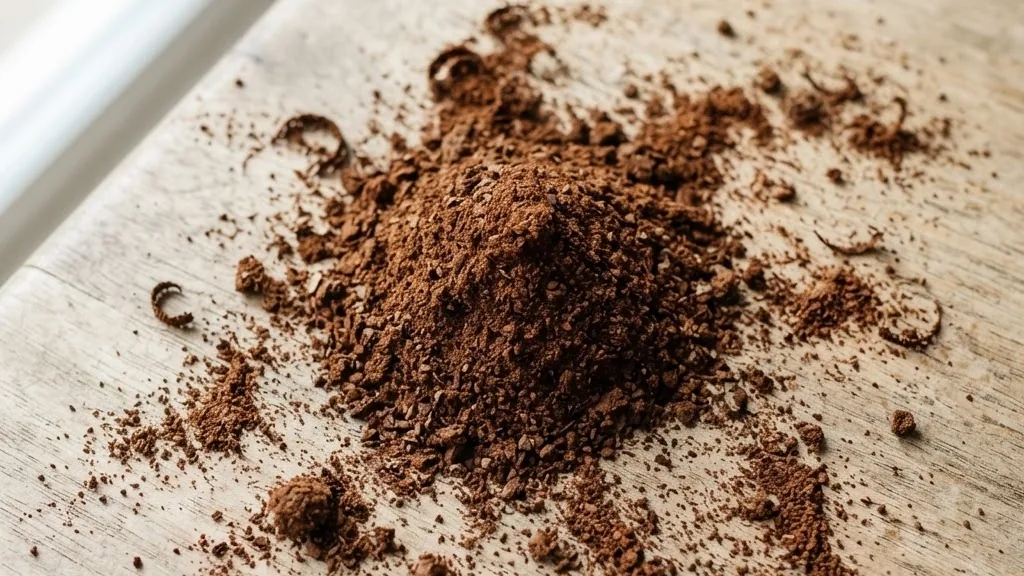
Coffee ground medium is a phrase that hides three unrelated decisions behind one word. A bag can be medium because the particles measure somewhere near 800 microns. It can be medium because the roaster stopped the drum before second crack. It can be medium because a marketing team wanted a word that sounds safe. Amazon files “Medium Dark Roast” products inside a “medium grind coffee” result set, and nobody corrects it. If you want the roast side of that story, the numbers behind a light roast bag make a useful contrast. What follows is the grind side, with the ranges named and the disagreements left visible.
Quick answer. Coffee ground medium usually refers to grind size: particles in the 600 to 800 micron band, the texture of granulated sugar, cut for automatic drip machines, flat-bottom pour-over, siphon, and refillable single-serve pods. Published ranges disagree, spanning 400 to 1000 microns depending on who is measuring and which basket they had in mind. Medium roast is a separate variable, and it barely changes caffeine. A medium grind will choke an espresso machine and will silt through a French press screen. Start at 600 to 800 microns, then adjust by taste, not by dial number.
Coffee ground medium: three labels, one phrase
Three variables share the word medium, and they control three different outcomes. Grind size is particle diameter, measured in microns, and it controls extraction rate: more surface area means solubles leave the bean faster. Roast level is bean development, and it controls flavour direction, from acidity toward caramelisation. Ground, as a format, controls freshness and convenience, since a pre-ground bag has already started losing aromatics before you open it. Retailers collapse all three into a single facet. A shopper filtering for medium grind on a marketplace lands in a grid that also contains medium roast whole bean, and the page offers no definition of either. The practical consequence: someone buys a bag labelled medium, loads a Moka pot with it, and gets a weak, watery cup for reasons the label never explained.
Sort the question this way before you spend money:
- If your problem is a bitter or sour cup, you have a grind size question.
- If your problem is that the coffee tastes flat or too roasty, you have a roast level question.
- If your problem is that a fresh bag tastes like cardboard by week three, you have a format and storage question.
Only the first one is answered by microns.
The micron ranges nobody agrees on
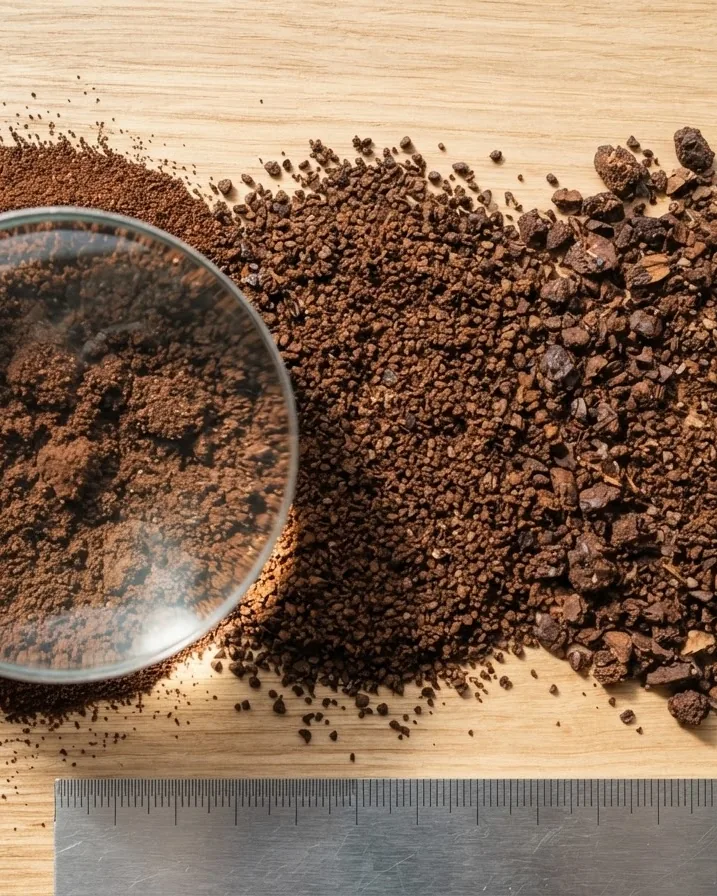
A micron, short for micrometre, equals 0.001 mm, one millionth of a metre, roughly 0.000039 inch. That unit exists because texture words fail. “Beach sand” and “granulated sugar” get used for the same grind by different writers, which tells you how much subjective language is worth here. The awkward part is that the numeric sources disagree too. Seven published ranges for the same word, “medium”, spread across 400 to 1000 microns, and every page that quotes one of them presents it as settled. Mill City Roasters puts medium at 800 microns for drip and pour-over. Genuine Origin says 800 to 1000 microns and calls it beach sand. Colipse says 600 to 800 microns and calls it granulated sugar. That is not a rounding difference. That is a factor of two.
The published spread, source by source
- Mill City Roasters: 800 microns, drip and pour-over.
- Genuine Origin: 800 to 1000 microns, described as beach sand, for drip makers.
- Colipse: 600 to 800 microns, granulated sugar, drip plus Keurig pods.
- Seven Sisters Coffee: 600 to 800 microns, drip, siphon, flat-bottom pour-over.
- Biodynamic.coffee: 400 to 600 microns, regular sand, automatic drip.
- RoastAroma: 400 to 600 microns, but labels that band medium-fine.
- Basic Barista: 300 to 900 microns for drip machines, noting it varies hugely by model.
Why the numbers fight each other
Four mechanisms explain most of the spread. Basket geometry comes first: a cone basket concentrates the bed and slows flow, so it tolerates a coarser cut than a flat-bottom basket of the same volume. Machine flow rate comes second, and Basic Barista’s 300 to 900 micron admission is really a confession that “drip machine” is not one device. Third, measurement method. Sieves, laser diffraction, and digital imaging systems such as the Lighttells CM-200 do not return identical distributions from identical grounds. Fourth, and least discussed, every grind is a distribution rather than a value. A grinder dial may move burrs a stated number of microns per click, but the output is always a range of particle sizes.
Take the union of the drip-relevant claims and you get roughly 400 to 1000 microns. The honest working recommendation inside that: 600 to 800 microns as a starting point for automatic drip, plus or minus 200 microns depending on basket geometry and machine flow rate.
The mesh bridge almost nobody builds
The Specialty Coffee Association, formed when the SCAA and SCAE merged in 2017, does not speak in microns for cupping. Its cupping protocol calls for a grind slightly coarser than typical paper-filter drip, with 70 to 75 percent of particles passing a U.S. Standard size 20 mesh sieve. That sieve series is governed by ASTM International, and a #20 mesh corresponds to roughly 850 microns. So the SCA cupping grind and the “medium” of a retail bag live in overlapping territory, and the two vocabularies finally connect. Honest Coffee Guide maintains a calibration database covering more than 200 grinders, which is how you convert any of this to a click count on your own machine. A Mahlkonig EK-43 with 98 mm flat steel burrs and a Fellow Ode with 64 mm flat steel burrs do not produce the same output at the same nominal setting.
Which brewers a medium grind actually serves
Medium grind exists to serve a specific time window. Solubles need long enough to leave the bean and not so long that the bitter, astringent fractions follow. An automatic drip cycle runs 2 to 5 minutes, typically 4 to 5. A Kalita Wave, flat-bottom, wants roughly 600 to 700 microns and a target contact time of 3:00 to 3:45. Pour-over generally targets 2.5 to 3.5 minutes at 400 to 600 microns, which is why some sources file that band as medium-fine rather than medium. Siphon brewing sits near 600 microns. Refillable single-serve pods behave like small drip baskets. The pattern holds: methods that finish in two to four minutes with gravity flow through paper or fine metal are medium grind territory, and everything else is not.
Hario’s V60, a 60-degree cone with spiral internal ribs, has won 6 of the last 11 World Brewers Cup competitions, which is a decent argument for reading the device maker’s own grind guidance before a blog’s. Chemex, Kalita, and AeroPress publish theirs too. The AeroPress, invented by Alan Adler, accepts 320 to 960 microns, the widest usable range of any brewer on the list, which makes it the most forgiving place to start if you only own one grind setting.
Where medium grind fails, and the mechanism for each failure
Medium fails in four places, each for a different physical reason. Espresso needs 180 to 400 microns to build resistance against pump pressure in a 25 to 30 second shot; a medium bed offers almost no resistance, and water channels straight through. Turkish coffee runs 50 to 150 microns because the grounds stay in the cup and must behave like suspended silt. French press steeps around 4 minutes at 800 to 1000 microns, and a medium cut is too fine: fines pass the mesh screen and keep extracting in your cup. Cold brew sits at 1000 to 1500 microns over 12 to 18 hours, and medium particles over that steep will overshoot into bitterness long before you decant.
For orientation, the full ladder in microns: Turkish 50 to 150, espresso 180 to 380, Moka pot 300 to 400, siphon around 600, AeroPress 320 to 960, cupping 470 to 850, Chemex 1100 to 1300 with its thick paper filter, French press 690 to 1300, cold brew 800 to 1400. Medium sits in the middle of that ladder, and the ladder is why one bag cannot serve one household with four brewers.
Distribution beats average: burrs, blades, and boulders
The most consequential idea in grinding is the one no product page mentions: a grind is a distribution, and the shape of that distribution matters more than its midpoint. Blade grinders chop rather than mill, producing a bimodal output. You get dust-like fines alongside boulders in the same batch. The fines over-extract, the boulders under-extract, and the cup arrives sour and bitter at once, which is the flavour signature people misread as “bad beans“. Burr grinders mill particles to a set gap, tightening that distribution. Conical and flat burrs differ in the shape of the tail. Burr wear over time degrades consistency the same way a blade does, slowly, so a grinder that produced clean cups two years ago may now be the reason your dial adjustments stop doing anything predictable.
Reading the cup instead of the dial
Symptom-based troubleshooting outperforms micron chasing for anyone without a sieve set:
- Weak, flat, sour: grind finer, or raise the dose.
- Bitter, dry, slow drawdown: grind coarser.
- Basket overflows or the bed floods: grind coarser.
- Sour and bitter at the same time: your grinder consistency is the problem, and no setting fixes it.
That last line is the diagnostic that saves money. Grind size is a lever you can move. Grind uniformity is a hardware property you cannot argue with.
Roast is a modifier, not a starting point
Roast level shifts where inside the band you land. Lighter roasts are denser and less soluble, so they generally want a finer cut or a tighter ratio. Darker roasts are more friable and give up solubles faster, so they want a coarser cut. Pick the starting point from the brew method, then nudge for roast. Reversing that order, which is what “medium roast, so medium grind” implies, produces the folk logic that keeps people stuck.
The SCA numbers: ratio, temperature, extraction
The Specialty Coffee Association’s Golden Cup Standard, last revised on 2015-12-23, is the reference every serious page borrows from. It sets brew strength at 11.5 to 13.5 g/L of total dissolved solids, which reads as 1.15 to 1.35 percent TDS on the Brewing Control Chart. It sets solubles extraction yield at 18 to 22 percent. It sets the coffee-to-water ratio at 55 g/L plus or minus 10 percent, so 49.5 to 60.5 g per litre, which converts to roughly 1:16 to 1:18. Water temperature at point of contact is 200 degrees F plus or minus 5, equal to 93.0 degrees C plus or minus 3. SCA Standard 310-2021, the certification protocol for home coffee brewers, restates 55 g of coffee per 1.000 kg of water and adds a uniformity-of-extraction rating.
Why 18 to 22 percent is the boundary
Roughly 30 percent of roasted coffee mass is water-soluble, so the full bean is never the target. Below 18 percent yield, good flavours stay in the bed and the cup reads sour and vegetal. Above 22 percent, the bitter and astringent fractions arrive. That preference band came out of consumer studies in the 1960s, Lockhart’s work, which became the foundation of the Brewing Control Chart, and later decades reproduced similar results.
The standard is contested
James Hoffmann, the 2007 World Barista Champion, argues for 60 g/L instead of the SCA’s 55 g/L, largely on the grounds that round numbers survive contact with real kitchens. Retail instructions push harder still. Trader Joe’s specifies about 2 Tbsp per 6 oz of water, which lands near 1:12 to 1:14, materially stronger than 55 g/L. Purity Coffee instructs 4 Tbsp, 20 g, per 12 oz mug at 195 to 205 degrees F. Three credible sources, three different ratios. Pick one, hold it constant, and move grind alone until the cup is right.
Water chemistry and the freshness clock
The SCA water guidance targets brewing water at 100 to 150 ppm total dissolved solids. Calcium and magnesium above 175 mg/L scales brewers and boilers. Reverse-osmosis and distilled water lack the minerals extraction needs, so they under-extract regardless of grind. Low-alkalinity water can push apparent yields above 22 percent without the usual over-extraction flavours, which quietly breaks the Brewing Control Chart as a diagnostic. Municipal supply quality falls under the Environmental Protection Agency for public systems, and your local report is free.
Freshness runs on a separate clock. Purity Coffee tells buyers to finish a bag within 10 days of opening for optimum aromatics. A 12 oz bag yields roughly 20 to 30 cups. Store airtight, cool, dark, in the resealable bag or an equivalent container.
Caffeine, filters, and what the agencies actually say
Every retail page selling medium ground coffee skips the health numbers, so here they are. A standard 8 oz cup, 240 mL, of brewed coffee carries roughly 80 to 100 mg of caffeine, with some sources citing 95 to 100 mg, and real-world cups ranging from near zero to over 500 mg. The Food and Drug Administration cites 400 mg per day as safe for most healthy adults, about four to five 8 oz cups. Serving size does the damage, not roast: a 20 oz Starbucks Sumatra Clover Brew contains 470 mg, more than the entire daily figure in one cup. Around 85 percent of American adults consume caffeine daily, averaging roughly 180 mg per day, about two cups. The agency’s food guidance sits at the FDA’s consumer update on caffeine.
Roast level barely moves caffeine
Roasting burns off small amounts of caffeine, so a light roast holds marginally more by volume than a dark one, and the difference is close to negligible. The real drivers are serving size first and dose ratio second. That kills the “medium roast means medium caffeine” belief outright. If you want the caffeine question handled from the other direction, the solvent and label rules behind decaf coffee cover what actually removes it.
Filtration, acrylamide, and who should ask a clinician
Paper filters retain the diterpenes cafestol and kahweol; French press, Moka pot, and other unfiltered methods let them through, and the LDL-cholesterol question attached to that is a live research topic rather than a settled number. Read the primary literature through the National Institutes of Health before you accept any blog’s version. Acrylamide forms during roasting and carries a regulatory hook in Europe under Commission Regulation (EU) 2017/2158, which sets benchmark levels and mitigation measures for roast coffee; the International Agency for Research on Cancer classifies it, and reclassified coffee itself in its 2016 monograph. General population guidance lives with the Centers for Disease Control and Prevention at cdc.gov, and symptom-level questions belong with a clinician, particularly for pregnancy, arrhythmia, GERD, anxiety disorders, or a slow-metabolizer CYP1A2 genotype. The European Food Safety Authority publishes the EU-side caffeine opinion for readers outside the United States.
What “low-acid” is doing on the bag
Low-acid, mold-free, and sensitive-stomach claims appear across medium ground SKUs without substantiation attached. Advertising claims of that kind fall under the Federal Trade Commission’s remit in the United States, and a claim with no cited method behind it is a claim with no method behind it. Consumer-facing comparison testing at Consumer Reports and clinical explainers at MedlinePlus are both better starting points than a product description.
Buying pre-ground: sizes, savings, and seals
Bag formats run 12 oz, 16 oz, 20 oz, 24 oz, 34.5 oz, 35.2 oz, 2 lb, and 5 lb. Colipse publishes per-ounce savings of 21.3 percent for the 2 lb versus the 12 oz, and 35 percent for the 5 lb, with a 5 percent subscription discount on top. Free-shipping thresholds sit at $40 at Verena Street, $49 at Peet’s, $50 at illy, and $60 at Purity Coffee. Run the arithmetic against the 10-day open window and the bulk case weakens fast. Seals decode simply: the USDA National Organic Program governs the USDA Organic mark, while Fair Trade USA, Fairtrade International, and Rainforest Alliance certify supply-chain and environmental criteria, not grind or flavour. For per-cup economics on a different format, see the real cost per cup of Leet Coffee.
FAQ
Is medium grind the same as medium roast?
No. Medium grind is particle size, roughly 600 to 800 microns, and it controls how fast solubles leave the bean. Medium roast is bean development, and it controls flavour direction. A bag can be one, both, or neither. Marketplace filters mix them constantly, which is where most of the confusion originates.
Can I use medium grind in a French press?
You can, but the cup will silt. French press steeps around 4 minutes and wants 800 to 1000 microns; medium sits below that, so fines slip past the mesh screen and keep extracting after plunging. The result reads muddy and bitter. Go coarser, or switch to a paper-filtered method.
What grind is pre-ground coffee from the store?
Usually a drip-oriented medium, cut for automatic machines and flat-bottom baskets. Brands rarely state the number: illy’s Classico ground drip says the grind allows optimal extraction and never gives microns, brew ratio, or water temperature. Assume drip territory, roughly 600 to 800 microns, and adjust the ratio rather than the grind.
How long does ground coffee stay fresh?
Purity Coffee instructs consuming a bag within 10 days of opening for optimum aromatics. Grinding multiplies exposed surface area, so pre-ground stales faster than whole bean. Keep it airtight, cool, and dark. A 12 oz bag yields roughly 20 to 30 cups, which is a realistic 10-day supply for a two-cup household.
Medium or medium-fine for drip?
Depends on the basket. Flat-bottom baskets and Kalita Wave brewers sit near 600 to 700 microns with a 3:00 to 3:45 contact time. Cone baskets tolerate coarser. Basic Barista puts drip machines anywhere from 300 to 900 microns because models vary hugely. Start at 700, then move by taste.
Why do published micron ranges disagree so much?
Because they measure different things. Basket geometry, machine flow rate, roast level, and measurement method all shift the answer, and every grind is a distribution rather than a single value. Sieves, laser diffraction, and imaging tools such as the Lighttells CM-200 return different numbers from identical grounds. Treat 600 to 800 microns as a starting point, not a specification.
Does espresso grind work if I just use less water?
No. Espresso runs 180 to 400 microns because pump pressure needs resistance across a 25 to 30 second shot. In a drip basket, that bed floods and over-extracts past the 22 percent yield boundary, so the cup turns bitter and astringent regardless of volume. Milk-based drinks like a cortado and its espresso-to-milk ratio depend on that fine cut.