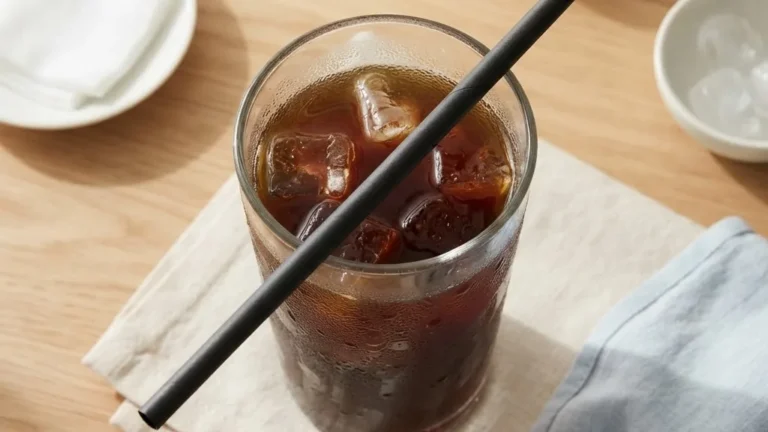
Coffee bean menu searches are brand searches wearing a generic costume. Nine times in ten they mean The Coffee Bean & Tea Leaf, the Los Angeles chain founded in September 1963 by Herbert B. Hyman and Mona Hyman, which opened its first retail store in Brentwood in 1968. The company’s own site lists items by category and parks the nutrition data in a separate downloadable sheet. Delivery aggregators show one store’s prices and no nutrition at all. Caffeine appears nowhere official. The layer nobody serves well is the one that matters: what each category contains, what the posted calorie numbers legally mean, where the sugar actually comes from, and why the price you paid at the airport was not the price your neighbor paid. If you want the roast vocabulary behind the retail shelf first, start with the numbers behind a light roast bag.
Quick answer: the coffee bean menu splits into Original Ice Blended, non-coffee Ice Blended, espresso classics, lattes, brewed coffee, cold brew, tea, tea latte, cold brew tea, cocoa, a pastry-led food case, and whole bean retail. Calories run from 0 kcal for unsweetened tea to 570 kcal for a 24 oz Cold Brew Coffee Ice Blended. A small 12 fl oz Ice Blended Vanilla on nonfat milk is 277 kcal; the same drink built with no-sugar-added powder is 120 kcal. The chain publishes 11 nutrition fields per item, and caffeine is not one of them. The Food and Drug Administration cites 400 mg of caffeine per day as the ceiling for healthy adults.
What the coffee bean menu covers, and what it does not
Three different searches collide on this phrase. The first is the chain: The Coffee Bean & Tea Leaf, operated by International Coffee & Tea, LLC and owned by Jollibee Foods Corporation since 2019. The second is any independent cafe that happens to be called The Coffee Bean, whose board has nothing to do with the chain and whose prices are its own. The third is whole bean as a commodity, meaning the roast lineup sold by the pound rather than by the cup. Everything below concerns the first, with the retail arm handled as one category among many. The chain ran 1,232 stores across 24 countries as of 2024 according to the Jollibee Foods Corporation annual report, which matters for a reason beyond bragging rights. That store count puts the company far past the 20-location threshold that triggers federal menu labeling, and that single fact explains most of what gets printed beside each drink.
Every category on the board, from Ice Blended to whole bean
The taxonomy has barely moved in decades: Original Ice Blended, non-coffee Ice Blended, espresso classics, lattes hot and iced, brewed coffee, cold brew, tea, tea latte, cold brew tea, and cocoa. Food sits beside the drinks as a pastry-led case. Whole bean, loose-leaf tea, powders and subscriptions form the retail arm. The Original Ice Blended is both the anchor and the origin story: a barista at the Westwood store in Los Angeles blended ice, coffee extract and chocolate powder in the summer of 1987. Starbucks tried to buy the company in 1991 and Herbert B. Hyman declined; the Frappuccino arrived afterward. Cold brew is the other signature, and its spec is unusually specific for a chain: a blend of Bali Blue Moon and Ethiopia Yirgacheffe with chicory, steeped cold for 20 hours. Time, not heat.
Reading the board is easier once you know which lever each category pulls.
- Original Ice Blended: coffee-based, powder-driven, the highest-calorie family on the menu.
- Ice Blended (non-coffee): the caffeine-free branch, built on chocolate, vanilla and fruit powders rather than coffee extract.
- Espresso classics: built on the signature L.A. Espresso. The Perfect Americano menu was announced on 2026-05-27 by PRNewswire and went nationwide on Wednesday 2026-06-03 as a permanent core addition, not a limited run.
- Lattes: hot and iced, including a protein-enriched line.
- Brewed coffee: hot and iced, the plainest and cheapest path through the board.
- Cold brew: including Cold Brew Ice Blended and cream-cap variants, which is where the calorie ceiling lives.
- Tea, tea latte, cold brew tea: loose-leaf black, green and herbal.
- Cocoa and food: pastries, breakfast items, bombolone-class doughnuts.
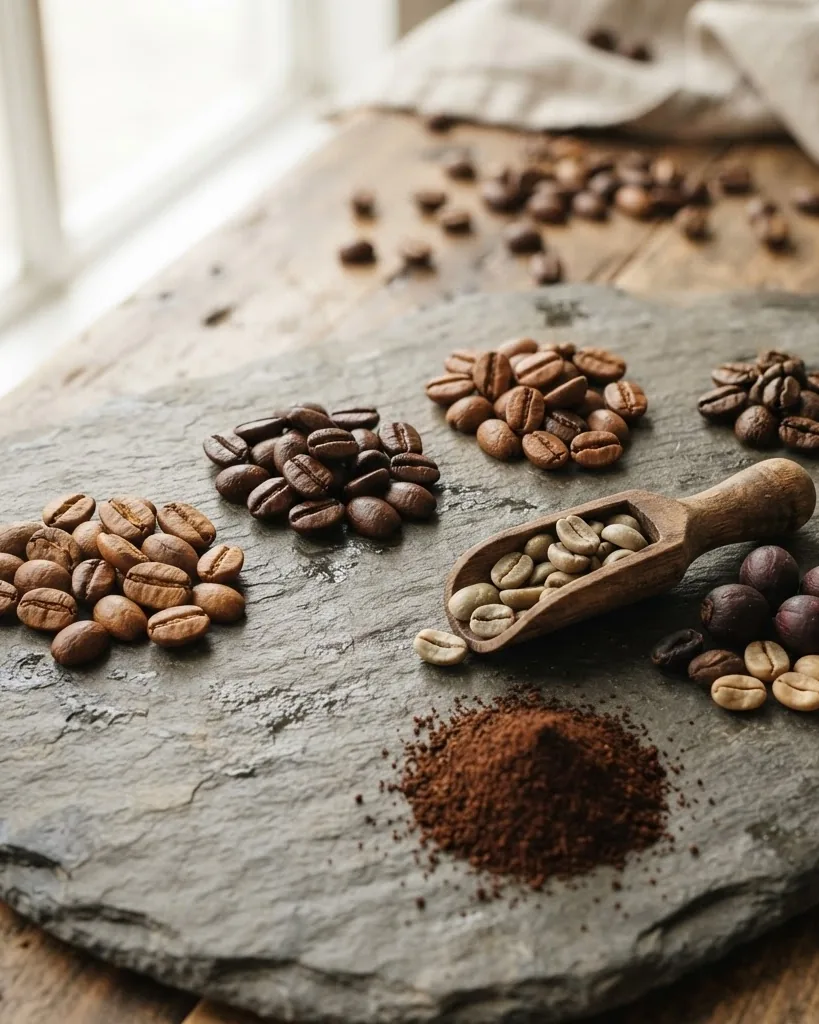
The roasting side deserves more attention than it gets from anyone writing about the drinks. Roughly 7 million pounds of coffee move through the Camarillo, California facility each year, hand-roasted, with origins including Costa Rica, Colombia, Kenya and Indonesia. That is the same green coffee feeding both the espresso hopper and the retail bag, which is why the whole bean shelf is not a souvenir rack. If you buy a bag, the grind label is the part that decides whether the cup works at home; what medium grind on a bag actually means covers the particle-size claims that packaging tends to fudge.
Seasonal cadence follows a predictable calendar. Pumpkin and cold brew reworks arrive in fall, a wellness-framed menu lands in January, and peppermint plus gingerbread carry the holidays. The Specialty Coffee Association publishes brewing and cupping standards that give useful context for extraction and roast, though nothing the association writes is chain-specific, and treating its protocols as a description of what happens behind this counter would be a mistake.
One honest note on food. The case is pastry-led, not lunch-led, and it is not trying to be a meal. Kitchens built around bean soups occupy a different slot in the day entirely, as do the street-side operators covered in guides to food trucks, where the economics reward a full plate rather than a scone. If you want something with real satiety after a 570 kcal blended drink, the honest move is to eat elsewhere: a bowl like this fiery black bean soup does the job a bombolone cannot, and even a sandwich format such as these plant-powered bean burgers lands closer to a meal. For the same reason, planning around protein-heavy food is a better lunch strategy than reading a cafe pastry case as one.
Calories and sugar: 0 kcal to 570 kcal on one board
Calories on this menu span from zero to 570. Plain hot or iced tea, black, green or herbal, unsweetened, is 0 kcal. A 24 oz Cold Brew Coffee Ice Blended is 570 kcal. Almost everything people order sits between those poles. A small 12 fl oz Ice Blended Vanilla made with nonfat milk is 277 kcal, and a small Ice Blended Dark Chocolate on nonfat milk is 270 kcal, both per CalorieKing. Swap the standard powder for the no-sugar-added version on that same small vanilla and it lands at 120 kcal. That is a cut of 157 kcal on an identical drink at an identical size, a reduction of roughly 57 percent, achieved by changing one component. No other decision on the board moves the number that far for that little effort.
Sugar is the axis the calorie count is really tracking. A small Extreme Vanilla Ice Blended made with milk runs 255 kcal, 7 g fat of which 6 g is saturated at 30 percent of the daily value, 240 mg sodium at 10 percent of the daily value, 45 g carbohydrate, 41 g sugar, 6 g protein, 0 g fiber and 0 mg cholesterol. Read that line again: 41 g of sugar in a 12 fl oz cup, and that is the small.
The sugar has three sources and they stack.
- Flavored powders. The Ice Blended base is a powder system. It carries most of the load.
- Syrups. Added on top of the powder in flavored lattes and seasonal builds.
- Lactose. Milk contributes sugar before anyone adds anything sweet.
Which gives you four reduction paths that actually work, in descending order of effect: switch to no-sugar-added vanilla or chocolate powder, order a drink Lightened, move to nonfat milk, or drop to unsweetened tea and black coffee at 0 kcal. Note the asymmetry. Milk choice is the lever people reach for first and it is the weakest of the four; the powder swap is the one worth 157 kcal.
Do not treat any posted number as a laboratory result for the cup in your hand. Barista variance, ice level and customization all move the real figure, and the rounding rule discussed below means the printed number was never exact to begin with.
Caffeine: the field The Coffee Bean & Tea Leaf never prints
Caffeine is the one number the chain does not give you. Its published nutrition sheet carries 11 fields per item: serving size, calories, total fat, saturated fat, trans fat, cholesterol, sodium, carbohydrates, dietary fiber, sugar and protein. Caffeine is absent from that list, and no official per-item figure exists in public. Third-party pages fill the vacuum with confident inventions. One widely copied page asserts 333 mg for a 16 oz brewed coffee, with no citation, no method and no date, sitting far above the reference band that authorities use for drip coffee. The honest position is that the company does not publish it and that anyone printing a precise per-item table is guessing. What can be anchored is the ceiling, and the ceiling is where the practical decisions live.
The Food and Drug Administration consumer guidance on caffeine cites 400 mg per day as the amount not generally associated with dangerous, negative effects in healthy adults, roughly four to five cups of coffee. Mayo Clinic frames the same 400 mg per day as apparently safe for most adults, about four cups of brewed. Use that number as a budget rather than a target.
Timing matters as much as total. Caffeine’s half-life runs about 3 to 5 hours, with peak plasma concentration 15 to 120 minutes after you drink it. Do the arithmetic on a 4 pm espresso with a 5 hour half-life and half of it is still circulating at 9 pm. That is the whole basis of the no-espresso-after-mid-afternoon rule, and it is why the cold brew decision at 3 pm is a sleep decision.
Two more things people get wrong. Decaf is not caffeine-free: the FDA puts it at 2 to 15 mg per 8 oz cup, so a heavy decaf day is not a zero day, and how much caffeine decaf actually keeps gets into why the residual varies by process. And cold brew is not a milder drink because it is cold. A 20 hour steep extracts on a different curve than a two-minute drip cycle, and serving sizes in the blended and iced formats are larger, both pushing per-serving caffeine up rather than down.
Who should sit well under 400 mg: anyone pregnant, trying to conceive or breastfeeding; anyone on medications with caffeine interactions; and children and adolescents, for whom the American Academy of Pediatrics discourages caffeine outright. Cleveland Clinic documents the overdose picture and the pediatric caveats in the same terms. USDA FoodData Central is the sane place to sanity-check any generic coffee figure you find floating around, because it will not pretend to know what is in a specific chain’s cup.
Why the calories are posted at all: 21 CFR 101.11
The calorie count beside each drink is not a courtesy. It is federal law, specifically 21 CFR 101.11, the menu labeling rule covering chains with 20 or more locations doing business under the same name and offering substantially the same menu items. The final rule was published in the Federal Register on 2014-12-01 at 79 FR 71156, and the compliance date was 2018-05-07. Calories must appear adjacent to the item name or the price, in type no smaller than the name or the price, whichever is smaller. The rule mandates a succinct statement, printed verbatim: 2,000 calories a day is used for general nutrition advice, but calorie needs vary. It also requires a statement of availability: additional nutrition information available upon request.
The rounding rule is the part nobody explains, and it changes how you should read the board. Calories are rounded to the nearest 5-calorie increment up to and including 50 calories, and to the nearest 10-calorie increment above 50. Anything under 5 calories may be shown as zero. So the 270 kcal on a small Ice Blended Dark Chocolate is a rounded value by law, not a measurement, and a 0 kcal tea may not be literally zero. The FDA also exercises enforcement discretion on the calories-from-fat declaration, which is why you will not see that line.
Two practical consequences follow. First, that statement of availability is an enforceable right: you can ask any counter for the full written nutrition information and the establishment must have it on premises. Almost nobody does this. Second, caffeine is simply not a required field under the rule, which reframes the chain’s silence as regulatory rather than evasive. The FDA menu labeling requirements page and the eCFR text maintained by the U.S. Government Publishing Office are the two documents to read if you want the mechanics rather than the summary. The Office of the Federal Register holds the rulemaking record, including the Affordable Care Act section 4205 amendment that created the obligation in the first place.
Allergens, coconut, and the diet paths that survive
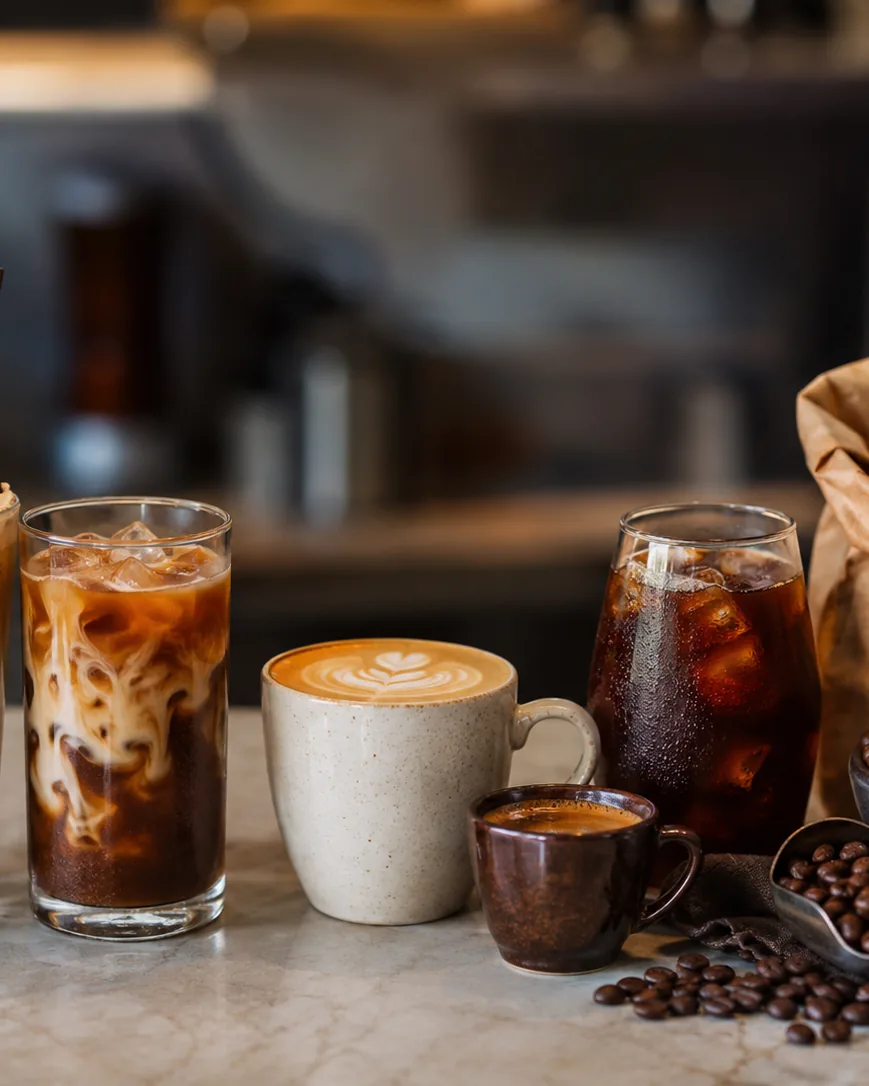
Four allergen families dominate this menu: milk, soy, tree nut, and wheat in some food items. The tree nut category is where people get caught, because it includes almond and coconut, and coconut is classified as a tree nut under United States labeling rules. Anyone avoiding tree nuts who orders a coconut-based drink because coconut felt like a fruit has made an understandable and potentially serious error. The chain publishes a downloadable allergen list alongside the nutrition sheet and keeps copies in store. Read it as a formulation document, not a safety guarantee: shared blenders, shared steam wands and shared powder scoops mean cross-contact is a real limit on any published sheet, and no allergen list can describe what happened in the last blender cycle.
The workable paths through the menu, if you have a constraint:
- Dairy-free: plant milks exist, but the powders are the risk surface, not the milk.
- Vegan: brewed coffee, espresso and unsweetened teas are trivially compliant; blended drinks require checking the powder.
- Keto or low-carb: a 45 g carbohydrate small Ice Blended is out. Black coffee, americano and unsweetened tea are in.
- Lowest sugar: unsweetened tea and black coffee at 0 kcal, then no-sugar-added builds at 120 kcal for a small vanilla.
If the constraint is real rather than preferential, ask for the written sheet at the counter and read it yourself rather than relying on a verbal answer from whoever is on shift.
Prices: why no honest national list exists
There is no national price list, and any page publishing one as fact is inventing it. The chain does not publish prices on its own menu pages, and the reason is structural rather than coy: the network is heavily franchised, so pricing sits with operators and formats, not with headquarters. A drive-thru, a mall kiosk, an airport unit and a campus store are four different cost structures wearing the same logo. Widely circulated ranges for this menu exist, but they originate from unsourced aggregator pages with no methodology and no collection date, which makes them directional gossip rather than data. The defensible statement is the one that survives a price change: your price is a function of size, customization, format and geography, in that order.
Delivery marketplaces add a second layer. Menu prices on third-party ordering pages are commonly marked up over in-cafe prices, and those pages do not say so. Compare the same item in the first-party app against the marketplace before assuming the delivery fee is the only premium you are paying.
The lever that actually works is the one the company promotes itself: The Coffee Bean Rewards app, with exclusive offers and pay-ahead ordering. That is the only price mechanism under your control at the counter. Note also that any page carrying affiliate or ordering links owes you a disclosure under the endorsement rules at 16 CFR Part 255, and the Federal Trade Commission’s endorsement guides FAQ for businesses spells out what that disclosure has to look like. If a price table has no date, no method and no disclosure, treat the whole page accordingly.
Ordering, rewards, and non-standard store formats
Store menus are not uniform, and the software makes that visible. Location pages run on Olo-powered ordering, which means the item list you see is the item list that specific store actually rings up, including regional items and gaps in the core lineup. The Perfect Americano menu is a rare counterexample: announced for nationwide availability from 2026-06-03 and added permanently to the core menu rather than run as a seasonal test. Non-standard formats matter too. Campus stores such as the one at UC Riverside, mall kiosks and airport units carry trimmed boards with different equipment behind the counter, which is why an item you had last month may not exist today.
Frequently asked questions
What is the strongest drink on the menu?
Nobody can answer this with a real number, because the chain does not publish caffeine among its 11 nutrition fields. Cold brew is the reasonable bet on mechanism: a 20 hour cold steep plus larger serving formats push per-serving caffeine up. Any page quoting an exact milligram figure for a specific item, such as 333 mg for a 16 oz brewed coffee, is guessing without a citation.
What is the lowest-calorie order?
Plain hot or iced tea, black, green or herbal, unsweetened, at 0 kcal, followed by black brewed coffee. If you want a blended drink anyway, a small 12 fl oz Ice Blended Vanilla on nonfat milk with no-sugar-added powder is 120 kcal, against 277 kcal for the standard build. That swap alone saves 157 kcal at the same size.
Is cold brew different from iced coffee here?
Yes, and the spec is public. The cold brew is a blend of Bali Blue Moon and Ethiopia Yirgacheffe with chicory, steeped cold for 20 hours. Iced coffee is brewed hot and then chilled. The extraction curves differ, which is why the two taste different and why cold brew is not the milder option simply because it is served cold.
What is the Original Ice Blended?
A blended coffee drink invented in the summer of 1987 at the Westwood store in Los Angeles, when a barista combined ice, coffee extract and chocolate powder. It predates the Frappuccino. Starbucks approached the company about a purchase in 1991 and Herbert B. Hyman turned it down. It remains the anchor category and the highest-calorie family on the board.
Does the menu change by location?
It does. The network is heavily franchised and store menus run through Olo-powered ordering, so the board reflects that specific location, including regional items and format constraints at kiosks, airports and campus stores. Prices vary the same way. Nationwide permanent additions do happen, such as the Perfect Americano menu rolled out on 2026-06-03.
Where do I get the official nutrition and allergen data?
The company hosts a downloadable nutrition facts sheet and allergen list, and stores keep copies on premises. Under 21 CFR 101.11 you can also ask any counter for the full written nutrition information, since the statement of availability on the board is an obligation, not a suggestion. Caffeine will not be on any of it.
The through-line is simple. The board tells you calories because federal law forces it, tells you sugar because the same sheet carries it, and tells you nothing about caffeine because nothing requires it. Order the small, swap the powder, ask for the sheet if a constraint is real, and use the app for price. If you want a coffee drink that is built on ratio rather than powder, the ratio behind a proper cortado is a better place to spend the calories.