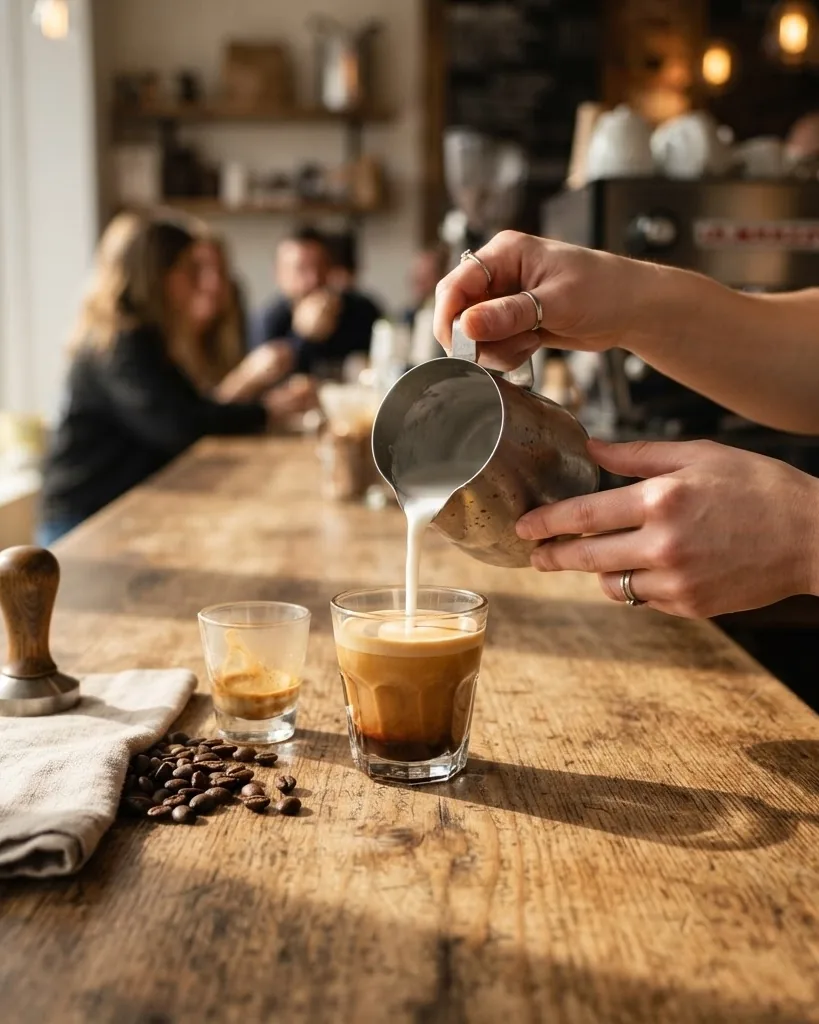
Cortado coffee is a double shot of espresso cut with roughly its own volume of lightly steamed milk, served in a small glass that usually holds 4 to 5 fl oz (120 to 150 ml). That is the convention. It is also the reason your order tastes different in Bilbao, Brooklyn and Melbourne, because no standards body has ever locked the ratio down. If you have ever wondered why the drink in front of you looks like a shrunken latte one week and a milky macchiato the next, the answer is in the sizing, the steaming temperature, and a glass manufactured in Ohio. Our breakdown of how a flat white differs from a latte covers the neighbouring end of that spectrum.
Quick answer: cortado coffee is espresso and steamed milk in roughly a 1:1 ratio, typically 4 to 5 fl oz (120 to 150 ml) total, built on a double shot. The milk is steamed cooler than latte milk, around 130 to 140F (54 to 60C), with minimal microfoam, so it softens the espresso without turning the drink into a milk beverage. Caffeine lands near 126 mg, derived from the 63 mg that USDA FoodData Central assigns to a single 1 fl oz (30 ml) shot. Calories with whole milk usually sit in the 35 to 50 kcal range. Spain gave it the name; the United States gave it a second one.
What Cortado Coffee Is, and What Cortar Actually Means
A cortado is a double espresso combined with an almost equal volume of milk steamed to a low temperature and poured into a small glass, usually 4 to 5 fl oz (120 to 150 ml) in total. The word comes from the Spanish verb cortar, meaning to cut, an etymology traceable to the Real Academia Espanola, the official authority on the Spanish language. The milk cuts the espresso rather than diluting it.
That verb does real work. It tells you the design intent: the milk exists to blunt the sharp edges of the shot, not to become the drink. Roots run through the Iberian Peninsula, with a particularly strong association with Spanish cafe culture including the Basque Country, from where the format travelled to Latin America and eventually into US and global specialty coffee menus.
Compare the arithmetic to a 12 fl oz latte and the difference is obvious. In a latte, milk outnumbers espresso by something like six to one, and the coffee becomes a background flavour. In a cortado the ratio is roughly one to one. Everything the roaster did to those beans is still audible.
Which raises a question most guides skip: audible to whom? A cortado is an unforgiving format. There is no volume of milk to hide behind, so a stale bag, a channelled shot or scalded milk all show up immediately. Baristas know this. It is part of why the drink became a quiet competence signal in specialty shops during the 2010s.
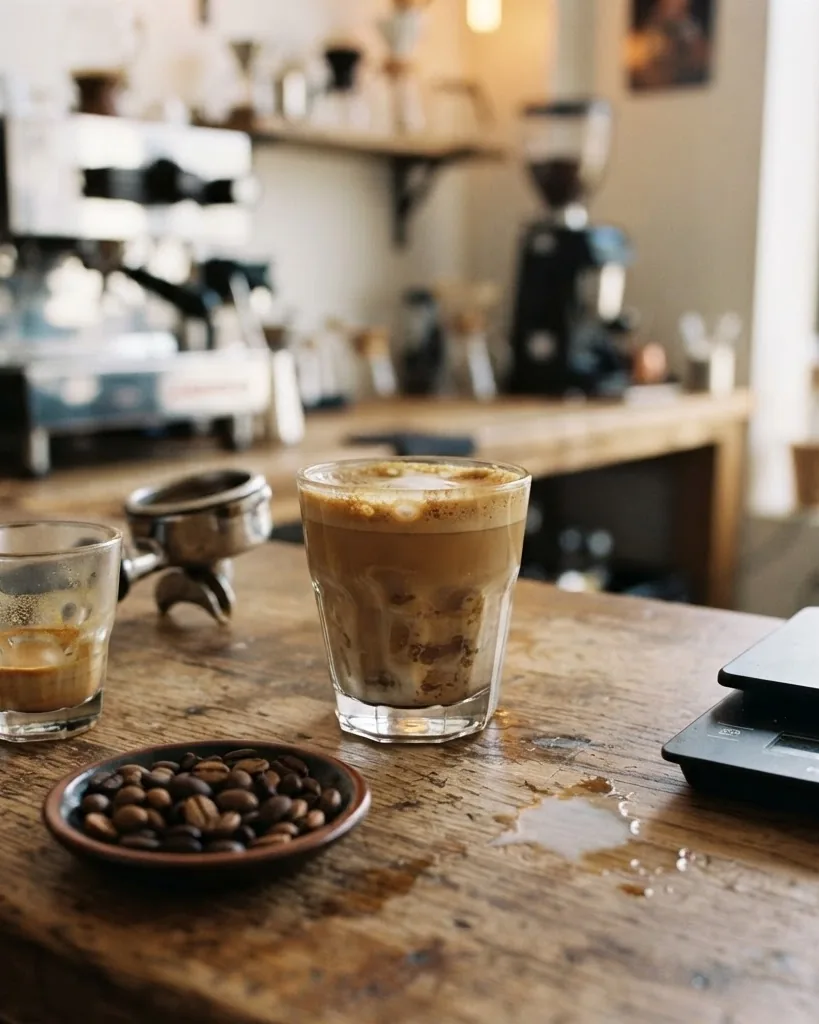
The glass matters too. Serving in clear glass rather than ceramic is not decoration, it is diagnostic: you can see the crema layer sitting on the milk, and you can see whether the pour integrated or separated. A cortado that has split into a brown band and a white band was steamed or poured badly, and the glass tells on it before you taste anything.
The Standardization Gap Nobody Wants to Admit
There is no globally codified standard for the drink. The Specialty Coffee Association, the trade and education body that governs professional coffee education, barista competition frameworks and general espresso and milk-steaming best practice, has not codified an official ratio or volume for this particular beverage the way it has for certain other benchmarks. That absence is the honest explanation for cafe-to-cafe inconsistency.
So when you get a 4 fl oz version in one shop and something closer to 6 fl oz down the street, neither barista is wrong in any enforceable sense. They are both following a convention, and conventions drift.
This drift has a name in the industry: size creep. A cafe buys a slightly larger glass, keeps the same double shot, and the ratio quietly slides from 1:1 toward 1:2. The drink is still on the menu under the same word. It is now a small flat white with a Spanish name.
Compare that with espresso itself, where the Istituto Nazionale Espresso Italiano certifies parameters for what it calls true Italian espresso: roughly 9 bar of pressure, about 25 ml of yield with a tolerance of plus or minus 2.5 ml, around 25 seconds of extraction, and roughly 88C water at the group head. That is what a codified drink looks like. Nothing equivalent exists one layer up, at the milk stage, for this format.
Treat published numbers, including the figures cited above, as strong conventions rather than law. Ask before you complain.
The Gibraltar: How a Libbey Glass Renamed a Drink
In the United States, the same drink frequently appears on menus as a Gibraltar. The name is not a different recipe, it is a glassware convention that hardened into a product name. Blue Bottle Coffee, the San Francisco roaster, is widely credited with popularizing both the name and the vessel in its mid-2000s cafes, borrowing the term from the Gibraltar-style tumbler made by the glassware manufacturer Libbey Inc.
That glass is commonly cited at roughly 4.5 fl oz (133 ml) of capacity, which is why so many US serving conventions cluster in that range: the vessel, not a standards committee, set the size. Order a Gibraltar in Madrid and you will get a blank look. Order a cortado in San Francisco and you will get the same drink, in the same glass, from the same box.
Regional Variants: Cortadito, Condensada, Leche y Leche
The Spanish original has relatives, and they are genuinely different drinks rather than accents on the same one. Cuba contributes the cortadito, in which sugar is whipped into the crema during brewing so the sweetness is emulsified into the coffee itself rather than stirred in afterward. The Canary Islands contribute two more, both built on sweetened condensed milk instead of fresh steamed milk. The United States contributes a name.
Each one changes the sugar mechanism, not just the sugar quantity, and that is what makes them worth distinguishing on a menu.
- Cortadito (Cuba): espresso sweetened during brewing, sugar beaten into the crema, then cut with milk. The sweetness is structural, not additive.
- Cortado condensada (Canary Islands): sweetened condensed milk replaces steamed milk entirely. Heavier body, caramelised dairy notes.
- Leche y leche (Canary Islands): condensed milk on the bottom, steamed milk on top, served layered rather than mixed.
- Gibraltar (United States): classic Spanish formula, American glass, different word on the board.
Two of those four are sweet by construction. If you order a cortado in Tenerife expecting the unsweetened Peninsular version, specify. The Canarian default assumes condensed milk.
Latin American menus inherited the Spanish format through migration rather than through any standards process, which is why the vocabulary varies more than the recipe does. Same drink, different noun, occasionally different sugar.
Cortado vs Latte, Cappuccino, Flat White and Macchiato
The sibling drinks separate cleanly on three axes: total volume, milk-to-espresso ratio, and foam type. Get those three right and the whole espresso-and-milk menu stops being a mystery. A cortado sits at roughly 4 to 5 fl oz (120 to 150 ml) with a ratio near 1:1 and almost no foam. A latte is several times larger with a thin foam cap. A cappuccino is defined by its thick foam layer rather than by volume.
The macchiato sits at the other extreme, where milk is a mark on the espresso rather than a component of it.
- Cortado: roughly 4 to 5 fl oz (120 to 150 ml), about 1:1, minimal microfoam, Spanish origin.
- Latte: substantially larger, milk-dominant, thin foam layer, Italian-American lineage.
- Cappuccino: defined by a thick, distinctly separate foam layer.
- Flat white: milk-forward but foam-restrained, Australasian origin, the closest genuine relative.
- Macchiato: espresso with a small mark of milk, far below a 1:1 ratio.
- Piccolo latte: small milk drink, but built on a ristretto-style shot rather than a full double.
The flat white is where confusion is real rather than pedantic. Both are small, both are foam-restrained, and the practical difference is that the flat white carries more milk and therefore reads sweeter and rounder. The cortado reads sharper. If a cafe has drifted upward in glass size, the two drinks converge until only the name distinguishes them.
Milk Science: Why 130 to 140F Changes the Drink
Milk for this format is steamed to a lower temperature than latte milk, typically cited in professional barista training at roughly 130 to 140F (54 to 60C), and textured to minimal microfoam rather than the thicker foam built for a cappuccino. That combination is the technical core of the drink. Steam it like latte milk and you have made something else, regardless of what the glass says.
Temperature does two things at once here. It governs perceived sweetness, and it governs how the milk sits against the espresso.
Lactose is not intensely sweet, but its perception is temperature-dependent, and overheated milk loses the rounded sweetness that a cortado depends on. In a 12 fl oz latte, that loss disappears into volume. At a 1:1 ratio, with only about 60 ml (2 fl oz) of milk against a double shot, it does not. There is nothing to mask it.
Foam is the second variable. A cappuccino wants a thick, stable foam layer that sits on top and delivers the drink in stages. A cortado wants the opposite: milk that has been stretched only briefly, so the bubbles are small enough to vanish into the liquid and carry body rather than air.
Practical consequence for the home barista: introduce air for a very short window at the start of steaming, then submerge the tip and roll the pitcher until the metal is warm but not hot to the palm. If you are still comfortable holding it, you are in range. If you cannot hold it, you have passed the target and the sweetness is gone.
Latte art is limited on a cortado for structural reasons rather than aesthetic ones. Free-pour patterns need surface area and a foam layer thick enough to hold a contrast edge. A 4.5 fl oz glass with almost no foam offers neither. A cortado with an elaborate rosetta on it usually means the milk was over-textured for the format, which is a defect dressed up as a flourish. The steaming technique that gets you there is covered in our walkthrough on steaming milk without a commercial machine.
Dairy alternatives behave differently at this ratio than they do in a large latte, because milk character is unusually prominent when it makes up half the cup. Barista-formulated oat performs closest to whole dairy on texture and adds its own sweetness, which can push the drink past balance. Soy contributes more body but curdles more readily against acidic espresso. Almond is the hardest case: thin texture, low protein, and a flavour that competes with the shot rather than supporting it.
Caffeine and Calories: What FDA, EFSA and USDA Actually Say
USDA FoodData Central, the official nutrient database maintained by the US Department of Agriculture, puts a standard single 1 fl oz (30 ml) espresso shot at approximately 63 mg of caffeine. Because the drink is normally built on a double, the derived total is 63 mg times 2, which is 126 mg, placing most servings in a commonly cited 120 to 130 mg range. That is a derived approximation rather than a laboratory constant, since dose and extraction vary by cafe.
For context from the same database, an 8 fl oz (237 ml) cup of standard brewed coffee contains approximately 95 mg of caffeine.
So the small glass carries more caffeine than the large mug. That surprises people, and it is worth stating plainly: volume is not a caffeine indicator, dose is.
On safe intake, the U.S. Food and Drug Administration states that for most healthy adults, up to 400 mg of caffeine per day is generally not associated with dangerous negative effects. That is roughly three cortados by the derived figure above, since 126 mg times 3 is 378 mg. The agency’s consumer-facing guidance sits within the FDA’s consumer update on caffeine.
The European Food Safety Authority, which conducts scientific risk assessments for food across the European Union, reached a compatible conclusion from a different direction. Its scientific opinion on caffeine indicates that single doses up to 200 mg, roughly 3 mg per kg of body weight for a 70 kg adult, and total daily intake up to 400 mg, are unlikely to raise safety concerns for the healthy general adult population.
Note what that means for a single serving. At a derived 126 mg, one cortado sits under the 200 mg single-dose threshold. Two in quick succession do not, at 252 mg. Whether that matters depends on you, and the general clinical guidance published by organisations such as the NIH’s MedlinePlus caffeine guide is a reasonable next stop for anyone with a cardiac or pregnancy-related reason to track intake. Peer-reviewed literature indexed on PubMed, maintained by the National Institutes of Health, goes deeper than any beverage guide should.
Calories are undramatic. USDA FoodData Central puts whole milk at around 3.25 percent milkfat and roughly 61 to 62 kcal per 100 ml. Apply that to about 60 ml (2 fl oz) of milk: 0.60 times 61.5 gives approximately 37 kcal, plus negligible calories from the espresso, which is why the commonly cited range for a whole-milk cortado is about 35 to 50 kcal. Skim or non-fat milk drops that to roughly 20 to 25 kcal.
The point estimate of about 37 kcal sits toward the low end of the 35 to 50 kcal range. The upper end reflects larger milk pours and cafe-to-cafe variation rather than different arithmetic. Consumption trend data from bodies like the National Coffee Association and the International Coffee Organization tracks the category rather than the drink, so no serving-level figure from either applies here.
How to Make One at Home, With or Without a Machine
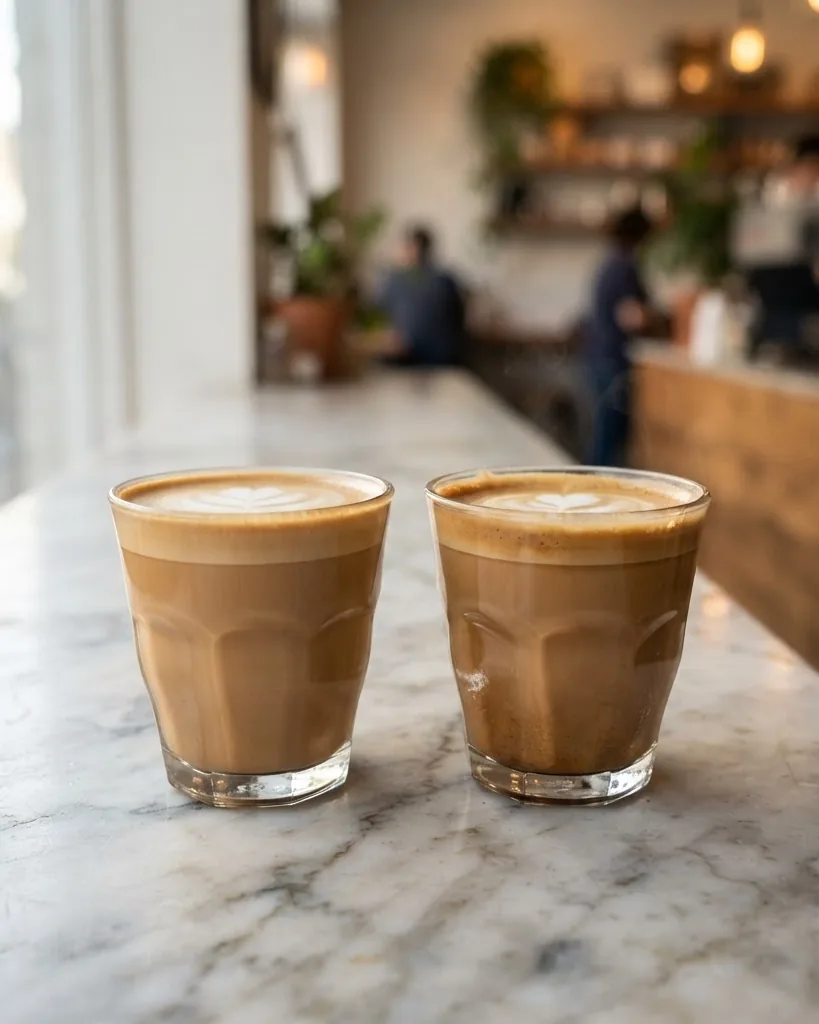
Building this drink at home comes down to two independent skills: a double shot that tastes good on its own, and about 60 ml (2 fl oz) of milk steamed to roughly 130 to 140F (54 to 60C) with minimal foam. Get the shot wrong and no amount of milk technique rescues it. The target glass is small, commonly around 4.5 fl oz (133 ml) in US specialty service, which leaves no room for error in either direction.
Start with the espresso parameters, then treat the milk as a separate problem.
For a double, hold the pressure, temperature and time and scale the dose and yield together.
Grind is the only variable you should be adjusting at first. Finer slows the shot, coarser speeds it up. Change one thing per shot or you will learn nothing.
Then the milk:
- Pour about 60 ml (2 fl oz) into the smallest pitcher you own. Small volumes in large pitchers are impossible to control.
- Introduce air for a very short window at the start, then submerge the steam tip and roll.
- Stop when the pitcher is warm to the palm but still comfortable to hold. That is your 130 to 140F (54 to 60C) window without a thermometer.
- Tap, swirl, and pour immediately. Textured milk separates within seconds.
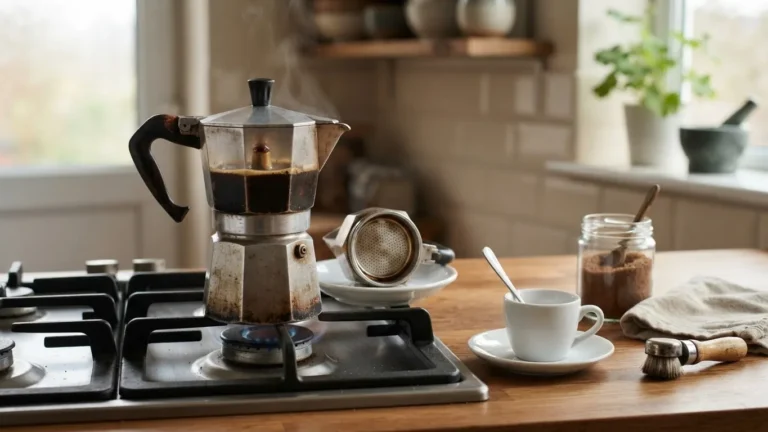
No espresso machine? Three workarounds function, with honest trade-offs. A Moka pot produces a concentrated, low-crema brew that stands up to a 1:1 ratio better than any drip method, and the technique is covered in our step-by-step Moka pot brewing guide. An Aeropress pulled espresso-style, with a fine grind and a short, forceful press, gets close on concentration and never gets there on body. A Nespresso or pod machine produces genuine pressure-brewed coffee and the most consistent result of the three, at the cost of choosing your own beans.
Troubleshooting, in order of how often it happens:
- Too bitter: the shot ran long or the grind is too fine. Coarsen slightly and shorten the yield.
- Too milky: your glass is bigger than 4 to 5 fl oz (120 to 150 ml), or you poured to the rim. Measure the milk before steaming, not after.
- Milk splits into layers: over-textured or over-heated. Less air, lower temperature.
- Sour and thin: the shot ran short. Grind finer.
- No sweetness at all: you passed 140F (60C). This one is not recoverable. Start the milk again.
Competition-grade milk texturing under World Barista Championship conditions, run under World Coffee Events with the Specialty Coffee Association, is a different discipline from home practice. The benchmarks are useful; the expectation of matching them is not.
Beans, Roast and Milk Choice for a 1:1 Ratio
Medium to medium-dark roasts are the common recommendation, and the reasoning is structural rather than traditional. With only about 60 ml (2 fl oz) of milk against a double shot, there is not enough dairy sugar to round off a very bright, high-acid light roast. Medium roasts bring caramel and chocolate tones that meet the milk halfway. That is the safe choice, and it is safe for a reason.
The interesting choice runs the other way.
Because the milk volume is so small, a light single-origin espresso can actually show its origin character in this format, where a latte would erase it. Washed coffees stay clean and structured, which suits the 1:1 balance. Naturals bring fruit intensity that can either transform the drink or fight the dairy, depending on the lot.
On milk itself, whole dairy at around 3.25 percent milkfat remains the default because fat carries body and the format has no volume to spare. Low-fat versions taste noticeably thinner here, in a way that would pass unnoticed in a larger drink.
Ordering One Without Getting the Wrong Drink
Ordering varies more than the recipe does. In Spain and much of Latin America, the word alone works and the default is unsweetened espresso cut with a small volume of steamed milk. In the United States, expect Gibraltar on some menus, particularly in specialty shops descended from the Blue Bottle Coffee lineage, and expect the roughly 4.5 fl oz (133 ml) Libbey glass. In the United Kingdom and Australia, the drink often sits next to a flat white and gets confused with it.
One question defends against size creep everywhere: ask what volume the glass holds. If the answer is well above 4 to 5 fl oz (120 to 150 ml), you are ordering a small latte.
Frequently Asked Questions
Is a cortado strong?
Stronger in concentration than a brewed coffee, and similar or higher in total caffeine. USDA FoodData Central puts a single 1 fl oz (30 ml) shot at approximately 63 mg, so a double-shot build derives to roughly 126 mg, against approximately 95 mg for an 8 fl oz (237 ml) cup of brewed coffee. The small glass hides a real dose.
How does the caffeine compare to a cup of coffee?
The derived figure of 126 mg, from 63 mg per shot times two, exceeds the approximately 95 mg that USDA FoodData Central assigns to an 8 fl oz (237 ml) brewed coffee. Both sit well under the 400 mg daily ceiling the U.S. Food and Drug Administration describes as generally not associated with dangerous effects in healthy adults.
Is it sweeter than a latte?
Usually not. A latte carries far more milk, and milk sugar is the source of perceived sweetness in both drinks. What a cortado offers instead is a rounder espresso, since the milk steamed to roughly 130 to 140F (54 to 60C) blunts acidity while keeping the coffee audible. Canarian condensed-milk versions are a separate case entirely.
Can you order it decaf or iced?
Decaf works without any structural change, since the ratio and the milk temperature are unaffected by the bean. Iced is harder: the format depends on milk steamed to roughly 130 to 140F (54 to 60C) for texture and sweetness, and chilling removes both. Many cafes will make one anyway. It is a different drink.
What is the difference between a cortado and a Gibraltar?
The name and the glass, not the recipe. Gibraltar entered US specialty vocabulary through Blue Bottle Coffee’s mid-2000s San Francisco cafes, borrowed from the Libbey Inc. tumbler of that name, commonly cited at approximately 4.5 fl oz (133 ml). It is a glassware convention rather than a separately standardized beverage.
Why does the size change from cafe to cafe?
Because nobody codified it. The Specialty Coffee Association has not locked an official ratio or volume for this drink. Cafes follow convention, conventions drift, and glassware quietly sets the ceiling.
The Short Version
Espresso and milk in roughly equal parts, in a glass of about 4 to 5 fl oz (120 to 150 ml), with the milk steamed to 130 to 140F (54 to 60C) and barely textured. Around 126 mg of caffeine derived from USDA figures, and 35 to 50 kcal with whole milk. No governing body enforces any of it, which is why the drink you order in one city is not the drink you order in another. If you want it consistent, make it yourself, and start with the milk steaming technique for small-volume drinks.