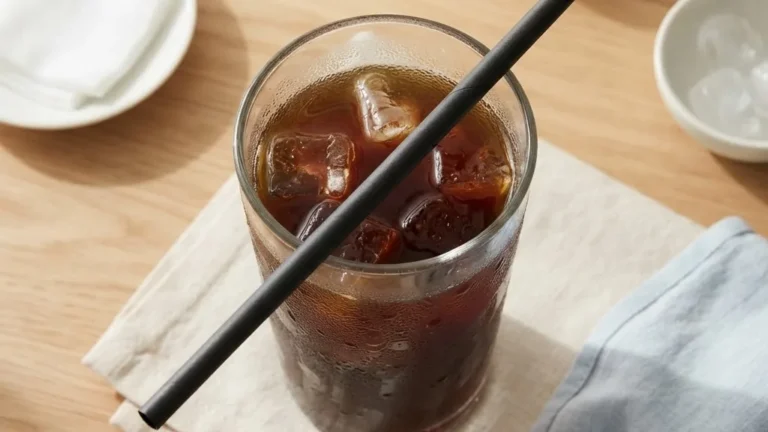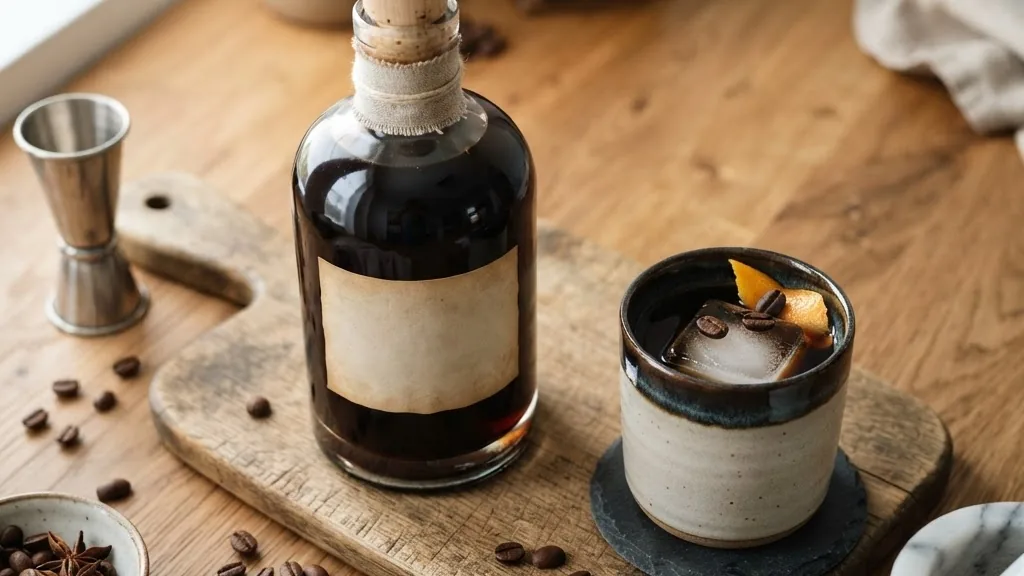
Coffee liqueur has no legal category of its own. Not in Brussels, not in Washington. It sits inside the generic liqueur class in both regimes, which means the words on the front of the bottle are doing marketing work while the actual rules that constrain the recipe are hiding in two documents almost nobody reads. That gap explains most of the confusion buyers run into: why a friend’s bottle is 20% ABV and yours is 16%, why one brand carries five times the caffeine of another, why “cold brew” on a label guarantees nothing.
The bottles themselves are wildly unlike each other. A legacy Mexican brand built on rum and caramel colour and an Australian cold-brew bottling built on wheat vodka are sold on the same shelf, at the same nominal purpose, with specs that differ by a factor of five. The same trap shows up in coffee retail, which is why the label rules that govern decaf coffee are worth reading alongside this.
Quick answer: Coffee liqueur is a sweetened, coffee-flavoured spirit regulated only as a generic liqueur. In the European Union it must carry at least 100 g/L of sweetening products expressed as invert sugar and at least 15% ABV. In the United States it needs sugar at not less than 2.5% by weight and faces no ABV floor whatsoever. Strength therefore varies by market on the same brand: Kahlua is 20% ABV in the United States and 16% ABV in United Kingdom and Canada bottlings. Caffeine varies even harder, from roughly 5 mg to roughly 25 mg per 44 ml serve.
What a coffee liqueur legally has to contain
Two rulebooks govern the category, and they disagree materially. Regulation (EU) 2019/787, which repealed Regulation 110/2008 and whose consolidated version dates from 13/05/2024, sets out spirit drink categories in Annex I. Category 33 covers liqueurs and imposes two floors: a minimum of 100 g/L of sweetening products expressed as invert sugar, and a minimum of 15% ABV. The United States takes a different route. 27 CFR 5.150, administered by the Alcohol and Tobacco Tax and Trade Bureau, requires cordials and liqueurs to carry sugar (sucrose, fructose, dextrose or levulose) at not less than 2.5% by weight of the finished product, and sets no minimum strength at all for the class. The European floor is the stricter of the two by a wide margin, and no popular guide to the category says so.
Inside the European Annex, the neighbouring categories show how deliberate that 100 g/L number is:
- Cherry liqueur: 70 g/L minimum, an explicit exception.
- Gentian liqueur: 80 g/L minimum, the other exception.
- Creme de X: 250 g/L minimum, 15% ABV minimum.
- Creme de cassis: above 400 g/L.
- Maraschino: 250 g/L minimum, 24% ABV minimum.
Nothing in that list is coffee-specific. A bottled product made from coffee simply has to clear the generic bar, which is why the category tolerates such enormous internal variation.
The American text adds two rules with real consequences. A liqueur may be labelled “dry” if its sugar content sits under 10% by weight of the finished product. Read that again: a product can legally call itself dry while carrying nearly four times the sugar the class minimum demands. The same section also forbids labelling a cordial or liqueur as “straight”, “distilled” or “compound”.
One citation detail separates careful writing from copy-paste. The old reference for this standard of identity was 27 CFR 5.22(h). It was superseded by T.D. TTB-176 in February 2022. Sites still quoting the dead section are quoting a rule that no longer exists.
Two more claims circulate widely and should be treated as wrong. The first: that United States law imposes a 15% ABV minimum on liqueurs. It does not; 5.150 sets no ABV floor for the class, and the 15% figure has been imported from the European text by people who did not check. The second: that coffee liqueur was first produced in the 16th century by French monks. No primary source supports it. Treat it as folklore and label it as such.
Why the same bottle is 16 percent in London and 20 percent in Chicago
Kahlua is the clearest worked example of market-by-market divergence. It has been produced in Veracruz, Mexico since 1936, under Pedro Domecq. Its strength was cut from 26.5% ABV to 20% ABV, and the sources disagree on when: the Oxford Companion to Spirits and Cocktails, edited by David Wondrich and Noah Rothbaum, gives 2003, while Wikipedia says 2004. That discrepancy has never been resolved in public, and picking one silently is worse than flagging it. Today the brand is 20% ABV in United States bottlings and 16% ABV in United Kingdom and Canada bottlings, with Pernod Ricard’s own product page listing Kahlua Original at 16% ABV.
The ownership chain matters because it explains the fragmentation. First United States export was 1940, brought in by importer Jules Berman. Pernod Ricard acquired Allied Domecq in 2005 for roughly $14bn, jointly with Fortune Brands, and the brand has been inside a multinational portfolio ever since. Multinationals bottle to local excise bands and local expectations. That is the whole mystery.
The European ingredient declaration is unusually candid, and it is the best single piece of evidence about how a legacy bottle is actually built. Pernod Ricard lists: sugar, water, coffee extract (rum or sugarcane distillate, sugar, arabica coffee, colour E150d, vanillin), rum. Sugar is first. The coffee arrives as an extract, not as brewed coffee. E150d is caramel colour. Vanillin is added flavour.
The line extension tells you where the money is now: the Kahlua Espresso Martini ready-to-drink can is 4.5% ABV, roughly a quarter the strength of the parent bottle.
How the coffee actually gets into the bottle
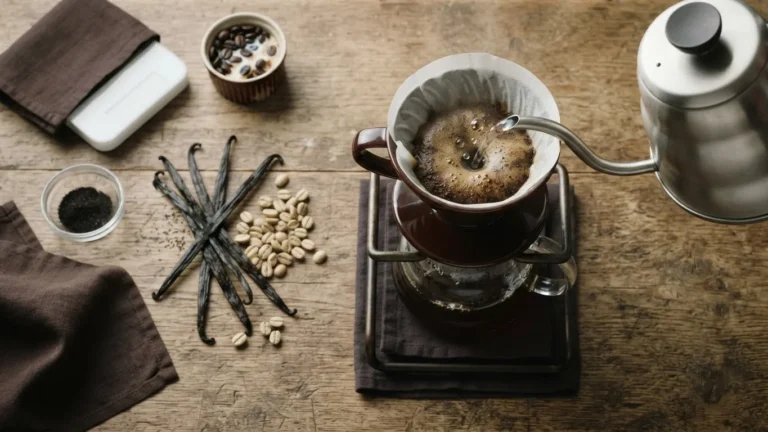
Three variables define a bottling: the base spirit, the extraction route, and the bean. Base spirit families run from neutral grain and vodka through rum and sugarcane distillate, tequila and agave, whiskey, and brandy. Extraction routes split into hot infusion, cold brew or cold infusion, espresso concentrate, and bought-in coffee extract or essence, with a further split between maceration and post-distillation addition. The bean choice sits underneath both: Arabica or Robusta, roast level, and origin. Veracruz and Yirgacheffe recur across the category for reasons that are half terroir and half supply chain. None of these three variables is disclosed on a standard label, and none of them is regulated. A producer can print “cold brew” without meeting any definition of cold brew, because no definition exists in either rulebook.
Compare three modern bottlings and the divergence becomes concrete.
- Mr Black: launched 2013 in Erina, New South Wales, Australia. Cold brew, 100% specialty Arabica, Australian wheat vodka base. ABV is reported as 23% in Australian and European coverage and 25% in United States coverage; both figures appear in reputable sources, so both belong in print. The brand claims roughly half the sugar and up to ten times the coffee of legacy liqueurs.
- St. George NOLA: from St. George Spirits, built on Yirgacheffe beans, cold infusion, French-roast chicory and Madagascar vanilla. The chicory is the New Orleans reference and it is a flavour decision, not a cost decision.
- KOVAL Coffee Liqueur: 20% ABV (40 proof), USDA Organic and OU Kosher certified, built on Intelligentsia single-origin coffee.
Roast level is the variable buyers underrate. A darker roast pushes bitterness and caramelised body forward and survives sugar better; a lighter roast keeps acidity and origin character that a 100 g/L sugar load will partially bury. The same trade-off drives bean selection on the retail side, and the numbers behind a light roast bag map directly onto what a producer is choosing between.
Sugar is not only sweetness. It is viscosity. It is what makes a shaken drink hold a foam. A bottling that halves the sugar to chase a cleaner coffee flavour also gives up mouthfeel, which is why swapping brands one-for-one in a cocktail rarely lands.
The four specs that separate the bottles
Almost every published recommendation for this category sells adjectives: rich, smooth, bold. Almost none publishes numbers. The four specs that actually decide whether a bottle works for a given use are base spirit, extraction method, ABV by market, and caffeine per serve. Sugar in g/L would be a fifth if brands disclosed it, and most do not. Where a spec is unavailable, “not disclosed” is the honest entry, and the absence is itself a finding about how the category communicates.
| Bottle | Base and method | ABV | Caffeine per 44 ml |
|---|---|---|---|
| Kahlua | Rum, coffee extract | 20% US / 16% UK and Canada | About 5 mg |
| Mr Black | Wheat vodka, cold brew | 23% AU and EU / 25% US reported | About 25 mg |
| Tia Maria | Not disclosed | 20% | Not disclosed |
| KOVAL | Single-origin coffee | 20% (40 proof) | Not disclosed |
Beyond those four, the strength spread across the category is far wider than the shelf suggests:
- Caffe Borghetti: 25% ABV. Ancona, Italy, founded 1860; owned by Fratelli Branca, inherited through the Carpano acquisition in 2001.
- Tia Maria: 20% ABV. Jamaican in origin, 1940s; now produced in Italy by ILLVA Saronno, and rebranded Tia Maria Cold Brew in 2020.
- Luxardo Espresso: 27% ABV.
- Mr Black Coffee Amaro: 28.5% ABV, launched 2021.
- Patron XO Cafe: 35% ABV, discontinued 2021 with a limited re-issue since.
From 16% to 35% is more than a doubling. Any recipe written without naming the bottle is guessing.
Caffeine, standard drinks, and what those numbers mean
Caffeine per serve varies roughly fivefold across the category, and that is the fact most buying guides skip. Per 1.5 fl oz (44 ml), Kahlua carries approximately 5 mg of caffeine while Mr Black carries approximately 25 mg. For scale: 8 fl oz of brewed coffee runs approximately 80 to 200 mg, and a single espresso approximately 60 to 75 mg. So even the most caffeinated mainstream bottling delivers, per pour, well under half a single espresso. The European Food Safety Authority’s 2015 caffeine opinion sets 400 mg per day for adults and 200 mg as a single dose as the reference thresholds. Nothing in a normal cocktail pour approaches either from the liqueur alone. The espresso in an espresso martini is doing the heavy lifting, not the bottle.
Alcohol arithmetic is the part that matters more. At 20% ABV, a 25 ml pour is approximately 0.6 United Kingdom units, or approximately 0.4 United States standard drinks. The National Institute on Alcohol Abuse and Alcoholism, part of the National Institutes of Health, publishes the American definition; the National Health Service publishes the British units framework. They are not interchangeable, and a drinker moving between the two systems is doing conversion maths without knowing it. The NIAAA’s public guidance on standard drinks is the primary reference rather than a bar blog.
Sugar rides along. The European floor alone means at least 2.5 g of sugar in a 25 ml pour, before any brand decides to exceed it, and most do.
The interaction is the real story. Caffeine masks perceived intoxication without reducing impairment. A drinker who feels alert is not less impaired; they are less accurate about how impaired they are, which is exactly the failure mode that matters before driving. The Centers for Disease Control and Prevention treats this as a public health question rather than a bar-craft question, and its alcohol and public health material is the appropriate starting point. Pregnancy, medication interactions and driving all sit outside what a spec sheet can answer.
Cream-based bottlings are a separate problem entirely. A dairy emulsion is a stability question, not a flavour question, and refrigeration guidance for those products does not transfer to a clear coffee bottling.
For anyone comparing caffeine loads across their whole day rather than one drink, the milk-and-espresso side of the ledger matters too: the ratio and caffeine numbers for a cortado put the 5 mg and 25 mg figures in context.
Labels, permits, and who checks what
Four agencies touch a bottle before it reaches a shelf, and each governs a different slice. The Alcohol and Tobacco Tax and Trade Bureau, sitting inside the United States Treasury, owns standards of identity under 27 CFR Part 5, Subpart I, and the health warning regime under 27 CFR Part 16. That warning is not optional and the trigger is low: any beverage at or above 0.5% ABV must carry the statement mandated by the Alcoholic Beverage Labeling Act of 1988. A 4.5% ABV ready-to-drink can clears that threshold nine times over. The Food and Drug Administration governs the food side, including ingredient identity and additives such as caramel colour E150d and vanillin. The Federal Trade Commission polices the advertising claims that the standards of identity do not reach. In Europe, Regulation (EU) 2019/787 handles legal names, labelling, compound terms and geographical indications, with European Commission and spiritsEUROPE implementation guidelines in force since 25 May 2021.
What that means for an operator is layered work rather than one filing. Formula and label approval sit with the TTB. Ingredient compliance sits with the FDA, whose food programme guidance covers the additive side. Claims made in a campaign sit with the FTC, whose advertising enforcement remit is where an unsupported “cold brew” or health-adjacent claim actually gets tested.
The practical asymmetry: a producer can print “cold brew”, “espresso” or “single origin” with no regulatory definition behind any of the three, but cannot print “dry” if sugar exceeds 10% by weight, and cannot print “straight”. The regulated words are the ones nobody markets with.
Primary texts, not summaries, are where this gets settled. EUR-Lex hosts the consolidated 2019/787; the eCFR hosts 5.150. Both are free.
The Espresso Martini did this to the category
One drink rebuilt the economics. The Espresso Martini was created by Dick Bradsell at the Soho Brasserie on Old Compton Street, London, and the date is genuinely contested. It is commonly given as 1983, but Bradsell’s daughter Beatrice argues for 1985 based on the Absolute Beginners shoot, a film released in 1986. The original build was on the rocks and called a Vodka Espresso. The three-bean garnish stands for health, wealth and happiness. The International Bartenders Association has since recognised the drink as an official cocktail, per secondary sourcing.
The demand numbers everyone recycles deserve a caution. Espresso martinis are reported to have risen from 2% to 15% of cocktails ordered worldwide between 2022 and 2024, a figure attributed to Diageo Bar Academy. Ready-to-drink espresso martini sales are reported up 252% in dollar terms for the 52 weeks to December 2023, attributed to Nielsen. Both are secondhand, both are quoted constantly without anyone locating the primary, and both should be read as directional rather than precise.
Volume data from IWSR gives a firmer floor. Kahlua moved approximately 1.6 million 9-litre cases in 2020 and approximately 1.8 million cases in 2021, reported as the sixth bestselling liqueur worldwide that year.
Making it at home, and what you give up
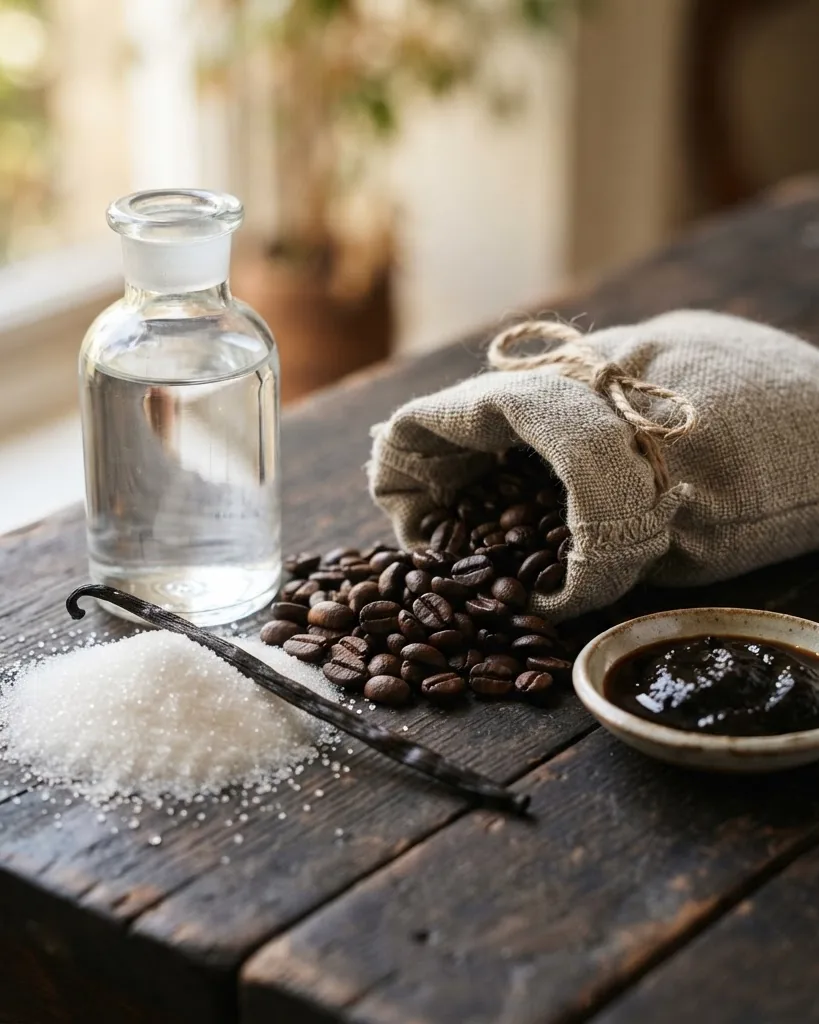
The homemade route is simple: cold brew, a base spirit, a syrup, and infusion time. It produces something clean and coffee-forward, and it lets you dodge caramel colour and vanillin entirely. What it will not produce is a commercial body. That syrupy weight comes from a sugar load most home makers will not tolerate on the palate, and viscosity is what holds foam in a shaken drink. A homemade bottling shaken into an espresso martini will look thinner. That is physics, not technique.
How to choose in five minutes
Work in this order. First, decide the drink: a White Russian, a Black Russian, a Carajillo and a shaken espresso martini reward different sugar loads. Second, read the ABV on your local bottling rather than the one you saw online, because 16% and 20% are the same brand. Third, if you want coffee flavour to lead, buy a cold-brew bottling and accept the thinner body; if you want texture, buy the sweeter legacy bottle and use less. Fourth, check the ingredient declaration for E150d and vanillin, because the presence of both tells you the coffee arrived as extract. You will know it worked when the drink stops needing adjustment.
Frequently asked questions
Does coffee liqueur have caffeine?
Yes, but far less than most people assume, and the spread between brands is roughly fivefold. Per 1.5 fl oz (44 ml) serve, Kahlua carries approximately 5 mg and Mr Black approximately 25 mg. A single espresso runs approximately 60 to 75 mg, and 8 fl oz of brewed coffee approximately 80 to 200 mg. The bottle is not the caffeine source in an espresso martini.
Why is Kahlua 16 percent in the UK and 20 percent in the US?
Because no rule forces consistency. Pernod Ricard bottles to local markets, and Kahlua Original is listed at 16% ABV on the brand’s own European page while United States bottlings run 20% ABV. The strength was cut from an original 26.5% ABV, though sources disagree on the year: the Oxford Companion to Spirits and Cocktails says 2003, Wikipedia says 2004.
Does “cold brew” on the label mean anything legally?
No. Neither Regulation (EU) 2019/787 nor 27 CFR 5.150 defines cold brew, espresso or single origin as regulated terms for this class. A producer can print all three without meeting any standard. The words that are regulated are the unglamorous ones: “dry” requires sugar under 10% by weight, and “straight”, “distilled” and “compound” are prohibited outright.
How long does an opened bottle last?
Longer than retailers claim. The widespread advice to finish an opened bottle within a few months is unsupported filler. Coffee volatiles oxidise over time, which dulls aroma, and dulling is not spoilage. Cream-based liqueurs are a different question entirely, because a dairy emulsion is a genuine stability problem with real refrigeration requirements.
Can a liqueur labelled “dry” still be sweet?
Yes, and by a wide margin. Under 27 CFR 5.150 a cordial or liqueur may be labelled “dry” when sugar sits below 10% by weight of the finished product, while the class minimum is only 2.5% by weight. A product can therefore carry roughly four times the required sugar and still legally advertise itself as dry.
Will an espresso martini keep me awake?
The espresso will do more than the liqueur. The European Food Safety Authority’s 2015 opinion cites 400 mg per day for adults and 200 mg as a single dose; a 44 ml pour of even a high-caffeine bottling contributes about 25 mg. The bigger issue is that caffeine masks perceived intoxication without reducing impairment, which matters if you are comparing the drink to the real cost and caffeine load of a leet coffee as a nightcap.
Alcohol content: for adults of legal drinking age only. Nothing here is medical advice.