Decaf coffee is not caffeine-free, and the distance between what the label implies and what lands in the cup is where most bad advice begins. Health publishers cover the benefits and skip the chemistry. Industry explainers cover the chemistry and skip the reader with an arrhythmia or a 200 mg daily ceiling. Both halves matter when you are picking a bag, a brand, or a limit. What follows pulls the regulatory text, the lab data, and the brewing physics together, numbers attached.
Quick answer: decaf coffee is coffee stripped of roughly 97 percent of its original caffeine under United States practice, or down to no more than 0.1 percent caffeine by dry weight under European Union rules, close to 99.9 percent removal. A standard 8 fl oz (240 mL) cup carries about 2-5 mg of caffeine, against 70-140 mg for regular. Four methods do the work: direct solvent, indirect solvent, Swiss Water Process, and supercritical CO2 extraction. Residue limits, flavor, and price all move with the method you choose.
What decaf coffee legally means in the United States and the EU
Decaf coffee has no single global definition, and the two big regimes measure different things. In United States industry and regulatory practice, coffee labeled decaffeinated must have had roughly 97 percent of its original caffeine removed, a figure expressed against what the green bean started with. The European Union sets a different bar. Decaffeinated roasted coffee sold there must contain no more than about 0.1 percent caffeine by dry weight, which is close to 99.9 percent removal. One rule counts what was taken out, the other counts what stays behind, which is why a bag that satisfies American practice does not automatically satisfy the European one. Our breakdown of caffeine content across brew methods shows how much wobble one roast can carry. Neither standard promises zero. Neither is the same as chicory, roasted grain, or an herbal blend, none of which ever held caffeine.
That last distinction is the one people get wrong at the shelf. A reader who needs genuinely zero caffeine, not merely less of it, is shopping in a different category.
- Decaf: real coffee, caffeine reduced to a regulated ceiling, never nil.
- Chicory, barley, and grain brews: no coffee bean, no caffeine at any point.
- Herbal infusions: same, though flavor overlap with coffee is minimal.
- Half-caf: a blend, so the caffeine sits between regular and decaf, not near either.
The four decaffeination methods, compared
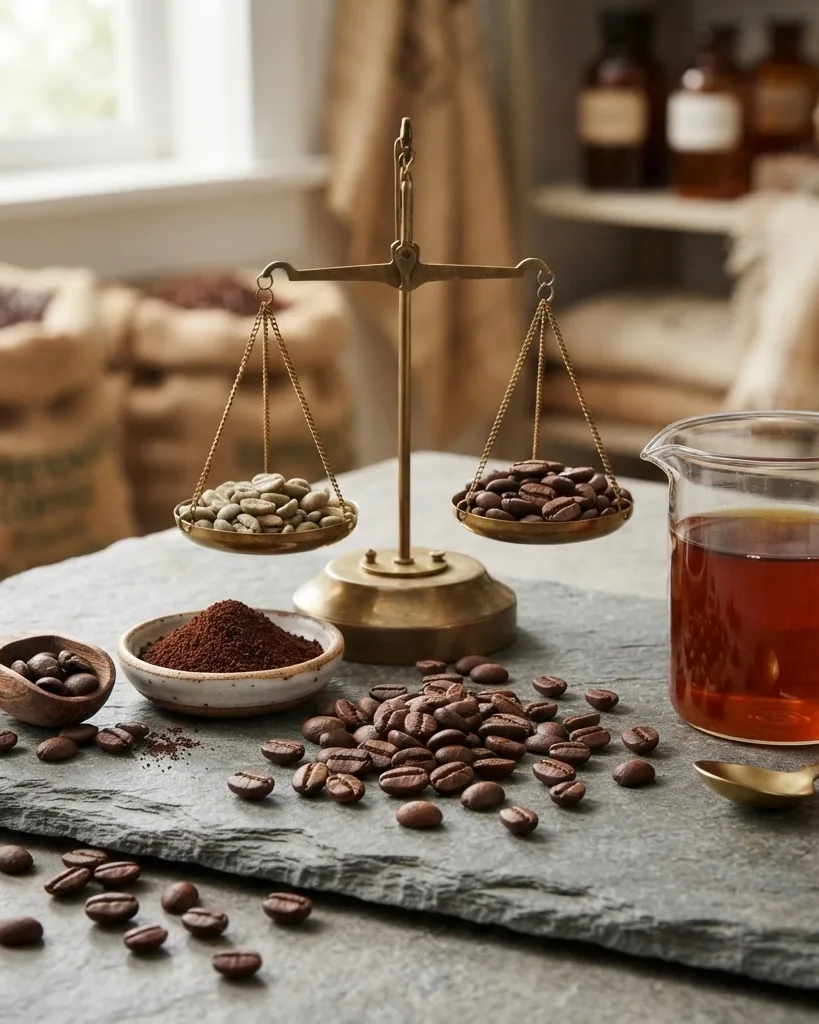
Four industrial routes strip caffeine from green beans, and every bag on the shelf went through one of them. Direct solvent soaks steamed beans in methylene chloride or ethyl acetate, then rinses and re-steams them. Indirect solvent pulls caffeine into hot water first, treats that water with the solvent, and returns the flavor-loaded water to the beans. The Swiss Water Process, owned and independently audited by Swiss Water Decaffeinated Coffee Inc., uses no solvent at all: a green coffee extract saturated with everything except caffeine acts as the selective bath, and carbon filters catch what comes out. Supercritical CO2 extraction pressurizes carbon dioxide until it behaves as both liquid and gas, then lets it bind caffeine while leaving larger flavor molecules alone. All four arrive at the same threshold on paper. They do not arrive at the same place in the cup, on the label, or on the invoice.
Solvent routes: methylene chloride and ethyl acetate
Methylene chloride is efficient and cheap, and it is also the reason the category carries a reputation problem. Ethyl acetate is the other workhorse. It shows up on bags as “naturally decaffeinated” or as the sugar cane process, and that wording deserves scrutiny.
Ethyl acetate can be derived from fermentation, including from sugar cane. It is also frequently synthesized industrially, and marketing rarely distinguishes the two. A bag reading “natural” tells you which molecule was used, not where the molecule came from. Treat the claim as chemistry, not provenance.
One detail almost nobody mentions: the caffeine pulled out of the beans does not get thrown away. It is commonly resold to soft-drink and pharmaceutical manufacturers, which is part of why decaffeination is economically viable at all.
Solvent-free routes: Swiss Water and CO2
Swiss Water and supercritical CO2 both sidestep the solvent question entirely, which is why they dominate specialty shelves and why they cost more. The Swiss Water Process is compatible with organic certification and carries independent third-party auditing, so the claim on the bag has something behind it. CO2 extraction recycles its carbon dioxide and scales well for large lots.
| Method | Agent | Regulatory hook | Where it shows up |
|---|---|---|---|
| Direct solvent | Methylene chloride or ethyl acetate | FDA 10 ppm residue cap, 21 CFR 173.255 | Commodity and supermarket decaf |
| Indirect solvent | Same solvents, applied to water | Same residue cap | Large-volume blends |
| Swiss Water Process | Green coffee extract, carbon filters | Organic-compatible, audited | Specialty roasters |
| Supercritical CO2 | Pressurized carbon dioxide | No solvent residue question | Large specialty lots, pods |
Flavor tracks this list loosely. The Specialty Coffee Association (SCA), which sets cupping and quality standards for the trade, has published on how decaffeination alters flavor compounds, and the practical upshot is that a modern Swiss Water or CO2 decaf from a good green lot is a different drink from the solvent-processed decaf that soured a generation on the category.
How much caffeine is really in your cup
Numbers first. A standard 8 fl oz (240 mL) cup of brewed regular coffee runs about 70-140 mg of caffeine depending on species, roast, and brew strength. The same cup of brewed decaf averages roughly 2-5 mg. That average hides the interesting part. In 2006, McCusker, Goldberger, and Cone published lab measurements in the Journal of Analytical Toxicology on decaf bought from major United States chains and found 8.6-13.9 mg of caffeine per 16 oz serving, with one decaf espresso shot at 15.8 mg. Halve the 8.6-13.9 mg range for an 8 fl oz equivalent and you land at roughly 4.3-7 mg, above the top of the commonly quoted 2-5 mg band. Both sets of figures are honest. One describes a laboratory average, the other describes what a barista actually handed to a paying customer.
The gap is not a scandal. It is variability, and it comes from bean species, roast level, dose, grind, contact time, and which method the roaster paid for. A brand does not owe you consistency below the legal ceiling.
For most healthy adults the gap is irrelevant. The U.S. Food and Drug Administration (FDA) guidance puts 400 mg of caffeine per day, roughly 4-5 cups of regular brewed coffee, outside the range associated with dangerous effects. The European Food Safety Authority (EFSA) reaches a compatible conclusion: single doses up to 200 mg and habitual intake up to 400 mg per day raise no safety concern for the healthy general adult population. Against those ceilings, a 5 mg cup is noise.
Doing the math for your own limit
The math changes when your ceiling drops. EFSA advises pregnant and breastfeeding women to stay at or below 200 mg per day, matching the guideline from the American College of Obstetricians and Gynecologists (ACOG). At 200 mg, decaf is still comfortably inside the budget, but it stops being free.
- Take the upper empirical figure, 13.9 mg per 16 oz, rather than the 2-5 mg average, if precision matters to you.
- Count everything else: tea, cola, chocolate, and pre-workout stack into the same 200 mg or 400 mg envelope.
- Espresso-based decaf is the wobbliest category. That 15.8 mg shot was a single serving.
- If you need a hard zero, chicory or grain brews are the only honest answer.
Readers on a monoamine oxidase inhibitor (MAOI) should raise dosing with their prescriber rather than a coffee site, since caffeine interactions there are a drug question. The same goes for arrhythmia patients, where the Mayo Clinic and Cleveland Clinic patient-facing guidance is a better starting point than a bag label. Peer-reviewed measurements underpinning any of this are indexed on the PubMed research database if you want the primary papers.
Who regulates decaffeination, and what compliance costs the roaster
Compliance for a decaf roaster runs through several bodies at once. The FDA sets the residue ceiling: under 21 CFR 173.255, residual methylene chloride in decaffeinated roasted coffee is limited to 10 parts per million (ppm). Coffee industry sources commonly cite a stricter European figure near 2 ppm under EU extraction-solvent rules, a number worth re-checking against the current directive text because these limits get revised. EFSA governs which extraction solvents may be used in Europe and publishes the intake opinions national regulators lean on. The International Agency for Research on Cancer (IARC), part of the World Health Organization (WHO), classifies substances rather than products. The National Coffee Association (NCA) documents the process side for the trade. Certification sits elsewhere again: the United States Department of Agriculture (USDA) organic standard decides which methods may carry the seal.
What that costs an operator is mostly structural rather than per-bag. A roaster who wants the organic seal cannot buy solvent-processed green and paper over it, so the method decision is made years upstream at the green contract. A roaster selling into both the United States and Europe must satisfy the tighter of the two residue bars, which in practice pushes toward Swiss Water or CO2 lots and their higher green cost. Residue testing, audit trails, and lot traceability are the recurring line items, and they are why solvent-free decaf carries a premium that has nothing to do with taste.
Methylene chloride itself is classified by IARC as Group 2A, probably carcinogenic to humans, on animal and limited human evidence. That classification is about the solvent, not about the cup, and the regulated residual limits sit far below the level driving the concern. The solvent limits live in the FDA food additive status list if you want the rule text rather than a summary of it.
Health effects, organized by body system
Decaf inherits most of coffee’s non-caffeine chemistry, which is where a surprising share of the health story lives. Chlorogenic acids survive decaffeination. So do the diterpenes cafestol and kahweol, and that matters: they are not removed by any of the four methods, and they can raise LDL cholesterol with heavy consumption of unfiltered brews. Switching to decaf does nothing about that. A paper filter does. On metabolism, large cohort work from the Nurses’ Health Study and the Health Professionals Follow-Up Study, synthesized by the Harvard T.H. Chan School of Public Health, links decaf consumption to a modestly lower risk of type 2 diabetes independent of caffeine. The effect size is described as modest and no percentage should be invented for it. On cancer, IARC reviewed more than 1,000 studies in 2016 and placed coffee drinking in Group 3, not classifiable as to its carcinogenicity to humans, moving away from an earlier Group 2B position tied to bladder cancer concerns the evidence did not support.
The stomach story is messier than the usual advice suggests. N-methylpyridinium (NMP) is formed during roasting, not by caffeine, and research points to it reducing gastric acid stimulation. That complicates the flat claim that decaf is automatically gentler on gastroesophageal reflux disease (GERD), since roast level may matter as much as caffeine content. Sleep and mood follow the same logic: decaf’s residual few milligrams do little for most people, though a minority report late-evening sensitivity. General dietary framing from the American Heart Association (AHA) and pediatric limits from the American Academy of Pediatrics (AAP) both treat coffee as a caffeine-delivery question, which is exactly the part decaf removes.
Buying and brewing beans that behave differently
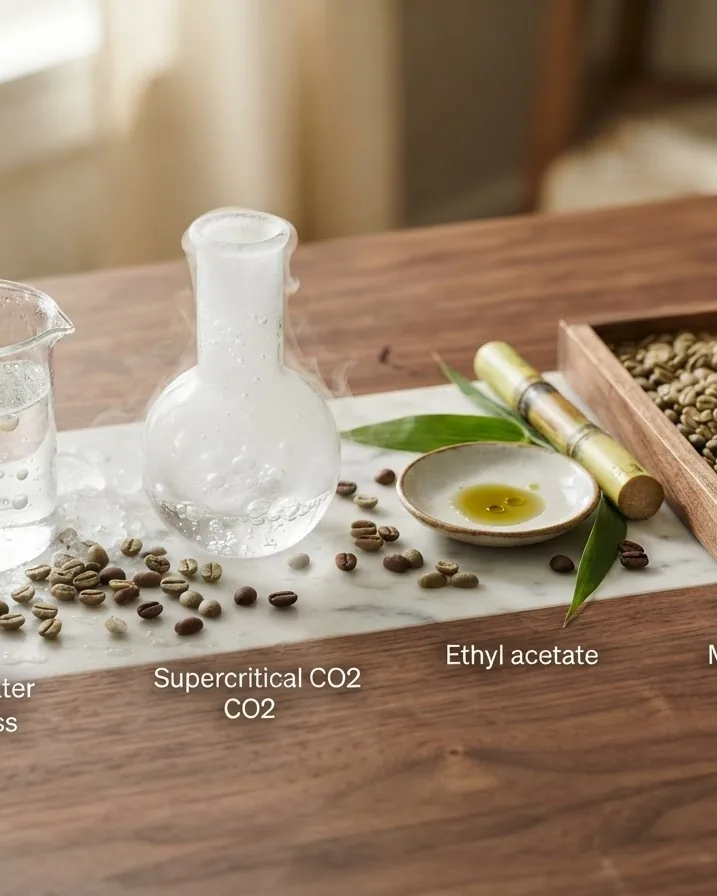
Decaffeination is a physical assault on the bean before it ever meets a roaster. The green coffee is swollen with water or extract, stripped, and dried again, and it comes out more porous than it went in. Three consequences follow. Decaf roasts faster and darker at the same profile, so roast color is a poor guide to development. Decaf extracts faster in the brewer, because water reaches the interior of an open structure sooner. Decaf also stales faster once ground, since more surface is exposed to oxygen. Most complaints about decaf tasting thin, hollow, or ashy trace back to one of those three, not to the absence of caffeine. Buy whole bean, buy recent, and adjust the brew rather than blaming the category. Pods and instant remove your ability to compensate at all, which is a real trade-off rather than a snobbery point.
Concrete adjustments, in the order worth trying:
- Coarsen the grind one step from your regular setting to slow an extraction that is already running quick.
- Drop water temperature slightly rather than pushing it toward boiling.
- Keep dose steady before you touch anything else, so you are changing one variable.
- Grind at brew time. The porosity penalty on pre-ground decaf is worse than on regular.
- Use a paper filter if cafestol and kahweol are on your mind, since decaffeination leaves them behind.
Patient-facing dietitian guidance from the MedlinePlus health library is a reasonable sanity check if a clinician has told you to cut caffeine and you want to know what remains negotiable.
Decaf versus the other low-caffeine options
Half-caf blends land between regular and decaf, which makes them useful for tapering and useless for a hard ceiling, since the actual milligram figure depends on the blend ratio the roaster chose. Decaf tea keeps the ritual and drops most of the caffeine, with a residual amount that behaves like decaf coffee’s does. Chicory and roasted grain brews are the only genuinely caffeine-free option among these, and they trade coffee’s chlorogenic acid load for something else entirely. Caffeine-free sodas solve the caffeine problem and nothing else. For a reader whose limit is 200 mg per day, all of these fit. For a reader who needs zero, only the non-coffee options qualify.
Water, solvents, and certification trade-offs
Every method has an environmental bill. The Swiss Water Process is solvent-free but water-intensive, which is a real cost in origin and processing regions rather than an abstraction. Solvent routes shift the burden to handling, containment, and disposal of methylene chloride or ethyl acetate. Supercritical CO2 extraction recycles its carbon dioxide, which is its main claim, though the pressure equipment is energy-hungry. Certification interacts with all of this: USDA organic rules constrain which method a lot may use, while Fair Trade and Rainforest Alliance certify the green coffee and its trade terms, not the decaffeination step. A bag can carry an ethical seal and a solvent process at the same time, legitimately.
Frequently asked questions
Is decaf coffee completely caffeine-free?
No. United States practice asks for roughly 97 percent removal, and the European Union caps decaffeinated roasted coffee at about 0.1 percent caffeine by dry weight. A typical 8 fl oz (240 mL) cup still carries about 2-5 mg, and chain samples tested by McCusker, Goldberger, and Cone in 2006 ran 8.6-13.9 mg per 16 oz serving.
Does switching to decaf help my cholesterol?
Not by itself. Cafestol and kahweol are diterpenes formed in the bean and they survive every decaffeination method, so they can still raise LDL cholesterol with heavy consumption of unfiltered brews such as French press or boiled coffee. The variable that changes the outcome is filtration, not caffeine. A paper filter traps them.
Is methylene chloride in decaf a cancer risk?
IARC classifies methylene chloride as Group 2A, probably carcinogenic to humans, based on animal and limited human evidence. That applies to the solvent. FDA regulation 21 CFR 173.255 caps residual methylene chloride in decaffeinated roasted coffee at 10 parts per million, far below the level driving that classification, and finished coffee is not treated as a meaningful risk at those levels.
How much decaf is safe during pregnancy?
EFSA advises pregnant and breastfeeding women to cap total caffeine at 200 mg per day, matching the American College of Obstetricians and Gynecologists guideline. Decaf fits easily inside that envelope even at the higher measured figures near 13.9 mg per 16 oz serving. Count tea, cola, and chocolate against the same 200 mg budget rather than ignoring them.
Is decaf gentler on reflux?
Sometimes, but the common explanation is incomplete. N-methylpyridinium, formed during roasting rather than by caffeine, appears to reduce gastric acid stimulation, which means roast level can influence GERD symptoms independently of caffeine content. Removing caffeine does not automatically remove the irritation. Trialing different roasts is more informative than assuming decaf solves it.
Why does my decaf taste flat?
Decaffeination swells and dries the green bean, leaving it more porous. It roasts faster, extracts faster, and stales faster than regular coffee. Flat or ashy cups usually mean over-extraction or stale grounds rather than a defect in the category. Coarsen the grind a step, lower the water temperature slightly, and grind at brew time.
Bottom line
Decaf is a regulated reduction, not an elimination, and the number that matters depends on which ceiling you are working against: 400 mg per day for most healthy adults per FDA and EFSA, 200 mg for pregnancy per ACOG. Below those, residual caffeine is noise. The decisions with real consequences are method, filtration, and freshness. Read the bag for the process, use a paper filter if diterpenes concern you, and buy whole bean. If the solvent question is what brought you here, our explainer on how the Swiss Water Process removes caffeine covers the audited alternative in detail.