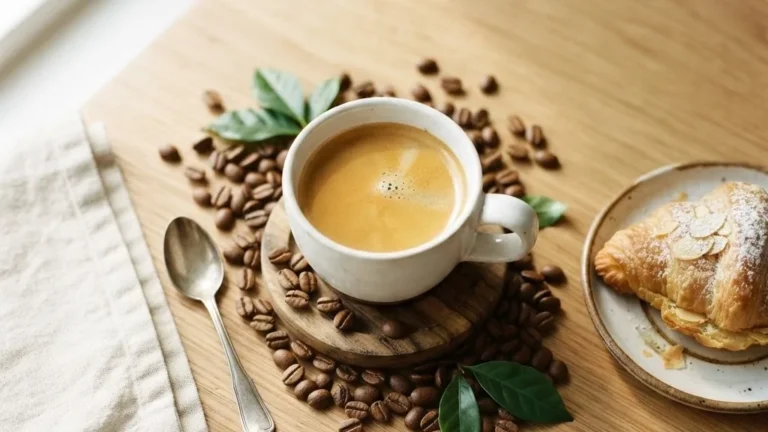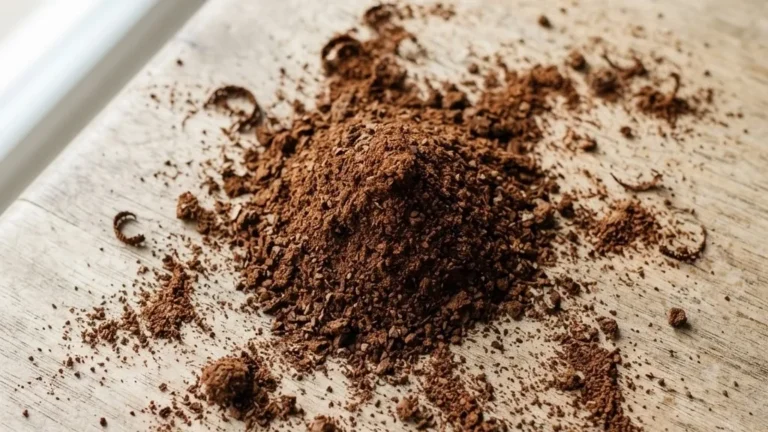
What is a light roast coffee? It is coffee pulled from the roaster at or just after first crack, when the bean has taken on color but has not yet begun burning its own sugars. That one decision, when to stop the roast, sets the density of the bean, the acids left inside it, how hard your grinder has to work, and how much coffee mass actually fits in your scoop. Most explainers stop at “bright and fruity” and leave it there. The measurable side goes much further, and it explains why a bag of Ethiopian Yirgacheffe behaves nothing like the beans in a cortado recipe with ratios and caffeine numbers.
Quick answer: A light roast coffee is coffee roasted to an internal bean temperature of roughly 180 to 205C (356 to 401F), stopped at or shortly after first crack near 196C (385F). It measures approximately 75 to 95 on the Agtron color scale used by the Specialty Coffee Association, and loses about 12 to 18 percent of its green weight. The beans stay denser and harder than dark roasts, keep more of their origin acids and aromatics, and hold roughly the same caffeine per gram as any other roast level. Brew hotter, grind finer.
What Is a Light Roast Coffee in Numbers: First Crack to Agtron 95
Light roast coffee leaves the drum between roughly 180 and 205C (356 and 401F), at or shortly after first crack, which occurs near 196C (385F). On the Agtron scale it sits around 75 to 95. The bean has typically shed 12 to 18 percent of its green weight by that point.
First crack is not a metaphor. Green coffee arrives at the roastery holding approximately 10 to 12 percent moisture, and as the drum drives that water toward steam, internal pressure from steam and carbon dioxide ruptures the cell walls. You hear it. It sounds like popcorn starting, and roasters use it as the single most reliable audible landmark in the whole process. Everything that defines this roast level happens in the narrow window on either side of that sound, before pyrolysis takes over and drives the bean toward second crack.
The dominant chemistry here is the Maillard reaction, the browning cascade between amino acids and reducing sugars. It builds color and body without yet demolishing the volatile aromatics the coffee arrived with. Push further and caramelization plus pyrolysis take the wheel, and the roast starts contributing more flavor than the farm did.
Agtron, Inc. makes the spectrophotometry instruments that turn that color into a number, which is why the scale carries the company name. The Specialty Coffee Association leans on those readings for its roast-color classification, and the scale runs 0 to 100, with 0 being the darkest and 100 the lightest.
- Very Light: Agtron approximately 95
- Light: Agtron approximately 85
- Medium-Light: Agtron approximately 75
- Medium: Agtron approximately 55 to 65
- Dark: Agtron below 45
One honest caveat about that list. The reference points above leave the bands between roughly 46 and 54, and between 66 and 74, unlabeled. That is not a hidden secret of the trade, it is simply how the commonly circulated reference points fall, and anyone publishing a gap-free chart should verify it against the primary Specialty Coffee Association and Agtron documentation first.
Why does an instrument reading matter to a person buying a bag? Because “light” is a marketing word and 85 is not. A roaster telling you the coffee landed at Agtron 85 is making a falsifiable claim. A roaster telling you the coffee is “smooth and approachable” is telling you nothing that transfers to the next bag you buy.
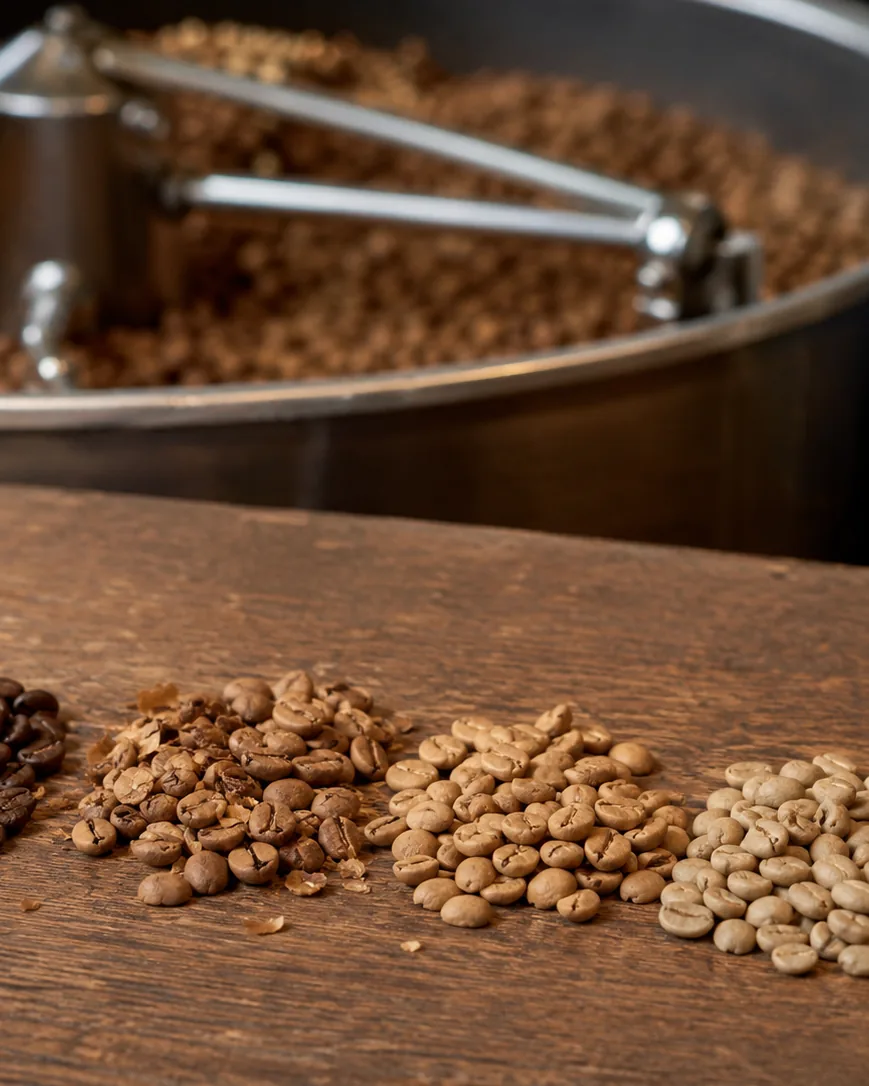
Cinnamon, Half City, Blonde: Why Light Roast Names Do Not Transfer
Light roast is a range, not a point, and the industry has never agreed on what to call the positions inside it. Cinnamon Roast, New England Roast, Half City Roast, and Light City Roast all describe territory in the same general band, with no governing body enforcing the boundaries between them.
Then there are proprietary names. “Blonde Roast” belongs to a specific retailer’s product line. “Nordic-style” describes an aesthetic associated with Scandinavian roasters who favor very light development. Neither is an industry classification, and neither maps to a fixed Agtron number that you could carry from one shelf to another. That is the practical failure of most brand explainers: they teach you their vocabulary rather than the trade’s.
The Specialty Coffee Association solved this by refusing to arbitrate adjectives. Numbers arbitrate instead. A roaster who prints a roast-color figure, or at minimum a roast date and an origin, is handing you information that survives the walk to a different store.
Flavor and Acidity: What Survives at 180 to 205C
Light roast keeps the organic acids the coffee cherry produced. Malic, citric, and phosphoric acids read on the palate as brightness and liveliness rather than as bitterness, and they are progressively broken down as roasting continues past this window into darker territory.
Aromatics follow the same logic. The floral, citrus, stone-fruit, and berry compounds that distinguish one farm from another are volatile, and extended heat destroys them. Stop the roast early and those compounds are still in the bean. Roast longer and the roast itself becomes the flavor: smoke, char, bittersweet caramelization, the same profile regardless of which mountain the coffee came from. This is why cupping tables use light roast as the evaluation standard. It exposes both origin character and defects, and it gives graders nowhere to hide.
World Coffee Research maintains the Sensory Lexicon, the standardized descriptor vocabulary professional tasters use so that “berry” means something consistent across two labs on two continents. The Coffee Quality Institute administers the Q Grader certification, the credential that trains people to apply that vocabulary reproducibly. When a bag lists tasting notes and the roaster holds a Q Grader on staff, those notes are more than copywriting.
Bitterness is not the enemy here, and brightness is not automatically a virtue. Underdeveloped light roasts taste like raw peanuts and wet grain, which is a roasting fault rather than a style. Well-developed ones taste like the fruit they came from.
The Caffeine Paradox: Similar by Weight, Slightly More by Volume
Caffeine is a thermally stable alkaloid. It does not meaningfully burn off at roasting temperatures, so the caffeine per gram of dry coffee is roughly comparable across light and dark roasts. The difference people notice comes from density, not chemistry.
Here is the mechanism. Light roast loses roughly 12 to 18 percent of its green weight, while darker roasts commonly lose 16 to 20 percent or more. Less mass lost means a denser, heavier bean. Scoop light roast by volume and you are scooping more coffee mass than the same scoop of a puffed-up dark roast, and therefore marginally more caffeine. Weigh both on a scale and the difference largely evaporates. Similar by weight, slightly more by volume. That is the defensible framing, and it is the answer that almost no competing page gets right.
Notice something in those two ranges. Light roast at 12 to 18 percent and dark roast at 16 to 20 percent overlap between 16 and 18 percent. That overlap is not sloppiness, it is the point: roast level is a continuum, and the categories are conveniences rather than walls.
For an actual number on the cup, the USDA Agricultural Research Service maintains FoodData Central, and USDA and NIH-referenced nutrition data put a standard 8 fl oz (approximately 240 ml) cup of brewed coffee at roughly 80 to 100 mg of caffeine, varying with bean, grind, and brew method. The PubMed index at the National Institutes of Health is the right starting point for the underlying literature, and the FDA consumer update on caffeine covers labeling and intake guidance for consumers.
What that range should tell you is where the leverage actually sits. Brew method, dose, and grind move the final caffeine number far more than roast level does. A 1:15 ratio and a 1:18 ratio are not the same drink. Roast level is a rounding error by comparison.
Be suspicious of any page assigning tidy milligram brackets to “light roast” versus “dark roast” cups. Without a specific controlled study and visible methodology, those numbers are invented. If caffeine control is your actual goal rather than roast curiosity, the decision tree looks different, and the decaf coffee guide to solvents and label rules covers the part of that tree where the caffeine is removed rather than estimated.
Chlorogenic Acids: The Compositional Case for Roasting Less
Chlorogenic acids, a family of polyphenolic antioxidants abbreviated CGAs, are present in meaningful concentrations in green, unroasted coffee. Heat degrades them progressively during roasting. Darker roasts show substantially greater reduction than lighter roasts. That is a compositional statement, and it stops there.
The exact percentage is where honest writing gets uncomfortable. CGA concentration in green coffee is commonly cited in the low-to-high single-digit percent-of-dry-weight range depending on species, which is a wide enough spread that quoting a single universal figure would be fiction. The correct citation category is peer-reviewed food chemistry: the Journal of Agricultural and Food Chemistry, Food Chemistry, and LWT – Food Science and Technology all publish in this area, and any specific percentage you publish should come from the specific study you actually read rather than from a number that has been photocopied across a hundred blogs.
Coffee sits in a category where health claims carry real consequences, so the line to hold is directional and compositional. Light roast retains more CGA content than dark roast. It does not follow that light roast prevents anything. For personal health questions, the MedlinePlus patient health library is a more appropriate reference than any roaster’s blog, this one included.
Light vs Medium vs Dark: The Comparison Table
The three roast bands differ on four measurable axes: internal drop temperature, Agtron color number, weight loss, and the sensory result. The table below holds only figures traceable to Specialty Coffee Association and Agtron reference points, and treats the boundaries as approximate because they genuinely are. Caffeine is deliberately absent from the table, since it varies by weight and volume rather than by roast band, and cramming it into a column would reproduce exactly the oversimplification this article is arguing against.
| Roast level | Internal drop temp | Agtron | Weight loss |
|---|---|---|---|
| Light | 180-205C (356-401F) | 75-95 | 12-18 percent |
| Medium | Past first crack, before second | 55-65 | Between light and dark |
| Dark | Into pyrolysis and second crack | Below 45 | 16-20 percent or more |
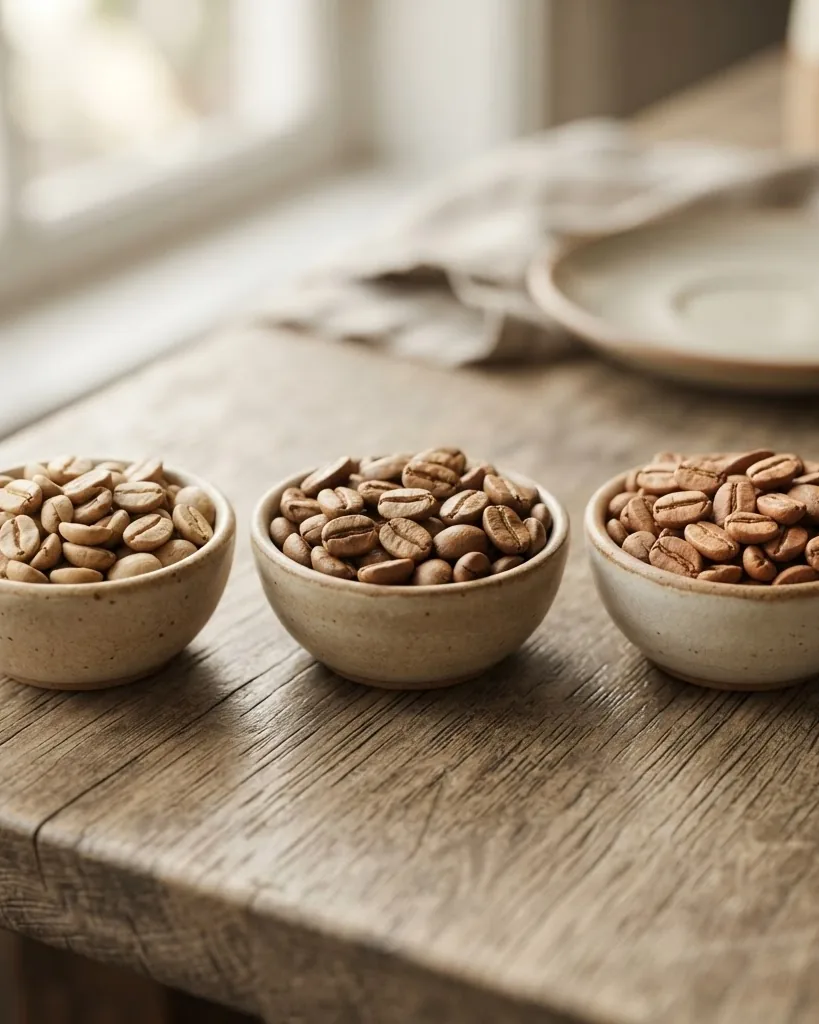
Brewing Light Roast Without Making It Taste Sour
Denser beans resist extraction. Light roast has lost less mass and less moisture than dark roast, so its cell structure is harder and less porous, and water has a harder time pulling solubles out of it. Grind finer, run water hotter, extend contact time slightly.
The Specialty Coffee Association Golden Cup standard sets brew water at approximately 90 to 96C (195 to 205F), with starting ratios of 1:15 to 1:18 grams of coffee to grams of water. For light roast specifically, live at the top of that temperature range: 93 to 96C (200 to 205F). That is not a preference, it is compensation for bean density. Kettle off the boil for thirty seconds gets most home setups into the zone without a thermometer.
Start every method at 1:16 and move from there. Toward 1:15 for more strength, toward 1:18 for more clarity.
- Pour-over: medium-fine, water at 93 to 96C (200 to 205F), 1:16 starting ratio, and do not rush the bloom.
- AeroPress: finer than you would use for a medium roast, water at the top of the Golden Cup range, longer steep before pressing.
- Drip: check that the machine actually reaches 90 to 96C (195 to 205F), because many do not, and a cool brewer will make any light roast taste sour no matter how you grind.
- Espresso: finer still, and expect to spend more coffee dialing it in than you would with a forgiving dark roast.
Troubleshooting is two rules, and they cover nearly everything.
- Sour, thin, salty: under-extracted. Grind finer, or raise water temperature, or both.
- Bitter, drying, harsh: over-extracted. Grind coarser, or shorten contact time.
The grinder is where budgets quietly fail. Blade grinders smash rather than cut, and light roast’s hardness makes that worse, producing a mix of boulders and dust that extracts unevenly by definition. A burr grinder matters more here than at any other roast level. Cheap manual grinders will physically fight these beans, and inconsistent particle size is not a problem you can brew your way out of.
Origins That Earn a Light Roast
High-altitude coffee grows slowly, and slow growth produces a denser bean. Density is exactly what light roasting rewards, because there is enough structure in the seed to survive a short roast with its aromatics intact. This is the mechanism behind every origin recommendation below.
Ethiopian Yirgacheffe and Sidama are the reference points for floral and berry character. Kenyan Nyeri and Kirinyaga bring the sharpest, most structured acidity in common circulation. Colombian Huila and Narino sit more balanced, with stone-fruit character that reads as approachable to people who find Kenyan coffee aggressive. Panama Geisha, a variety rather than a region, is the tropical-complexity showpiece and priced accordingly.
Species matters as much as geography. The International Coffee Organization puts Arabica at roughly 60 to 70 percent of global production and Robusta at the remaining 30 to 40 percent, and specialty light roasts are almost exclusively Arabica because Arabica develops more complex flavor at lighter roast levels. World Coffee Research maintains the Arabica variety catalog if you want to trace what Geisha actually is.
Buying Light Roast: Roast Dates, Labels, and Storage
The Specialty Coffee Association threshold for “specialty” is a score of 80 points or higher out of 100 on the standardized cupping form, and that evaluation is performed at light roast precisely because it hides nothing. A bag claiming specialty grade without a score, a roast date, or a traceable origin is claiming a word. The National Coffee Association publishes the annual National Coffee Data Trends report if you want to see what Americans actually buy versus what they say they prefer.
Roast date beats best-by date every time, and it matters more for light roast than for any other level, because the volatile aromatics you paid the premium for are the first thing to fade. Store the bag sealed, cool, dry, and away from light. Buy what you will drink in a few weeks.
Frequently Asked Questions
Is light roast coffee weaker than dark roast?
No. It tastes less roasty, which people read as weaker, but strength in the cup is set by your brew ratio, not roast color. The Specialty Coffee Association Golden Cup standard puts starting ratios at 1:15 to 1:18. Move toward 1:15 and any light roast will hit you harder than a badly dosed dark roast.
Does light roast have less caffeine?
No. Caffeine is thermally stable, so per gram of dry coffee it is roughly comparable across roast levels. Because light roast loses only 12 to 18 percent of its green weight versus 16 to 20 percent or more for dark, a scoop measured by volume holds slightly more mass and slightly more caffeine. Weigh your dose and the gap mostly disappears.
Is light roast more acidic and harder on the stomach?
Light roast retains more of its organic acids, including malic, citric, and phosphoric, which taste bright rather than bitter. Perceived brightness is a flavor description and does not translate directly into digestive effects. For anything involving your own health, the Mayo Clinic and NIH resources linked above are the appropriate references rather than a roaster’s opinion.
Can I pull espresso with light roast?
Yes, and it is harder. The beans are denser and resist extraction, so you will grind finer than usual and spend more coffee dialing the shot in than a dark roast would demand. Water toward 93 to 96C (200 to 205F) helps. Sour shots mean under-extraction: go finer or hotter before blaming the beans.
Are light roasts always single-origin?
No. Single-origin labeling is a sourcing decision and light roast is a roasting decision, and blends exist at every roast level. Light roasting is more common on single origins because the whole point is showcasing farm character, and blending several farms into one bright cup works against that goal without making it impossible.
What Agtron number counts as a light roast coffee?
Roughly 75 to 95 on the Agtron scale, which runs from 0 at the darkest to 100 at the lightest. Very Light sits near 95, Light near 85, Medium-Light near 75. Medium falls around 55 to 65 and dark below 45. The bands between about 46 and 54 and between 66 and 74 are commonly left unlabeled.
The Short Version
Stop the roast near first crack at 196C (385F), drop somewhere in the 180 to 205C (356 to 401F) window, land at Agtron 75 to 95, and you have a bean that kept its acids, kept its aromatics, and kept its density. That density is the whole story. It is why the grinder struggles, why the water needs to be at 93 to 96C (200 to 205F), and why the scoop lies about caffeine while the scale tells the truth.
Buy on roast date, weigh your dose, and fix sour with a finer grind before you fix it by switching bags. If you want to see how far the arithmetic goes once you start tracking grams and money together, the breakdown of real cost per cup and brewing runs those numbers end to end.