
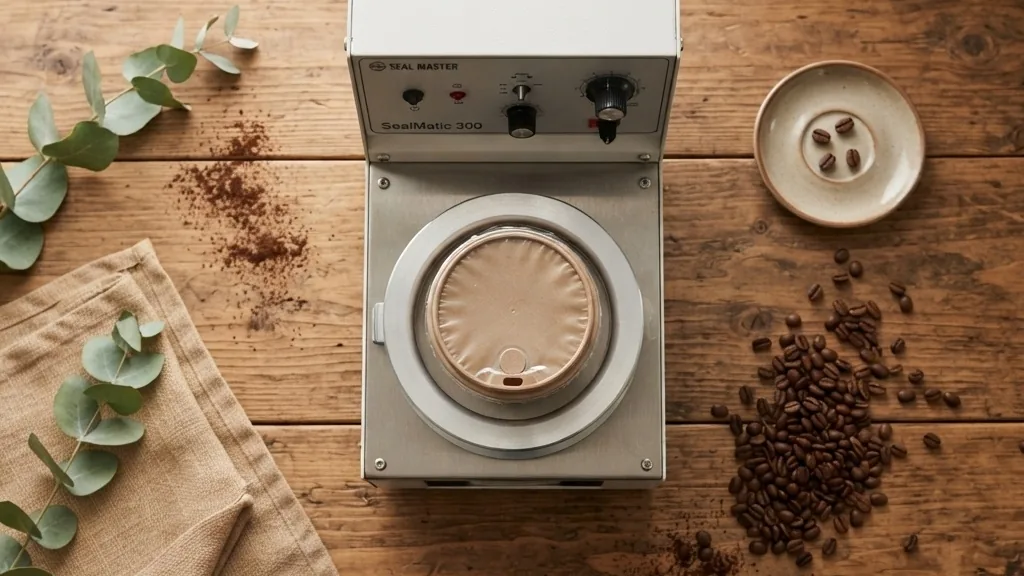
Can sealer machine coffee searches collapse three incompatible buyers into one keyword, and choosing wrong is not a bad purchase but a botulism-liability event. A cafe selling iced coffee over the counter, a roaster canning shelf-stable cold brew, and a roaster packaging whole beans each need a completely different machine and a completely different rulebook. Every page currently ranking answers one of these and never tells you which one you are. Sort yourself first, then buy.
Quick answer. A can sealer machine for coffee is either a heat-seal PET cup or can sealer for same-day refrigerated iced coffee, a true double-seam seamer for aluminum cans of ready-to-drink cold brew, or a bean sealer using a valved foil lid. Cold brew measures pH 4.85 to 5.13, above the 4.6 low-acid line, so canned shelf-stable cold brew is a low-acid canned food under 21 CFR 113. If you label it Keep Refrigerated, you sidestep that entire framework. Match the machine to the intent before the budget.
Triage in 30 Seconds: Are You Buyer A, B, or C?
The first decision is not price or throughput but which of three product categories you are actually selling, because each one carries a different food-safety exposure. Buyer A runs a cafe, boba shop, or juice bar and sells iced or cold brew coffee over the counter the same week, labeled to keep cold. Buyer B is a roaster distributing ready-to-drink cold brew in aluminum cans, either shelf-stable or through a cold chain. Buyer C wants to can whole beans, which is a packaging problem, not a thermal one. The kill criterion for Buyer B is simple: if you cannot name your process authority, you are not ready to buy a machine.
- Buyer A (cafe, refrigerated): budget roughly $120 to $1,500, zero canning registration if the label reads Keep Refrigerated.
- Buyer B (RTD cold brew, distributed): budget $900 to $25,000 and up, full US Food and Drug Administration exposure under 21 CFR Parts 108 and 113.
- Buyer C (whole bean): a barrier-and-degassing question, not a botulism question.
Get this sort wrong and everything downstream is wrong. A cafe that skips the refrigerated label inherits a canning burden it never planned for. A distributor who treats a film-sealed PET can as hermetic ships product that cannot be validated. Everyone else on page one blurs these lines. Do not.
What the Machine Physically Does: Double Seam vs Heat Seal
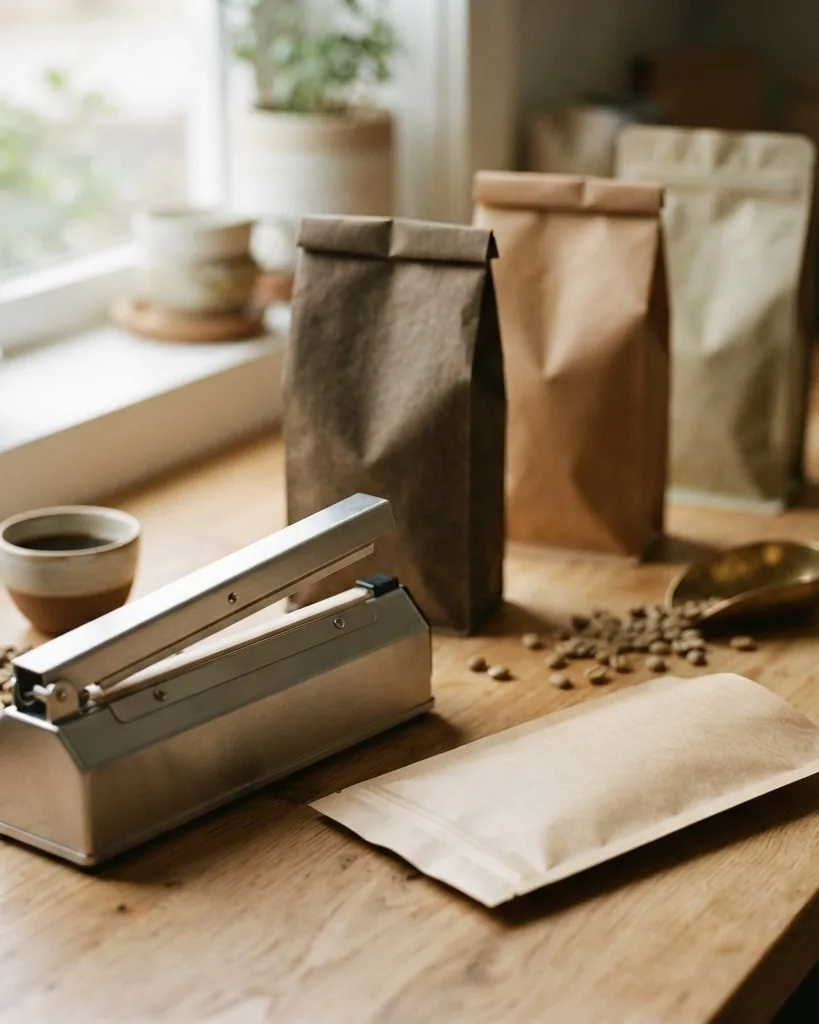
A double seamer and a heat-seal cup sealer are not two versions of the same tool; they produce fundamentally different closures. Double seaming is two roller operations. The first operation curls the cover hook around the body flange. The second operation flattens and compresses that fold into a hermetic seal built from five interlocked layers of metal and a bead of sealing compound. That interlock, measured and verified, is what lets a can hold shelf-stable low-acid food. A heat-seal sealer, by contrast, bonds a film lid over a PET rim. It looks finished and pours fine, but it is not hermetic, it is not a double seam, and it cannot be validated to 21 CFR 113.60.
The vocabulary you will live with: body hook, cover hook, overlap, seam thickness, countersink depth, and the sealing compound that fills the microscopic gaps. Two setup variables move the seam more than anything else, and both belong on your first checklist:
- Base plate load: the force pressing the can up into the chuck.
- Pin height: the vertical position that sets how the rollers engage the end.
One more trap worth naming early. The chuck must match the end profile, whether B64, CDL, or SuperEnd 360. Mount the wrong chuck and the head deadheads, spinning uselessly in the countersink while the seam never forms. Before wiring is discussed, drink safety matters at the human level too, and readers weighing dental risk can see the timeline in Can I Drink Coffee After Tooth Extraction.
Container and End Standards: Lock the Lid Before the Machine
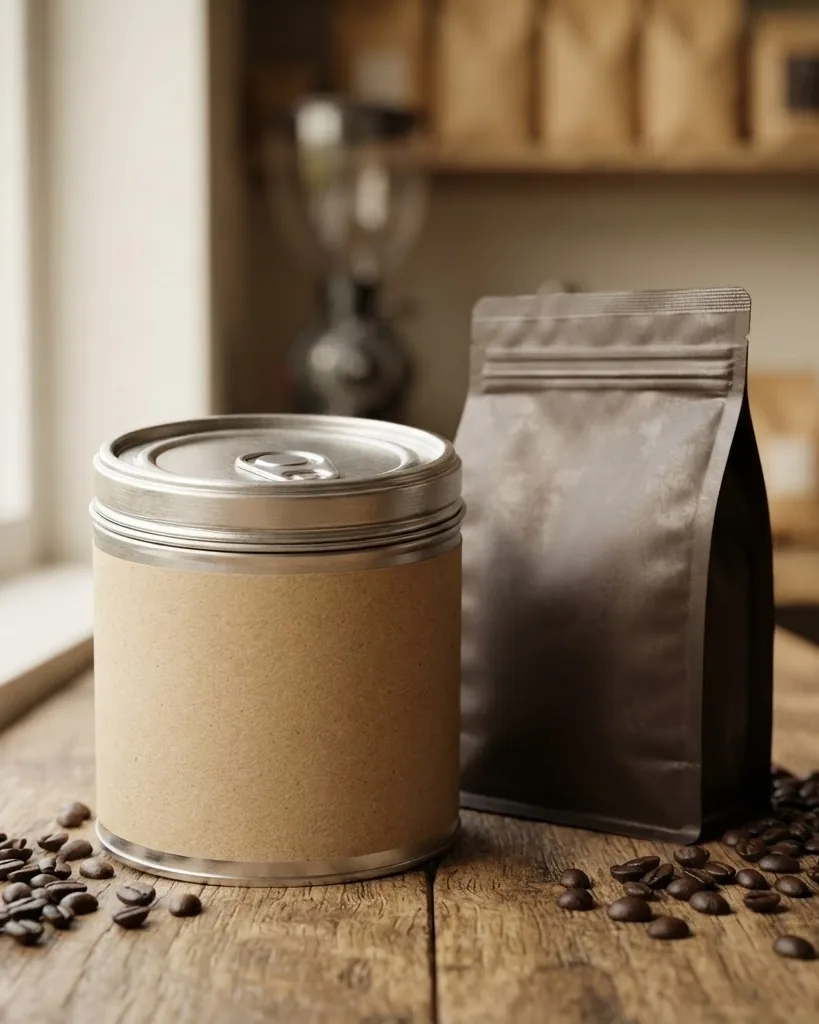
Can sizing runs on a diameter code system that trips up first-time buyers, and getting it wrong means your lid supplier and your seamer never agree. A 202 end is 2 and 2/16 inch, roughly 52 mm. A 204 is 2 and 4/16, and a 211 is 2 and 11/16 inch. The workhorse 12 oz aluminum can holds 355 mL, stands about 122 mm tall, and runs about 66 mm in diameter. Whole beans usually ride in a 401-diameter steel can capped with a valved foil lid. The single most common ordering mistake is buying the machine first and discovering the lid supplier is incompatible, because lid curl geometry has to match the body flange or the seam simply fails.
The Can Manufacturers Institute publishes the North American dimensional standards that make this interoperable. For a 202 beverage end, the institute specifies a curl diameter of 2.340 plus or minus 0.006 inch, a curl height of 0.080 plus or minus 0.005 inch, and a countersink depth of 0.270 plus or minus 0.005 inch. Those are not the seamer maker’s numbers. They belong to the end.
- Sleek, slim, stubby: narrower-diameter formats for premium positioning.
- Crowler: a 32 oz single-serve can popular with small runs.
- 8.4 oz: the compact format Pilot Coffee Roasters chose for canned cold brew.
Treat the end supplier’s product standard as the governing document. Ball Corporation, Crown Holdings, and Ardagh Metal Packaging each publish binding double-seam specifications for their own ends. The end maker’s spec wins, not the machine brochure.
Machine Tiers, Honest Costs, and Real Throughput
Price scales with automation, and the honest range for a coffee can sealer runs from a few hundred dollars to well over twenty thousand. At the bottom sit hand-driven and drill-driven benchtop units in the BenchMK, All American, and Cannular class. A step up, the Oktober SL1 Homebrewer launched at $879 in a 2021 hands-on review, weighs 27 lb, measures 9.25 by 10.5 by 19.25 inch, and runs 202 ends in the B64 profile with adapters for 12 and 16 oz. That machine defines the entry electric tier: enough to prove a product, not enough to feed distribution. The jump from there is not linear, because commercial and industrial machines carry compressed-air and three-phase-power requirements that a cafe outlet cannot supply.
The middle and upper tiers separate on cans per minute more than on features. Below is the practical ladder:
- Oktober Model 8: seals one can in roughly 3 seconds, supports 200, 202, 206, 209, 300, and 401 ends, and quotes a 3 to 6 week build-to-order lead time.
- Oktober Model 8-H (coffee tooling): from $3,600 in 2023, fully automatic, running 401-diameter steel cans with a valved foil lid.
- Oktober Canning Line: a 4-head filler with integrated CO2 purge, automatic end placement with sensor verification, under-cap CO2 purge, and a single-head seamer rated above 20 cans per minute; earlier crowler-class output ran about 9 to 11 cans per minute.
- Cask mACS: a micro automated system rated at 15 or more cans per minute.
- Industrial class: 20 to 50 cans per minute, one sealing head, four seaming rollers, 304 stainless build, 2,050 W, three-phase 220 to 380 V, compressed air at 0.5 to 0.6 MPa, and roughly 700 kg of mass.
For a cafe, the picture is simpler and cheaper. A PET sealer in the 100x100chef Can Sealer Pro class handles 400 or more cans per hour across 180, 250, 330, and 500 mL PET formats. A comparable Hammont unit runs on 110 V, measures 10.04 by 17.72 by 22.44 inch, weighs 68.34 lb, and covers 8, 12, 16, and 21 oz plus square formats. That is Buyer A’s whole world, and it never touches a double seam.
The growth path for a serious cold brew brand is not a bigger seamer alone. It is a seamer feeding a retort. Pilot Coffee Roasters cans 8.4 oz aluminum cold brew and processes it in an RDSW-3SS retort using full water immersion and overpressure cooling. A food truck operator plotting the same jump can study the equipment economics of mobile builds through this guide to mobile food trucks before committing to fixed plant. Coffee format details are worth a second read in Coffee Ground Medium.
Permits, Inspections, and Food-Safety Compliance: The Part That Bites
Canned shelf-stable cold brew is a low-acid canned food, and that single classification triggers the most expensive rules in the category. The US Food and Drug Administration defines a low-acid food as one with a finished equilibrium pH above 4.6 and a water activity above 0.85, excluding alcoholic beverages, under 21 CFR 113. Coffee lands squarely inside that definition. Measured across Brazil, Ethiopia, Colombia, Myanmar, and Mexico origins, coffee pH runs 4.85 to 5.13, with Ethiopian Ardi lowest at 4.85 plus or minus 0.09 and Brazilian highest at 5.10 plus or minus 0.02, per Rao and Fuller in Scientific Reports, 2018. Above 4.6 means low-acid. Low-acid means the full framework.
Here is what that framework costs an operator in practice, body by body:
- US Food and Drug Administration: writes and enforces 21 CFR Part 108 (registration and process filing), Part 113 (low-acid foods in hermetically sealed containers), and Part 114 (acidified foods). You register the facility and file the process on agency forms before you ship.
- Registration: Form FDA 2541 yields your Food Canning Establishment number; the scheduled process is filed on 2541d, 2541f, or 2541g for low-acid product, 2541e for acidified. Authority sits in 21 CFR 108.25(c) and 108.35(c).
- Facility registration: a separate step under the Federal Food, Drug, and Cosmetic Act Section 415, filed on Form FDA 3537.
- Process Authority: a qualified individual or lab must establish your scheduled process. The Association of Food and Drug Officials maintains the list of Food Processing Authorities.
- Better Process Control School: at least one supervisor must hold this FDA-recognized certification, delivered by land-grant universities such as Penn State Extension, UC Davis, and NC State.
The National Advisory Committee on Microbiological Criteria for Foods sets the parameters for the challenge and inoculated-pack studies that validate a shelf-life claim, and the Institute for Thermal Processing Specialists publishes the best-practice protocols for temperature distribution and heat penetration studies your process authority will lean on. None of this is optional decoration. It is the difference between a legal product and a recall.
There is an off-ramp, and it is the sentence nobody on page one prints. Products labeled Keep Refrigerated are exempt from 21 CFR 113 and 114 under FDA Compliance Program 7303.070. That label is the cafe’s entire legal shield. It moves Buyer A out of the canning world completely, provided the cold chain holds. Retail enforcement adds one more variable: the FDA Food Code is a model that states and local health departments adopt and interpret, so inspectors have been inconsistent on room-temperature steeping and nitro kegs, as the Tea and Coffee Trade Journal has documented. In Canada, the BC Centre for Disease Control, the Canadian Food Inspection Agency, and Health Canada govern the same terrain, and EU Regulation 1935/2004 covers food-contact materials abroad. The eCFR published by the Government Publishing Office carries the authoritative current text of Title 21; cite the section numbers, not a paraphrase. For a cautionary read on how a wind-down gets misreported, see Instant Coffee Supplies Liquidation.
The Nitrogen Myth and What Actually Controls Botulism
Nitrogen does not make canned cold brew safe, and believing it does is the most dangerous mistake in this category. Clostridium botulinum is the hazard, and the cold brew process itself does not control it. The BC Centre for Disease Control assessed nitro cold brew directly and reached three conclusions worth memorizing: nitrogen does not change acidity, nitrogen does not reduce existing hazards, and nitrogen may slightly increase risk by further reducing oxygen inside the can, which is exactly the low-oxygen environment the organism prefers. Canning a low-acid liquid creates a reduced-oxygen atmosphere on its own. Adding an inert gas does not rescue it.
There are only three legitimate control routes, and each is a real commitment:
- Retort: steam or water under pressure above 100 degrees Celsius, roughly 212 Fahrenheit, held 7 to 15 minutes on a filed scheduled process.
- Acidification: bringing finished pH to 4.6 or below with a scheduled process filed as an acidified food.
- Refrigerated short shelf life: a validated cold-chain product, not a shelf-stable one.
The non-pasteurized route exists but it is a cold-chain business, not a shelf-stable one. Trident Coffee in San Diego runs filtration plus nitrogen dosing plus a full cold chain from brewing through retail and reports about 5 months of shelf life with no pasteurization, distributed regionally. That is a logistics model, not a preservation shortcut. Break the cold chain and the safety margin goes with it. This topic touches real health risk, so if you are researching it for personal safety reasons rather than production, treat any decision to sell as one that belongs in front of a certified process authority first.
Seam Quality Control: The Numbers and the SOP Nobody Publishes
A double seam is only hermetic if it measures inside spec, and the tolerances are published, not folklore. Using Ball Corporation Product Standard SEAM-201 Rev C for a 202 end as the worked example, the second-operation seam thickness targets 0.044 plus or minus 0.001 inch (1.118 plus or minus 0.025 mm) at setup, with an operating range of 0.042 to 0.046 inch (1.067 to 1.158 mm). Countersink depth sets at 0.270 plus or minus 0.003 inch. Seam height sets at 0.096 to 0.100 inch (2.438 to 2.540 mm). Tightness rating is 100 percent at setup and 90 percent minimum in operation. Treat these as the example from one end maker; your own supplier’s standard is the one that governs.
The hooks and overlap are where a seam quietly fails:
- Body hook length: 0.065 plus or minus 0.005 inch (1.651 plus or minus 0.127 mm) at setup; operating 0.055 to 0.075 inch.
- Cover hook length: 0.060 plus or minus 0.005 inch at setup; operating minimum 0.053 inch (1.346 mm).
- Actual overlap: 0.035 inch (0.889 mm) minimum at setup; 0.025 inch (0.635 mm) minimum operating.
- Base plate load: cold fill 100 plus or minus 5 lb (45.36 plus or minus 2.27 kg); hot fill 130 plus or minus 20 lb.
The regulator sets the inspection cadence, and 21 CFR 113.60(a) is specific. Perform a visual closure examination of a can from each seaming head at intervals not exceeding 30 minutes, recorded. Have a qualified individual tear down and measure double-seam cans at intervals not exceeding 4 hours, recorded, with corrective action noted. Run an additional visual inspection immediately after any closing-machine jam, after any adjustment, and after startup following a prolonged shutdown. Measure the seam by micrometer using 3 readings roughly 120 degrees apart excluding the side seam, or by seam scope using 2 readings at different locations excluding the side seam. The theoretical overlap length equals cover hook plus body hook plus seam thickness minus seam width.
Learn the defect vocabulary because each name points at a cause. A cutover is metal fractured over the seam edge. A deadhead means the chuck spun in the countersink without forming the seam. A droop is a bulge at the seam bottom. A false seam is hooks that never interlocked. A lap is a gap in the overlap, and skidding leaves an incomplete first operation. Verification gear ranges from a hand seam micrometer and digital seam gauge to a seam projector and full vision systems in the CMC-KUHNKE Z310, SEAMscan XTS III, SEAM360, and AUTO-XTS class. Chart seam thickness over time with statistical process control; a slow drift is your earliest warning of roller wear or pressure loss.
Whole-Bean Sealing and the Oxygen Problem
Sealing whole beans is a barrier and degassing question with no botulism component, which makes Buyer C the simplest case on the list. Roasted whole-bean coffee can exceed 12 months of shelf life inside high oxygen and moisture barrier packaging in dry storage, yet the same beans can drop to as little as 1 month when oxygen is present. Raising oxygen to atmospheric levels accelerates deterioration roughly 20-fold, per Cardelli and Labuza in 2001. The packaging, not the roast, decides how long the flavor survives. That is why the format for beans is a barrier can or bag rather than a pressure vessel.
Two specifications carry the whole category:
- Oxygen transmission rate: a specialty barrier target of 0.5 cc per square meter per day or lower.
- Degassing valve: coffee releases CO2 for roughly 5 to 14 days after roasting, and a one-way valve vents it without letting oxygen back in.
Nitrogen flush and modified-atmosphere packing round out the toolkit. For light roasts, where the numbers behind the bag matter most, the format choice compounds with roast level, a point developed in What Is a Light Roast Coffee.
The Real Total Cost of Ownership
Machine price is the smallest line on a canned cold brew budget, and treating it as the whole cost is how new brands run out of money. Beyond the seamer sit the invisible items every competitor page omits: engaging a process authority, Better Process Control School tuition, a seam gauge or seam scope, a dissolved-oxygen meter, a challenge or shelf-life study run to National Advisory Committee on Microbiological Criteria for Foods protocols, minimum order quantities on printed cans and ends, and separate tooling for each can size you run. Then there is the throughput math. Cost per can differs sharply at 9 to 11 cans per minute versus 15 versus 20-plus versus an industrial 20 to 50 range, and only volume tells you whether to buy or to co-pack.
Run the break-even honestly against a co-packer before you buy anything:
- Low volume: co-packing usually wins because the fixed compliance cost swamps a small run.
- Rising volume: an Oktober SL1 at $879 proves the product; a Model 8-H from $3,600 handles real orders.
- Distribution scale: a canning line above 20 cans per minute, then a retort like the RDSW-3SS, is the path to shelf-stable.
Roasters watching their input costs should read the recall and shelf-date lessons in the Dollar General Coffee Recall before scaling. For protein-forward cafe menus pairing cold brew with food, the high protein recipes hub and the meat and protein collection show how beverage brands widen a same-day menu. Lighter kitchen options that pair with iced coffee include these tangy mango popsicles and, for a bakery counter, some gluten-free vanilla cupcakes. The Specialty Coffee Association is where much of this equipment debuts, and OSHA machine guarding rules under 29 CFR 1910.212 govern the rotating seaming head once it lands in your space.
Frequently Asked Questions
Is canned cold brew a low-acid canned food?
Yes, when sold shelf-stable. Coffee measures pH 4.85 to 5.13 across common origins, above the 4.6 low-acid threshold in 21 CFR 113, so it counts as a low-acid canned food. That triggers Form FDA 2541 registration, a scheduled process, and a certified process authority. Labeling it Keep Refrigerated exempts you under FDA Compliance Program 7303.070.
Does nitrogen make canned coffee safe from botulism?
No. The BC Centre for Disease Control found nitrogen does not change acidity, does not reduce existing hazards, and may slightly raise risk by further lowering oxygen inside the can. Clostridium botulinum thrives in low-oxygen conditions. Real control comes from retort processing, acidification to pH 4.6 or below, or a validated refrigerated shelf life.
How often must I inspect double seams under FDA rules?
Under 21 CFR 113.60(a), run a visual closure check on a can from each seaming head at intervals not exceeding 30 minutes, and a full teardown examination by a qualified individual at intervals not exceeding 4 hours, both recorded. Additional inspections are required after any machine jam, after adjustments, and after startup following a prolonged shutdown.
What is the cheapest real seamer to start with?
The Oktober SL1 Homebrewer launched at $879 in 2021, weighs 27 lb, and runs 202 ends in the B64 profile with adapters for 12 and 16 oz. It proves a product on a small budget. For automatic coffee cans, the Model 8-H starts from $3,600 in 2023, running 401-diameter steel cans with a valved foil lid.
Can a PET cup or can sealer hold shelf-stable coffee?
No. A heat-seal PET sealer bonds film over a rim; it is not hermetic, not a double seam, and cannot be validated to 21 CFR 113.60. It is fine for a cafe selling refrigerated iced coffee the same week under a Keep Refrigerated label. It is never a legal closure for shelf-stable low-acid product held at room temperature.